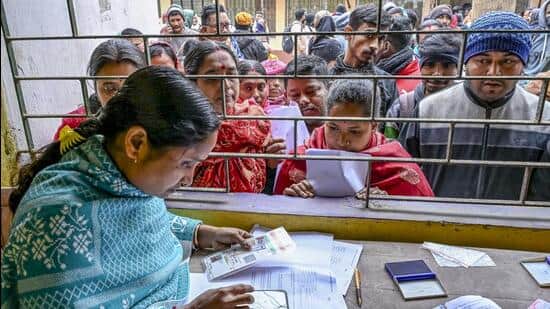
The name of nearly every fifth voter in Uttar Pradesh might be removed after the special intensive revision (SIR), as the Election Commission of India (ECI) on Tuesday published the draft roll that dropped 28.9 million people, marking the highest percentage of deletions among major states where the controversial exercise has been conducted.
The draft roll now lists 125.5 million voters, down from 154.4 million voters in the roll published on October 27, 2025, after the special summary revision – a shrinking of 18.7% – said chief electoral officer Navdeep Rinwa. This number is lower than the size of the electorate in the 2014 and 2019 Lok Sabha polls in the state, and the 2017 and 2022 assembly polls.
Lucknow, Ghaziabad, Balrampur, Kanpur Nagar, and Meerut districts saw the highest deletions as a share of electors as on October 27. These districts saw 30%, 28.8%, 26%, 25.5%, and 24.7% names deleted from the rolls, respectively. The lowest deletions were seen in Lalitpur, Hamirpur, Mahoba, Banda, and Jyotiba Phule Nagar, which saw 10%, 10.8%, 12.4%, 13%, 13.2% deletions, respectively.
“The EC will issue notices to 10.4 million voters whose names could not be matched or linked during the mapping exercise with the voter list of the last special intensive revision conducted in 2003”, Rinwa said. These names have been provisionally included in the draft rolls, he added. The final electoral list will be published on March 6.
Uttar Pradesh is one of 12 states and Union Territories where the SIR began on November 4, covering roughly half of India’s nearly one billion-strong electorate in an exercise that has already become a political flashpoint. The state was given three extensions.
The SIR in Uttar Pradesh, which goes to the polls in early 2027, is important because the percentage of deletions is the highest among the major states and regions where the SIR is ongoing. It is also more than double the proportion seen in West Bengal, Rajasthan, and Bihar, the other big states where SIR is underway or has already taken place.
Chief minister Yogi Adityanath also drew attention to the numbers last month during a meeting of Bharatiya Janata Party workers. “These are not your opponent’s voters, 85 to 90% of these missing voters are ours,” he had said on December 14.
In this round of SIR, Andaman and Nicobar held the highest percentage of deletions (21%) and Lakshadweep the least (2.5%). Overall, states/UTs with the highest percentage of potential deletions in the enumeration phase after Andaman and Nicobar were Uttar Pradesh, Tamil Nadu, and Gujarat, where roughly 18.7%, 15.2%, and 14.5% names, respectively, were dropped. Apart from these states, Chhattisgarh, Puducherry, Kerala, and Goa – where 12.9%, 10.1%, 8.6%, and 8.4% names could be excised, respectively – could see higher deletions than the 8.3% deletions seen in Bihar.
Rajasthan (excluding Anta assembly seat), West Bengal, Madhya Pradesh, and Lakshadweep could see relatively fewer deletions, with 7.7%, 7.6%, 7.4%, and 2.5% electors, respectively, removed from the rolls after the enumeration phase.
In all, for this round of the SIR that spanned 510 million people across 12 states and Union Territories, around 66 million names might be dropped from the rolls. This is around 13%, a proportion higher than the 8% deletions seen in the SIR exercise in Bihar in July, the first state to undergo an SIR in the country since the eighth round conducted between 2002 and 2004.
Rinwa said 162,486 booth level officers (BLOs) distributed enumeration forms to 154.4 million voters. A total of 125.5 million voters (81.30%) returned the enumeration forms while 18.70 % or 28.9 million forms remained uncollectible. Among the 28.9 million uncollectible voters, 12. 9 million (8.40%) were categorised as permanently shifted, 4.6 million (2.99%) as deceased, 2.54 million ( 1.65%) as duplicate, and 7.95 million (5.15%) as untraceable, according to data. Another 774,472 voters (0.50%) did not return enumeration forms after collecting them from booth-level officers.
The exercise involved 172,000 booths and 576,000 booth-level agents appointed by recognised parties. ECI also outlined clear remedies for eligible voters whose names did not appear in the draft roll.
ECI has opened a claims and objections window from January 6 to February 6, during which any eligible voter whose name is missing can apply for inclusion by submitting Form-6. Voters found registered at more than one place will be retained at only one verified location after scrutiny.
Voters can check their names in the draft roll through BLOs, the ECINet mobile application, the chief electoral officer’s website (ceouttarpradesh.nic.in) or the Election Commission portal voters.eci.gov.in. Applications can be submitted offline through BLOs or voter registration centres at tehsil offices, or online through the ECINet app and ECI website.
Rinwa said 1.58 million Form-6 applications have already been received.
“No name will be removed from the electoral roll without following due process,” he added, reiterating his commitment to a transparent, participatory and inclusive revision to ensure that no eligible voter is left out.
The BJP’s state unit spokesperson, Hero Bajpai, said that the EC has removed only missing names from the voters’ list. “This shows that the entire exercise was carried out in a fair manner,” he said.
Uttar Pradesh Congress chief Ajay Rai criticised SIR. “The SIR was an unconstitutional and hurried exercise conducted in Uttar Pradesh that took lives of several staff involved in voter list revision work,” he said.
Samajwadi Party spokesperson Fakhrul Hasan Chand said, “The list released today and the names that have been struck off are mostly the ones who voted for the BJP in rural and urban vicinities. Akhilesh Yadav had already suggested linking the voter list with the Aadhaar number to avoid duplication, the EC should take this suggestion seriously.”
Editorial Context & Insight
Original analysis & verification
Methodology
This article includes original analysis and synthesis from our editorial team, cross-referenced with primary sources to ensure depth and accuracy.