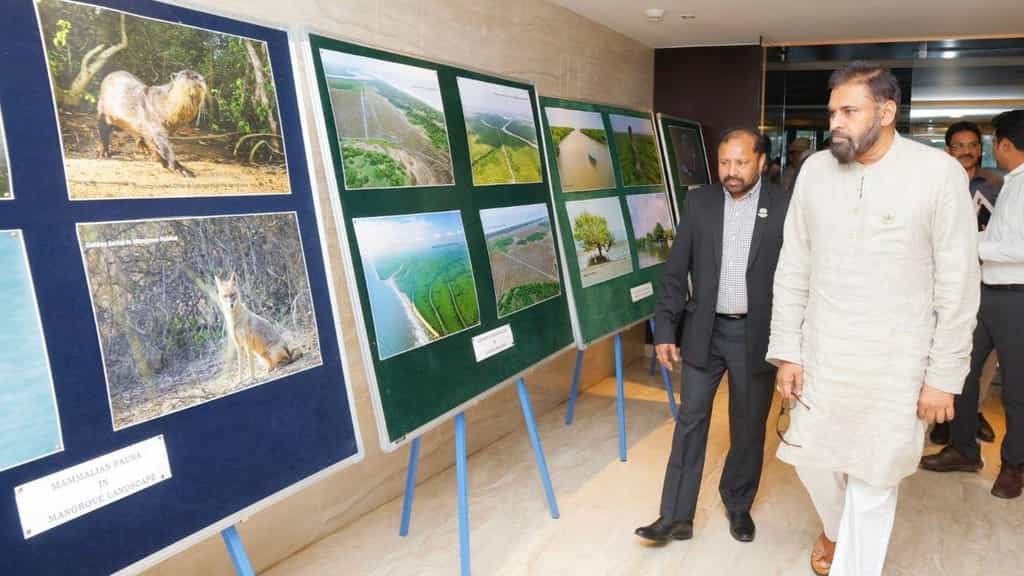
Emphasising the critical role of mangroves in protecting coastal regions and enhancing biodiversity, Andhra Pradesh Deputy Chief Minister K. Pawan Kalyan called upon the State to emerge as a national role model in mangrove conservation and sustainable coastal development.
Addressing a national-level workshop on Mangrove Development and Sustainable Livelihoods (MISHTI) organised by the State Forest and Environment department here on Thursday, the Deputy Chief Minister said mangroves act as strong natural barriers against cyclones, floods, and coastal erosion along Andhra Pradesh’s 1,052-km-long coastline.
He stressed that protecting existing mangroves while expanding new plantations is essential to minimise losses caused by frequent natural disasters, particularly in the Krishna and Godavari basins. Mr. Pawan Kalyan said the State government had already developed mangroves over nearly 700 hectares in coastal areas during 2025 and pledged to continue the effort with greater commitment.
He highlighted plans to create a three-tier green belt along the coast and involve local communities to ensure sustainable income generation. Skill development, eco-tourism, marketing support, and incentives will be extended to coastal residents to improve livelihoods linked to mangrove ecosystems.
Referring to the “Great Green Wall” initiative, he said the government aims to increase green cover to 50 per cent of the State’s geographical area. The programme focuses on planting diverse native species to combine environmental protection with economic benefits.
The Deputy Chief Minister also underlined the need for inter-State cooperation to address human-wildlife conflict and other ecological challenges, citing successful coordination with Karnataka. Assuring full support to Forest department staff, he said the coalition government was committed to strengthening systems, empowering officials, and ensuring effective implementation of conservation programmes.
Meanwhile, senior officials, scientists and experts from coastal States and Union Territories participated in a national workshop at the event.
The workshop was organised jointly by the A.P. Forest department, Ministry of Environment, Forest and Climate Change (MoEF&CC), National Afforestation and Eco-Development Board (NAEB) and National CAMPA (Compensatory Afforestation Fund Management And Planning Authority) with the objective of reviewing the progress of MISHTI, sharing best practices, and charting future strategies for mangrove restoration, shoreline protection, climate resilience, and livelihood generation.
Senior officers from Andhra Pradesh, Karnataka, Odisha, Tamil Nadu, West Bengal, Maharashtra, Goa, Kerala and Puducherry made detailed presentations on the status of mangroves, progress achieved under MISHTI, and future proposals. They highlighted the national importance of mangroves in coastal protection, carbon sequestration and sustainable livelihoods.
Renowned experts from institutions such as M.S. Swaminathan Research Foundation, National Centre for Sustainable Coastal Management (NCSCM), Annamalai University, National Centre for Coastal Research and other leading conservation organisations shared insights, research findings, and successful field experiences.
Editorial Context & Insight
Original analysis & verification
Methodology
This article includes original analysis and synthesis from our editorial team, cross-referenced with primary sources to ensure depth and accuracy.