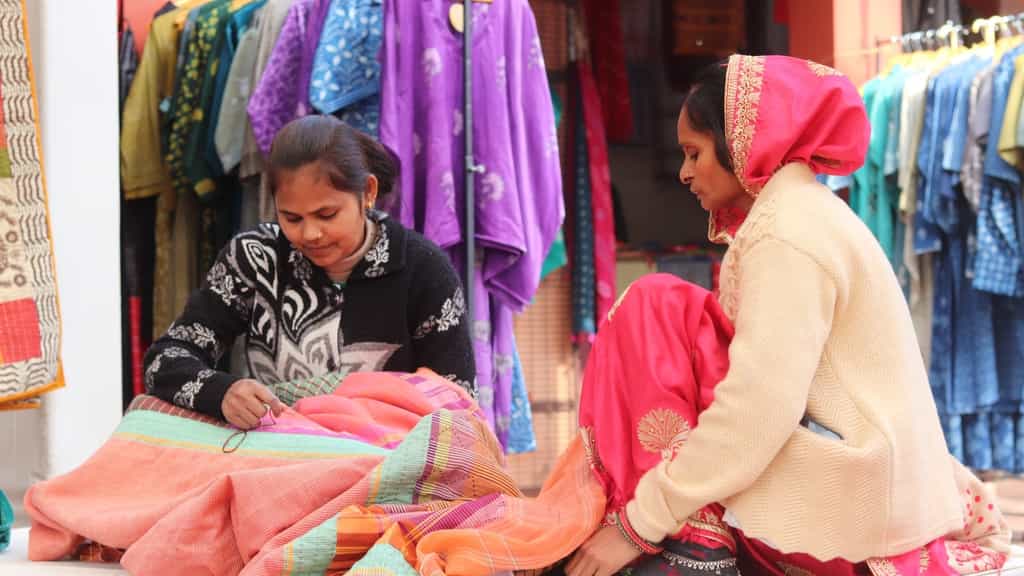
A live demonstration of quilt crafting at the bazaar draws curious onlookers.
The annual Dastkari Haat Crafts Bazaar is back at Dilli Haat to bring together craft, culture and people. With over 130 stalls from across the country, there are handwoven textiles from Kutch and Barmer, Madhubani and Gond paintings, Pashmina, block-printed fabrics, appliqué bed covers, pottery, jewellery, and hand-crafted footwear.
The celebration of artisanal craft dates back to 1986, when Dastkari Haat Samiti was founded by craft revivalist Jaya Jaitly, with just 90 members. “There was a need for a common platform where concerns could turn into larger projects for self-reliance and egalitarian principles,” says Jaitly. She also reflects on how her commitment to crafts stemmed from a deeply personal foundation. “I was strongly influenced by my father’s fine aesthetic sense and love for reading and writing and by my mother’s compassion for those in need,” she adds.
Master weaver Vankar Murji Hamir, 55, from Bhujodi, near Kutch, speaks about the long journey of his craft, how their community moved from making blankets to shawls and saris and now is working with organic kala cotton. “Some saris take 10 days. A masterpiece can even take six months,” he says, emphasising why handmade textiles cannot be priced or produced like machine-made ones.
The Dastkari Haat Crafts Bazaar has also given craftspeople the space to be innovative and entrepreneurial. Khetaram Sumra from Barmer, Rajasthan, with his brand Rohida Handloom, has restarted pattu weaving in his village almost single-handedly; he now trains others. Jaitly’s advice to young artisans is not to be lazy. “Be serious. Learn deeply. And don’t run to Google, ChatGPT, or AI at the very beginning. They will blank out your own thoughts. Contribute your own knowledge,” she says.
Hand-block printer Arshad Kafeel from Pilkhuwa, Uttar Pradesh, speaks candidly about changing markets. He reminisces of the time when products would sell out when the stalls were being set up. Today, the challenge is awareness. “People often don’t understand that this work is done by hand,” he says, pointing to the meticulous process of carving blocks, matching colours and printing layer by layer. He says, “Digital printing has changed everything.”
The 40th Dastkari Haat Crafts Bazaar at Dilli Haat, INA is ongoing till January 15
A frequent visitor to the Bazaar is Shobha Mehta, a teacher who lingers over hand-painted works and textiles. “Exhibitions like these celebrate diversity and give artisans a platform to earn and be seen,” while Anita Katyal, a Delhi-based journalist, says that no two visits feel the same, “I consciously shop from these exhibitions. If we don’t appreciate this art, it may slowly disappear.”
At the Mother Quilt stall, founder Niraj Borate explains how their work centres on upcycling textile waste into hand-stitched quilts and apparel and how they work with over 350 artisans across nine states.“We work with traditional quilters and train them. People appreciate the social and environmental impact,” he adds that the idea of turning old saris and clothes into something functional is very appealing to the larger crowd.
A live demonstration of quilt crafting draws curious onlookers. Gulabi Devi, an artisan at the workshop, stitches gudri by hand. She explains how this has been a generational occupation for their family. “I have been doing this for 50 years. Before me, my grandmother and my mother did this work and I would like to take this work further, hence I am here in Delhi,” she adds.
The Dastkari Haat Crafts Bazaar at Dilli Haat, Delhi, closes on December 15.
Editorial Context & Insight
Original analysis & verification
Methodology
This article includes original analysis and synthesis from our editorial team, cross-referenced with primary sources to ensure depth and accuracy.
Primary Source
The Indian Express