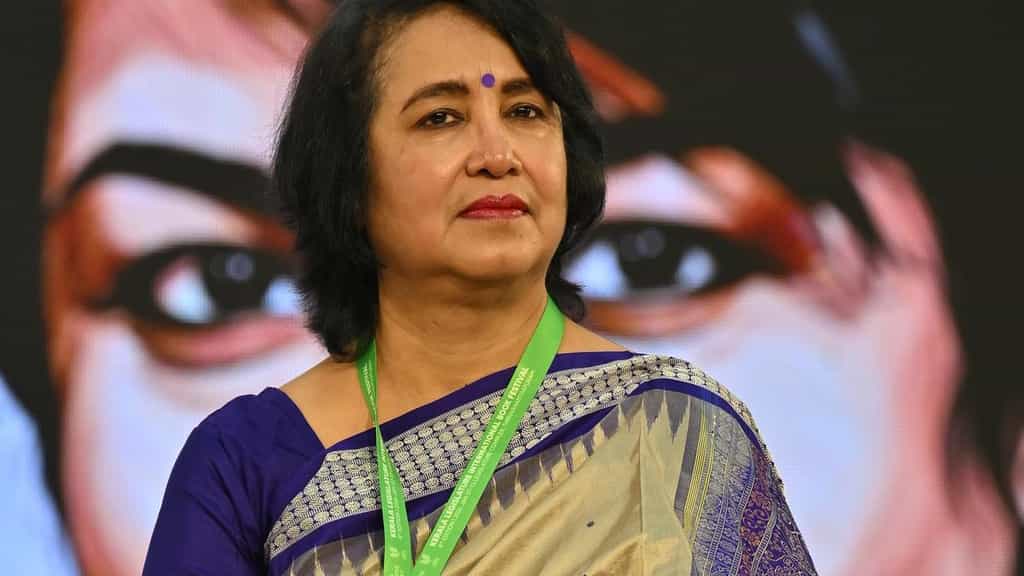
Thirty-one years after she was forced into exile from her home country Bangladesh in the aftermath of her controversial novel Lajja, the wounds appear still fresh when Taslima Nasrin speaks. Oppression and silencing of dissenting voices were recurring themes in a talk she delivered on the third day of the 4th Kerala Legislature International Book Festival (KLIBF) here on Friday.
“Oppression often survives because it disguises itself as tradition. My crime was that I critically examined religion, demanding equal rights for women and defending the rights of all including religious minorities. Religious extremists threatened to take my life. Fatwas were issued against me. They wanted my silence, instead my word travelled further. I lost my home, I didn’t lose my voice. The pain survived, the book survived, and the truth survived,” she said.
Peace, like truth, changes meaning depending on who defines it and who benefits from that definition, she said, touching upon her topic of ‘Book for Peace’.
“Peace that demands silence in the face of injustice is not peace. It is a moral withdrawal. Self-help books that tell the oppressed to adjust to oppression does not aid healing. It does harm. History is full of peaceful societies built on slavery, stable systems built on patriarchy, and orderly cultures built on religious terrorism. A society where women are controlled by religion might look peaceful on the surface, but that peace is a graveyard peace, enforced by fear. Real peace is not avoiding conflict, but confronting its causes. When I speak of books for peace, I don’t mean books that make us comfortable but books that make injustice uncomfortable, books that disturb us, provoke us and make us choose between silence and courage,” she said.
Speaking on the current situation in Bangladesh, Ms. Nasrin accused Muhammad Yunus, the Chief Adviser of Bangladesh, of aligning himself with religious, extremist forces and promoting agendas that threaten secularism and the safety of ordinary citizens. Her criticism also extended to the Nobel Peace Prize, which Mr. Yunus had received in 2006.
“I don’t trust official peace, certified by committees, stamped by institutions because history has taught us something brutal. The world often reveres power and calls it peace. Henry Kissinger received the peace prize whose policies left countries burning, whose strategy erased villages and whose peace was built on top of dead bodies. Aung San Suu Kyi was celebrated as a saint of democracy, but when the Rohingyas were violently driven out from their land, she didn’t stand with the victims. She stood with the State. She chose power over humanity. Even in Bangladesh, figures celebrated as agents of peace and development have done this,” she said.
Ms. Nasrin said that Kerala has shown the world that ideas and courage matter. “Resistance to injustice happens here, not as nostalgia, but as living memory and practice. From Sree Narayana Guru to Ayyankali and E.M.S. Namboodiripad, Kerala has repeatedly shown that progress is not accidental. It is a choice,” she said.
Editorial Context & Insight
Original analysis & verification
Methodology
This article includes original analysis and synthesis from our editorial team, cross-referenced with primary sources to ensure depth and accuracy.