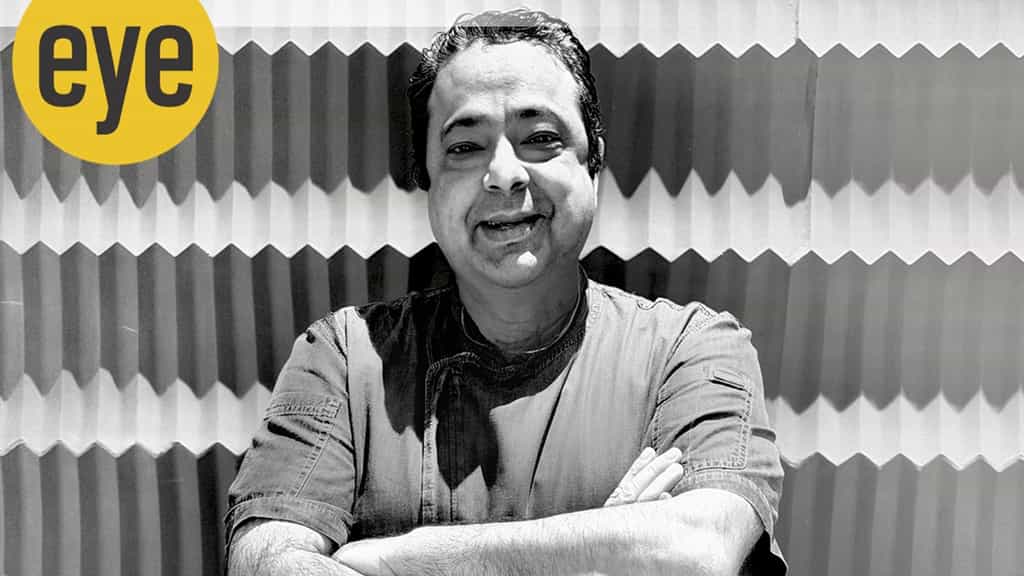
For nearly two decades, chef Manish Mehrotra and Indian Accent were inseparable in the public imagination. So when he parted ways in mid-2024, the question wasn’t whether he would open something new, but what it would look like. That answer arrives on January 17 with Nisaba, Mehrotra’s first independent restaurant under the Manish Mehrotra Culinary Arts (MMCA) banner.
Parked on the first floor of Humayun’s Tomb World Heritage Site Museum, Sunder Nursery, Nisaba is named after an ancient Sumerian goddess revered as the deity of grain and knowledge. “I wanted a name that’s easy on the tongue but meaningful to us,” he explains, “We’ve always worshipped Annapurna Devi, the goddess of grain. When we came across Nisaba, it immediately appealed to us.” The restaurant is a distillation of everything he stands for: familiar flavours, refined presentation and food that speaks to India.
“It’s a fine-casual restaurant,” he says, over a phone call from Delhi where he has been hosting his friends, family and people from the industry. “The food is not modern Indian or progressive Indian. I would describe it as Indian food of today’s India.”
Winter saag with jammy eggs
While Nisaba does offer a tasting menu, it’s restricted to the private dining room, which accommodates up to 14 guests. The rest of the space focuses on an à la carte menu and sharing plates. In all, the menu features around 45 dishes. The restaurant, led by Mehrotra, is backed by founding partners Amit Khanna and Binny Bansal, with Shubham Upadhyay heading the front of the house.
The inspiration for the menu comes not from fine-dining kitchens but from the unsung heroes of India’s food culture. “It is inspired by our unsung heroes, our chaat wallahs, people cooking at dhabas and thelas,” he adds.He had shortlisted nearly 120 dishes after extensive trials, 45 made the final cut.
The first glimpse of the menu hints at this layered approach. A dish of saag topped with jammy eggs immediately stands out. “This is my homage to a saag I ate at a dhaba on the way to Shimla,” says Mehrotra. He connects the memory to his culinary training. “Back in college, one of the early dishes we made was eggs Florentine — a classic French dish with poached eggs and sautéed spinach so I knew eggs and greens would work beautifully together.” At Nisaba, the saag is made not just with sarson but with five greens: palak, sarson, methi, bathua and shaapoo shepu/suva (dill).
The menu also features a beetroot and goat cheese dahi vada, chilli tomato crab ghotala, paneer butter masala and paneer pakoda. Both paneer dishes are built in layers, a detail that inevitably recalls Mehrotra’s iconic 100-layer paneer at Indian Accent. The beverage programme leans heavily on wines, with close to 80 labels on offer.
A look at food at Nisaba
MMCA now also invests in mentoring young chefs. “We’ve hired seven freshers straight out of college and also brought on board two people from a village in Bihar at Nisaba,” he shares.
Given how closely Mehrotra’s public identity has been tied to Indian Accent, was it challenging to decide what to carry forward? “It was a dilemma,” he admits. “I asked friends and even professionals what I should do. Everyone had an opinion but one analogy really stayed with me. Someone asked, ‘Would you go to a Kishore Kumar or Michael Jackson concert if all the songs were new?’ I said no. That’s when I decided to keep a few of my signature dishes.” Among those that have made the transition to Nisaba are the blue cheese naan that he introduced in 2009 and the meetha achaar pork ribs, featuring slow-cooked pork glazed in a sweet and tangy mango pickle sauce.
The restaurant’s location is as considered as its menu. Attached to Sunder Nursery, the space is bathed in natural light during the day. “One side opens to the courtyard of the Humayun World Heritage Site Museum, while the other overlooks the gardens of the nursery itself,” he says. Designed by Ram Joshi of Via Design, the interiors are contemporary, shifting from bright and open during the day to intimate and dramatic in the evening. Nisaba occupies a space that was once a garage, located just outside the main public area. “It’s a beautiful addition to the neighbourhood. More thoughtful additions like this are needed around our old monuments,” he says.
From the conversation, we realise that Nisaba isn’t going to be restricted to Delhi. “The dream is to open in more cities, but aaram se. The flagship has such a stunning view and any future restaurant would need to match that. The cuisine also lends itself well to travel. It’s global Indian food, relatable to people across cultures.” What it finally becomes will reveal itself over time. At present, it signals a quieter, more deliberate phase for Mehrotra — one shaped by memory, informed by experience and unhurried in its intent.
Editorial Context & Insight
Original analysis & verification
Methodology
This article includes original analysis and synthesis from our editorial team, cross-referenced with primary sources to ensure depth and accuracy.
Primary Source
The Indian Express