

Key takeaways
- AI workloads are scaling faster than any single infrastructure approach can support — with more models, new agent-driven workloads and surgi
- Our approach to AI infrastructure is designed to support the breadth of how AI systems are built and run.
- Building on our close collaboration with AMD, Microsoft is bringing AMD’s latest Helios AI platform and next-generation EPYC datacenter processors to Azure.
What happened
AI workloads are scaling faster than any single infrastructure approach can support — with more models, new agent-driven workloads and surging compute demand driving the need for greater specialization across the stack. To meet this need, Microsoft continues to evolve Azure’s infrastructure, including expanding its AI fleet with AMD’s most advanced AI and high-performance computing (HPC) solutions.
For this reason, Azure HX virtual machines, launched in partnership with AMD in 2023 and featuring AMD’s unique 3D V-cache technology, have seen significant adoption among silicon design firms working to bring more capable and efficient AI silicon to market. Today, we are announcing the next step in our workload optimized journey for these customers, HXv2. HXv2 virtual machines build on and extend the strengths of HX.
They both continue the differentiation Azure offers for RTL simulation workloads by again employing 3D V-cache technology, while offering significant improvements to single threaded performance and memory.
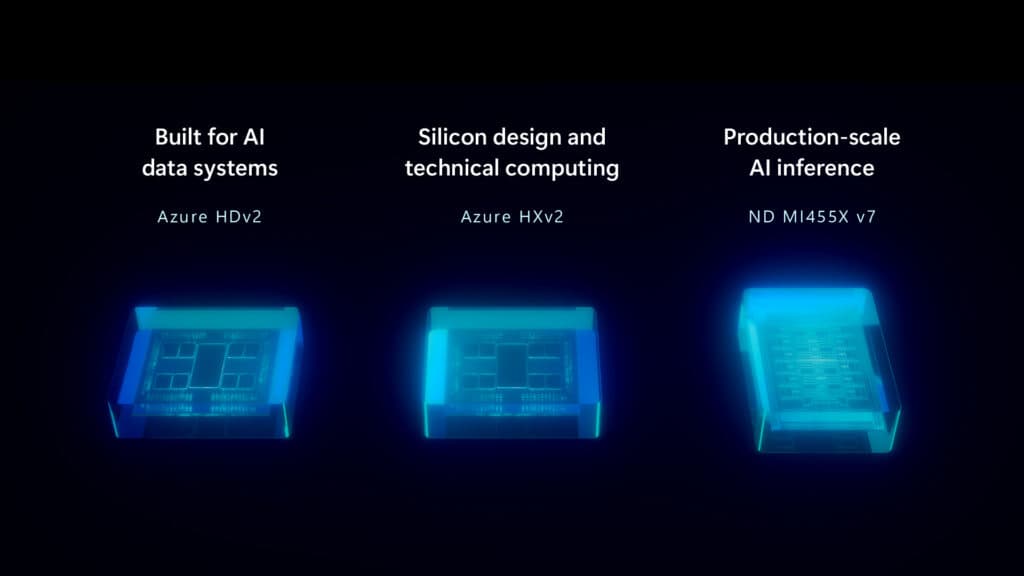
HXv2 VMs will feature 176 AMD 6th Gen EPYC CPU cores with a clock frequency of more than 5 GHz, 50% more addressable cache per core and VM sizes with nearly 2 or 4 terabytes of RAM, helping customers optimize their workloads to memory needs. Azure HXv2 is also designed to support a broader range of technical computing workloads including scientific simulation, engineering analysis and other distributed memory applications.
Why it matters
Our approach to AI infrastructure is designed to support the breadth of how AI systems are built and run. We closely work with industry innovators like AMD as well as our own purpose-built silicon and systems to provide customers with a comprehensive, open and heterogenous platform to achieve the best performance, cost and energy efficiency outcomes.
Building on our close collaboration with AMD, Microsoft is bringing AMD’s latest Helios AI platform and next-generation EPYC datacenter processors to Azure. These technologies will power three upcoming Azure offerings: HDv2 VMs for data processing, HXv2 VMs for electronic design automation (EDA) and ND MI455X v7 VMs for AI inference workloads. CPU infrastructure is essential to the performance and efficiency of modern AI systems.
AI accelerators depend on high-density, power-efficient CPU compute to process data, coordinate workloads and keep pipelines running at scale. Without this, training jobs don’t have enough data to learn from, and agents don’t have enough capacity to perform tasks on behalf of customers. Azure HDv2 virtual machines are one of our latest offerings designed from the ground up to eliminate these bottlenecks and empower massive agentic workload adoption.
Co-designed with AMD, HDv2 VMs expand Azure’s portfolio of purpose-built solutions for the most demanding CPU workloads from AI customers, including data preparation, search, reinforcement learning and agent coordination at scale.
Featuring nearly 500 physical 6th Gen AMD EPYC CPU cores, 4 terabytes of RAM, 32 terabytes of local NVMe storage and 400 Gb Azure Boost networking, HDv2 VMs are built for the workload needs of our most demanding AI customers. The AI era has created tremendous need and opportunity for firms developing the silicon products that power this infrastructure.
What to watch
The significantly increased per VM and per core performance, and the inclusion of 800 Gb InfiniBand, enable large-scale MPI-based simulations and make HXv2 an ideal fit for a wide variety of HPC customers.
AMD, a leading HX-series customer, highlights this impact directly: — Mark Papermaster, Executive Vice President and CTO, AMD — Shankar Krishnamoorthy, Chief Product Development Officer, Synopsys ND MI455X v7 is designed for the reasoning, search and agentic workloads behind modern AI services. Powered by the AMD Helios rackscale solution, it expands Azure’s infrastructure options for large-scale inference and is designed to deliver strong performance and efficiency for demanding AI workloads. Together, t