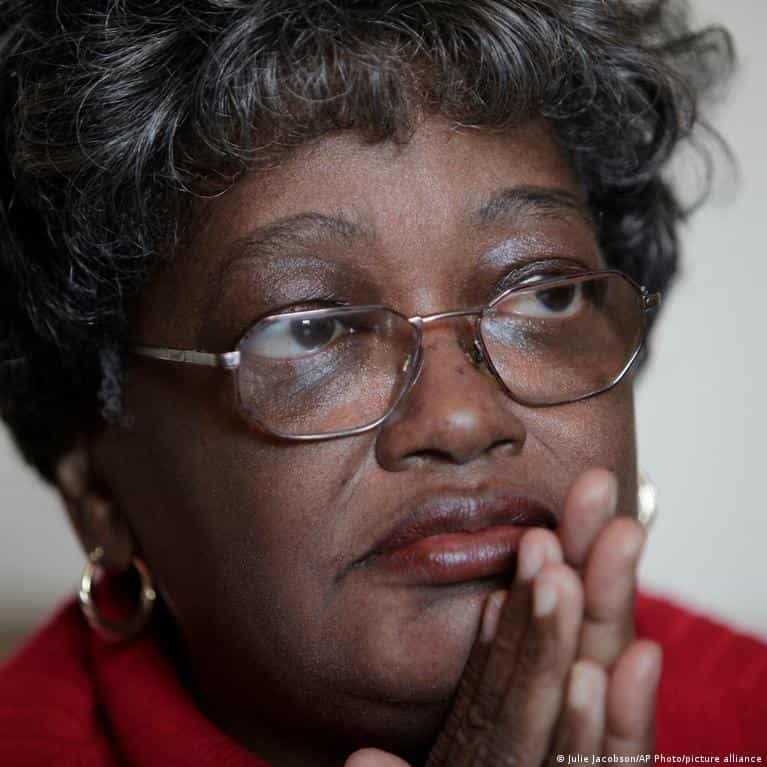
Claudette Colvin, who became an US civil rights pioneer after her detention for refusing to give up her seat to a white woman on a segregated bus in Alabama in 1955, has died aged 86, her foundation has said.
She was just 15 when she carried out her protest in the city of Montgomery against the segregation laws, several months before Rosa Parks defied them in much the same manner in the same city, an incident that has received more historical attention.
Colvin "leaves behind a legacy of courage that helped change the course of American history," her foundation said.
Colvin's act on March 2, 1955, was partly informed by what she had learned studying Black history at school.
"My mindset was on freedom," Colvin said in 2021 of her defiance.
"So I was not going to move that day,” she said. "I told them that history had me glued to the seat."
Her refusal came after the driver of the bus taking her home from high school ordered Black passengers to give up their seats to white passengers, as the white section at the front of the vehicle was full.
She said that although the white woman concerned could have sat on the seat opposite, that woman "refused because ... a white person wasn't supposed to sit close to a negro."
Colvin was briefly put in jail for disturbing public order. The next year, she became one of four Black female plaintiffs who filed a lawsuit challenging the segregation rules on buses in Montgomery.
The lawsuit was successful and had consequences for public transportation throughout the US including trains, airplanes and taxis.
Colvin's brave act was overshadowed by that of Parks, who was already a prominent member of the local chapter of the National Association for the Advancement of Colored People (NAACP) at the time of her arrest for defying the segregation laws.
Parks' detention triggered a yearlong bus boycott in Montgomery, an action that led to Martin Luther King Jr. becoming the spearhead of the civil rights movement.
It ended up considerably advancing the cause of Black people in the US in the 1960s, among other things by ending legal segregation and securing them voting rights.
For her part, Colvin, who was born in Alabama in 1939 as the eldest of eight sisters, was ostracized from the civil rights movement when she conceived a child as an unmarried woman.
She remained virtually uncelebrated for decades, working in the elderly care sector, but received recognition later in life, among other things being the subject of a 2009 biography by Phillip Hoose, "Claudette Colvin: Twice Toward Justice," which won the US National Book Award for young people's literature.
However, it was only in 2021 that the record of her 1955 arrest and adjudication of delinquency was expunged by a US court after she filed a petition.
"When I think about why I'm seeking to have my name cleared by the state, it is because I believe if that happened it would show the generation growing up now that progress is possible, and things do get better," Colvin said at the time. "It will inspire them to make the world better.”
Editorial Context & Insight
Original analysis and synthesis with multi-source verification
Methodology
This article includes original analysis and synthesis from our editorial team, cross-referenced with multiple primary sources to ensure depth, accuracy, and balanced perspective. All claims are fact-checked and verified before publication.
Primary Source
Verified Source
Deutsche Welle
Editorial Team
Senior Editor
Shiv Shakti Mishra
Specializes in World coverage
Quality Assurance
Quality Assurance Editor
Fact-checking and editorial standards compliance