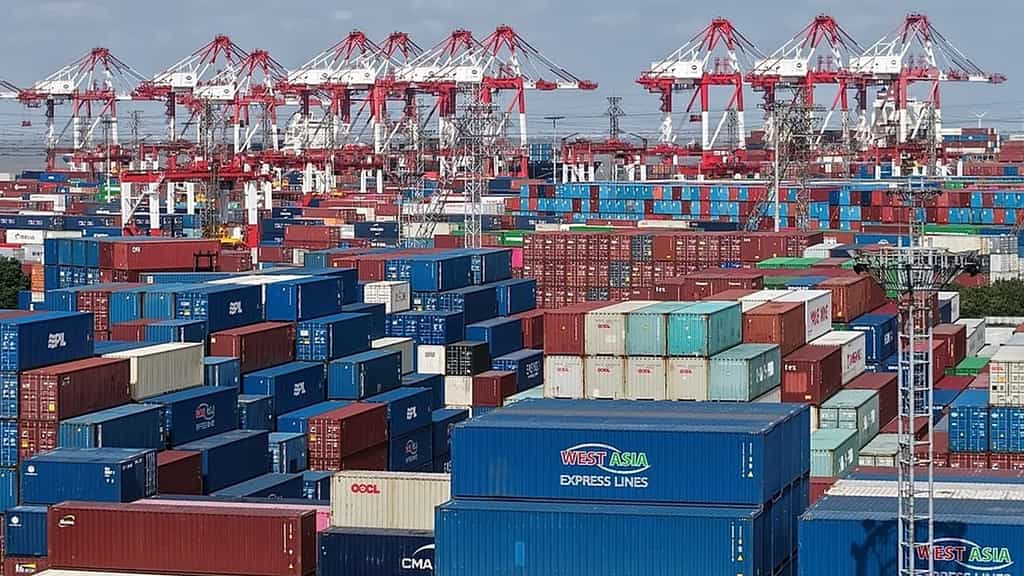
China’s trade surplus surged to a record of almost $1.2 trillion (€1.031 trillion) last year, the government said Wednesday, as exports to other countries made up for slowing shipments to the United States in what was a turbulent year of global trade.
Beijing’s exports rose 5.5% in 2025 to $3.77 trillion (approximately €3.644 trillion using the 2024 year-end exchange rate), but imports for the year were flat at $2.58 trillion (approximately €2.492 trillion), resulting in a record trade surplus of $992 billion (approximately €958 billion).
According to Customs data, the surplus was boosted by trade gains in December, with exports climbing 6.6% from the year before, better than economists’ estimates and higher than November’s 5.9% year-on-year increase. Imports in December were up 5.7% year-on-year, compared to November’s 1.9%.
Economists expect exports to continue supporting China’s economy this year, despite trade friction and geopolitical tensions.
“We continue to expect exports to act as a big growth driver in 2026,” said Jacqueline Rong, chief China economist at BNP Paribas.
Since US President Donald Trump took office and intensified his trade battle with the world's second-largest economy, China's exports to the United States have drastically decreased, but sales to other markets in South America, Southeast Asia, Africa, and Europe have more than made up for this reduction.
Strong global demand for computer chips and other devices, and the materials needed to make them, were among categories that supported China’s exports, analysts said.
China’s strong exports have helped keep its economy growing at an annual rate close to its official target of about 5%. But that has triggered alarm in countries that fear a flood of cheap imports is damaging local industries.
With increasing spending by consumers and businesses a focus of its economic policy, actions taken so far by Beijing have had a limited impact. One of its main strategies has been to pay subsidies to encourage people to discard old appliances and vehicles and replace them with newer, more energy-efficient models.
While performance for last year beat odds, Beijing faces a “severe and complex” external trade environment in 2026, according to Wang Jun, vice minister of China’s customs administration.
Jun, however, remained optimistic, saying China’s “foreign trade fundamentals remain solid.”
On Monday, Brussels published new guidelines that will allow Chinese electric vehicle producers to submit offers for minimum prices by replacing the steep tariffs imposed to counter Beijing's subsidies. The move is a significant de-escalation in the electric vehicle (EV) standoff and signalled a potentially new direction for the EU and China dealings.
Both parties have been negotiating a plan under which Chinese manufacturers would pledge to increase the price of their BEVs to ensure more equitable competition with their European counterparts since the levies were applied in October 2024.
China is the EU’s second-largest trading partner for trade in goods alone, after the United States
Editorial Context & Insight
Original analysis and synthesis with multi-source verification
Methodology
This article includes original analysis and synthesis from our editorial team, cross-referenced with multiple primary sources to ensure depth, accuracy, and balanced perspective. All claims are fact-checked and verified before publication.
Primary Source
Verified Source
Latest News From Euronews | Euronews RSS
Editorial Team
Senior Editor
Shiv Shakti Mishra
Specializes in World coverage
Quality Assurance
Associate Editor
Fact-checking and editorial standards compliance