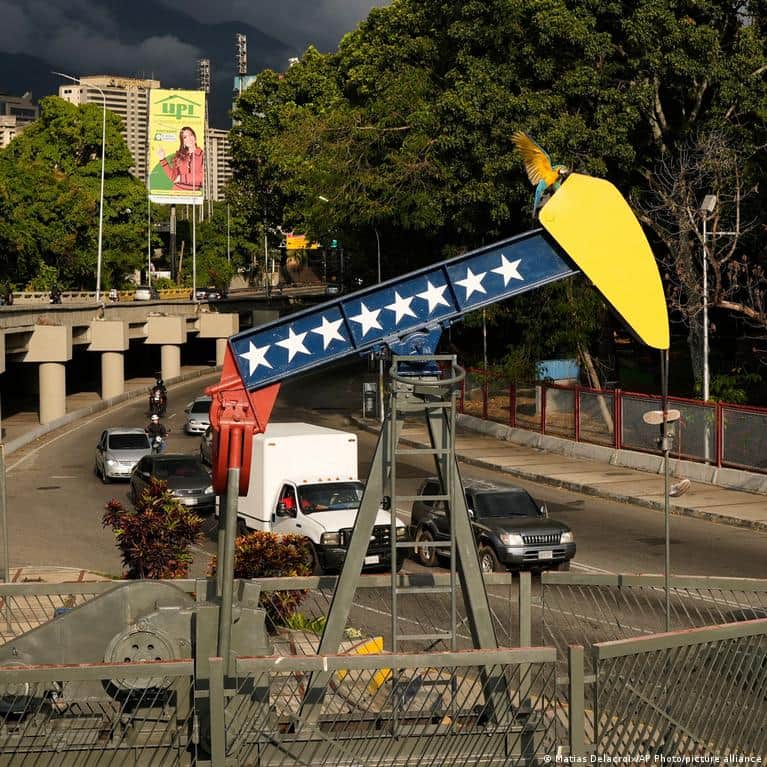
US President Donald Trump has announced that "interim authorities in Venezuela will be turning over" between 30 to 50 million barrels of sanctioned oil to the US.
"This oil will be sold at its market price, and that money will be controlled by me, as president of the United States of America, to ensure it is used to benefit the people of Venezuela and the United States!" Trump wrote in a social media post.
He did not provide further details about the plan. Venezuelan officials did not immediately comment on the announcement.
Trump said the US plans to take control of Venezuela's oil industry and have US oil companies revitalize it, although experts say it will take major investment to restore the country's energy infrastructure.
To view this video please enable JavaScript, and consider upgrading to a web browser that supports HTML5 video
Venezuela's new acting leader Delcy Rodriguez has announced a week of mourning for soldiers killed in the US attack that captured Nicolas Maduro and his wife.
"I have decided to decree seven days of mourning to the honor and glory of the young people, women and men who gave up their lives defending Venezuela and president Nicolas Maduro," Rodriguez said in a TV address.
Venezuela's military said at least 24 officers were killed during the raid. Another 32 Cuban soldiers were also killed, the Cuban government said.
Venezuela's president Delcy Rodriguez said on Tuesday that no foreign power was governing her country.
"The government of Venezuela is in charge in our country, and no one else. There is no foreign agent governing Venezuela", she said in a televised address.
She added: "Personally, to those who threaten me … my destiny is not determined by them, but by God."
US President Donald Trump previously told NBC News on Sunday that the US was "in charge" of Venezuela after US forces kidnapped Venezuelan leader Nicolas Maduro and his wife in a daring raid Saturday.
Trump warned Rodriguez she would fare "probably worse" than Maduro if she didn't cooperate. Trump said Saturday in a new conference after Maduro's capture that the US would "run" Venezuela with the support of top US officials.
US Secretary of State Marco Rubio later tried to walk back that declaration, saying the US would not take a day-to-day role in governing Venezuela but would instead exert pressure on its new government by controlling its export of oil.
International law experts see the US abduction of Venezuelan President Nicolas Maduro as a dangerous precedent.
Christoph Safferling from the University of Erlangen-Nuremberg disputes the legality of the Trump administration's actions.
In his opinion, the situation is clear: "The US has violated the prohibition of the use of force under international law, as guaranteed in Article 2(4) of the United Nations Charter. According to this, states must respect each other's political independence and territorial sovereignty," he told DW in a written response.
Delcy Rodriguez, a 56-year-old lawyer and longtime deputy to Nicolas Maduro, has been sworn in as Venezuela's interim president. Much of Maduro's inner circle remains in place. Here's who is still running the country.
Stephen Miller, a top aide to Donald Trump, signaled a stance in US foreign policy on Monday, saying: "We live in a world … that is governed by strength."
Researcher Mike Cowburn told DW how such rhetoric fits into US thinking on the Western Hemisphere.
Colombia says it will file a formal complaint with the United States over remarks made by President Donald Trump.
Foreign Minister Rosa Villavicencio said she’ll deliver the protest to the US embassy's Charge D'Affaires in Bogota.
On Sunday, Trump threatened Colombia with military action similar to the operation in Venezuela and labeled President Gustavo Petro, an outspoken critic of US involvement in Venezuela, a "sick man who enjoys making cocaine and selling it to the United States."
Villavicencio however told reporters she hopes to ease tensions and strengthen cooperation against drug trafficking.
"It is necessary for the Trump administration to know in more detail, about all that we are doing in the fight against drug trafficking," Villavicencio said.
US President Donald Trump told House Republicans that no US forces had been killed as they launched their attack to capture leader Nicolas Maduro.
"Talk about boots on the ground, we had a lot of boots on the ground. But it was amazing. And think of it, nobody was killed," Trump said.
"And on the other side, a lot of people were killed, unfortunately I say that, soldiers. Cubans, mostly Cubans, many, many killed," the US president said.
According to figures from Cuba and Venezuela, 55 Cuban and Venezuelan military personnel were killed during the US raid.
Venezuela's military said at least 24 security officers were killed, while on Sunday the country's Defense Minister said that Maduro's presidential guard was largely eliminated during the US attack.
Cuba published the names of 32 members of its military who died in the nighttime assault that led to Maduro's capture in Caracas on January 3.
Mexican President Claudia Sheinbaum called on the United States to ensure that deposed Venezuelan leader Nicolas Maduro receives a fair trial.
"Now that President Maduro is in detention, what we request is a fair trial," Sheinbaum told reporters in Mexico City.
Sheinbaum has sought to navigate regional geopolitical tensions diplomatically, maintaining a strong relationship with President Donald Trump while opposing US intervention in Latin America.
Trump has previously floated the idea of military intervention in Colombia and Mexico.
Venezuelan Attorney General Tarek Saab urged the US judge overseeing a narcoterrorism case against deposed President Nicolas Maduro to dismiss the charges.
He argued the United States lacks jurisdiction and that Maduro is immune from prosecution as a head of state.
Maduro, who was removed from office over the weekend, pleaded not guilty Monday to federal drug trafficking charges in a US courtroom.
Saab said three prosecutors will investigate deaths that occurred during the US military operation that ousted Maduro.
The leader of the Bavarian conservative Christian Social Union (CSU), Markus Söder, has pushed back against criticism in Germany over the arrest of Venezuelan President Nicolás Maduro.
Speaking at a retreat of CSU lawmakers at Seeon Abbey in Bavaria, Söder said he could not understand what he called "partial hysteria" around the case and added that it was good "that Maduro is gone."
Opposition politicians have criticized the US action against Venezuela and Maduro's arrest as a violation of international law.
Germany's government has not yet taken a position, with Chancellor Friedrich Merz, from the CSU's Christian Democrat sister party, saying it would take time to assess a complex situation.
Söder echoed the chancellor's caution on legal questions, saying he was not an expert in international law. He added that there was "broad approval" of the outcome.
The US operation in Venezuela has fueled debate over whether forceful intervention is becoming a new norm under Donald Trump.
Trump's subsequent threats toward Cuba and renewed ambitions involving Panama Canal and Greenland have unsettled regional leaders and drawn sharp criticism from Russia and China.
The Vente movement of opposition figure Maria Corina Machado has called for the release of all political prisoners following the US' capture of President Nicolas Maduro.
"Those who unjustly hold the civilian and military political prisoners should free them immediately," it said.
A leading local rights group puts the number of political detainees in Venezuela at 863.
Maduro is known to have imprisoned many of his opponents since taking power in 2013, and his predecessor, Hugo Chavez, also put a number of his critics behind bars.
Machado, who enjoys considerable popularity in her home country, said on Monday that she was "planning to go back to Venezuela as soon as possible."
In an interview with US broadcaster Fox News, she also rejected the country's interim president, Delcy Rodriguez, saying Rodriguez ""is one of the main architects of torture, persecution, corruption, narcotrafficking."
Rodriguez was vice president to Maduro from 2018.
The UN has voiced severe criticism of the US strikes in Venezuela that led to the capture of the country's president, saying they "undermined a fundamental principle of international law."
"States must not threaten or use force against the territorial integrity or political independence of any state," Ravina Shamdasani, spokeswoman for the Office of the United Nations High Commissioner for Human Rights, told reporters in Geneva.
She said the US operation "sends a signal that the powerful can do whatever they like."
Shamdasani rejected the justification given by the US government for the raid, where it accused the Venezuelan government of overseeing serious human rights violations.
"Accountability for human rights violations cannot be achieved by unilateral military intervention in violation of international law," she said, noting that the UN rights office had consistently reported on the dire state of human rights in Venezuela over a decade.
"We fear that the current instability and further militarization in the country resulting from the US intervention will only make the situation worse," she said.
The Trump administration is planning a meeting with representatives of US oil majors to discuss possibilities for the US to regain its foothold in the Venezuelan oil industry after the ouster of President Nicolas Maduro, according to a source familiar with the matter.
CBS News, citing an unnamed source, said executives from the three three biggest US oil companies — Exxon Mobil, ConocoPhillips and Chevron — were expected to meet on Thursday with Energy Secretary Chris Wright.
US-led energy operations in Venezuela were taken over by the government there under late President Hugo Chavez almost two decades ago, with Chevron the only major US firm still active in the country under rules allowing it to partner with companies that are at least 50% owned by the Venezuelan state.
However, a return of other US companies to Venezuela is considered by industry analysts to be a tricky proposition in view of a lack of infrastructure, the uncertainty surrounding the country's political future, the legal framework and US policy in the long term.
They say billions in investment will be needed to boost oil production to sustainable levels.
None of the three companies has so far had talks with the administration about the possible consequences for them of the ouster of Maduro, oil industry executives cited by Reuters news agency said.
This contradicts US President Donald Trump's assertion that he had held meetings with "all" US oil companies before and after Maduro was seized by US forces in a weekend operation.
However, White House spokesperson Taylor Rogers has claimed that "all of our oil companies are ready and willing to make big investments in Venezuela that will rebuild their oil infrastructure, which was destroyed by the illegitimate Maduro regime."
Venezuela has the world's largest proven oil reserves, with over 300 billion barrels available — even more than Saudi Arabia.
However, it accounts for less than 1% of the global oil production, a figure that was more than 10% of global production in the 1960s.
Crude production has collapsed by more than 70% since the late 1990s, and Venezuela is now 21st in the list of global producers.
You can read more about the situation of the oil industry in Venezuela and the US's past and potential future role in it in this article:
Editorial Context & Insight
Original analysis & verification
Methodology
This article includes original analysis and synthesis from our editorial team, cross-referenced with primary sources to ensure depth and accuracy.
Primary Source
Deutsche Welle