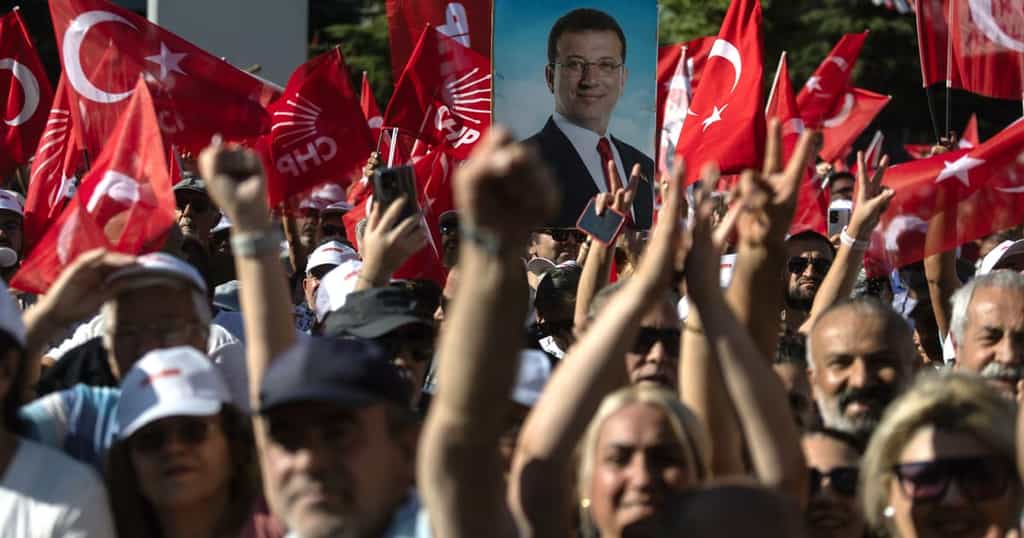
The 55-year-old, who faces a potential jail term of more than 2,300 years, replied via his lawyers and political advisers to a series of questions sent by POLITICO. The rare remarks signal İmamoğlu is confident in the groundswell of his support and is determined to remain a political force from behind bars.
“What we are living through today is not a genuine legal process; it is a strategy of political siege,” he wrote.
“President Erdoğan’s aim is not only to shape the next election. It is to erase my candidacy now and in the future, and to push me completely out of politics. The reason is clear: They know that in a free and fair election, I can defeat President Erdoğan at the ballot box, and they are trying to prevent that.”
The sweeping crackdown against İmamoğlu — along with many other mayors from the opposition Republican People’s Party (CHP) — came amid signs that the country’s political tide was shifting dramatically to the secularists.
The Islamists were defeated by an unexpectedly high margin in municipal elections in 2024, and the authorities moved to charge İmamoğlu on multiple counts, just as he was about to be nominated as the CHP’s official presidential candidate. Despite his detention, more than 15 million Turks still voted in a CHP primary to name him as the official challenger — a highly symbolic public outpouring, as he was the only candidate.
İmamoğlu and members of his team were charged with corruption, extortion, bribery, money laundering and even espionage.
The sheer scale of the case revealed its weakness, İmamoğlu explained. He complained of “1,300 inspections at Istanbul Metropolitan Municipality that produced no concrete findings; a 3,900-page indictment based largely on rumors and witnesses whose credibility is contested; a demand for prison sentences totaling up to 2,352 years; and a maximum trial duration set at 4,600 days.”
The next election isn’t expected until 2028, but İmamoğlu is still seen as posing a particular risk. He has defeated Erdoğan’s party allies in Istanbul mayoral elections three times; crucially, his party won in traditionalist, religious quarters of Turkey’s biggest city, which the Islamists had long seen as their political bastions. Erdoğan himself used the mayoral office in Istanbul as a springboard to win national power years ago.
Despite his incarceration, İmamoğlu continues to campaign online through platforms like X, Instagram and TikTok, with help from his team.
But can a candidate really run a serious presidential campaign from prison, while Erdoğan controls all the vital levers of state? İmamoğlu’s main campaign account on X, which has nearly 10 million followers, was blocked in Turkey in May.
The incarcerated mayor fully acknowledges the limits imposed on him but insists a campaign without his physical presence or podium speeches can succeed.
“What defines a campaign is its ideas, its values, and the shared will of citizens. We have all of these on our side … Everyone is aware that my arrest is unjust. Even a significant portion of Justice and Development Party (AK Party) voters consider my detention unfair and see it as a grave blow to justice,” he wrote.
He also stressed the importance of the CHP primary in demonstrating the swell of popular support for him beyond the traditional party base.
“The presidential primary on March 23, 2025 demonstrated this clearly. Although I was detained, around 15.5 million citizens voted to support my candidacy. Only 2 million of that number were CHP members; the other 13.5 million came from every segment of society,” he explained. “The campaign launched by my party to demand trial without detention and early elections has gathered 25.1 million signatures. All of this reflects a demand that transcends party lines: a demand for justice, merit, and dignity.”
Yet the legal fate of his candidacy now rests with a judiciary that has a poor record of independence.
Last February, Istanbul’s chief prosecutor’s office opened an investigation alleging that İmamoğlu’s diploma from Istanbul University had been forged; one day before his arrest, the university annulled the diploma. Under Turkey’s constitution, presidential candidates must be over 40 and hold a university degree.
Another hearing is expected later this month.
According to Soner Çağaptay, an expert on Turkey at the Washington Institute think tank, İmamoğlu has little chance of being allowed to take on Erdoğan in a free and fair race, as the president will use the advantages of incumbency and state institutions to block his candidacy, stigmatize him and weaken support for the CHP.
“Even though İmamoğlu can declare his candidacy virtually from a jail cell, there is no way this will be legally allowed — because for Erdoğan this would be a mortal political threat if this were a free and fairly contested race,” he said.
In his responses, İmamoğlu took aim at Erdoğan’s “aggressive” foreign policy and his close relationship with U.S. President Donald Trump, linking both to the erosion of rights at home.
“It is clear that President Trump’s presidency has opened a turbulent era … Diplomacy has increasingly shifted from institutions to leader-to-leader dealings, squeezed between rapid bargains and gestures that rarely lead anywhere,” he wrote.
He argued Erdoğan was seeking the legitimacy he had lost domestically in Washington, but questioned whether Ankara was really getting what it wanted.
“We must ask what the concrete gains of this alleged success are. Despite claims that relations with Washington are improving, Türkiye still has not returned to the F-35 [U.S. stealth fighter] program and [associated] sanctions have not been lifted,” he wrote.
“Our neighbor Greece continues, in violation of agreements, to militarize the Aegean islands. The alliance among Greece, Israel, and Southern Cyprus against Türkiye strengthens and extends steadily. Israel is pursuing provocative policies towards Kurds in various regional countries. The Gaza peace plan, struck with a ‘real-estate-dealer mentality,’ has still not ended Palestinians’ suffering and hunger. What is the government doing in response?” he asked.
İmamoğlu also insisted that Erdoğan’s security-driven policy had narrowed the space for democratic politics at home.
“Fundamental rights are restricted, pressure is placed on elected officials, and media and civil society are silenced, justified by ‘security’ and geopolitical importance. Over time, the idea that freedoms can be pushed aside ‘for stability’ becomes normalized.”
If elected president, İmamoğlu said, rebuilding ties with Europe would be one of his top priorities, alongside fulfilling the democratic criteria to be a candidate EU member.
“As the CHP, our goal of full EU membership remains intact. In the short term, we will work to modernize the Customs Union to include services, agriculture, public procurement and digital trade, and to align with European standards,” he wrote.
İmamoğlu said he is maintaining a strict routine in prison despite the bleak short-term prospects. He writes, reads and follows the news as closely as possible — not only for personal resilience, but out of a sense of public duty.
“That responsibility does not end at the prison gate … I am treated within the official framework, but I believe detention should never be normalized in a democracy. Especially when it is used as a tool of political containment. The issue is not the conditions, but the principle: Detention and prolonged legal uncertainty must not become instruments of politics.”
What he misses most is his family; his wife Dilek, his children, parents and friends. A large share of visitation requests are rejected without justification.
“I also miss the ordinary rhythm of the city, walking freely in the street, direct contact with people, and sharing unplanned moments,” he wrote.
He added that he keeps up his strength, knowing he is still part of a democratic movement larger than his personal circumstances.
“That is what truly determines everything, not the walls around me.”
Editorial Context & Insight
Original analysis & verification
Methodology
This article includes original analysis and synthesis from our editorial team, cross-referenced with primary sources to ensure depth and accuracy.
Primary Source
POLITICO