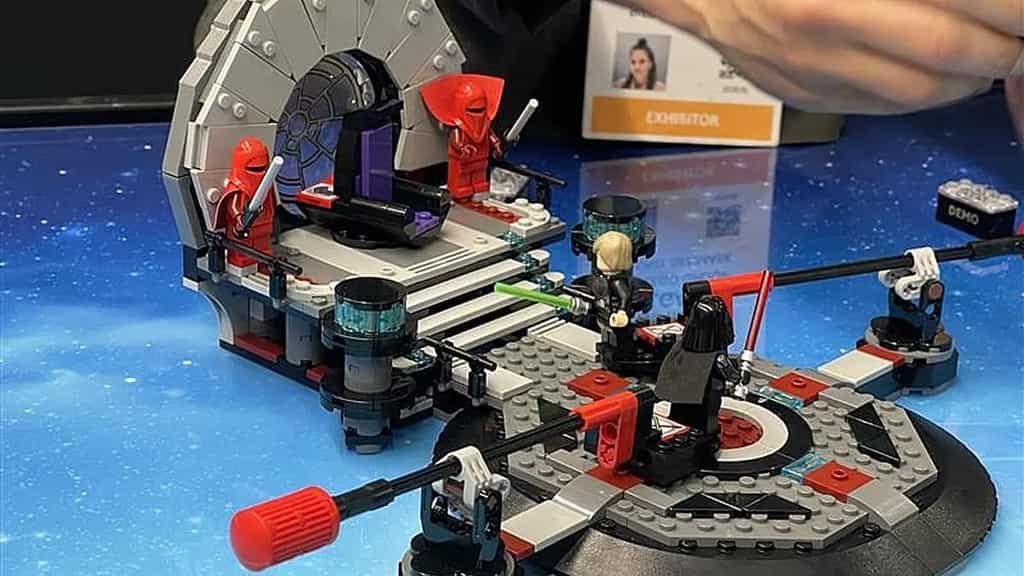
LEGO’s new smart brick has created one of the biggest buzzes at the CES 2026 technology conference in Las Vegas, which comes at a moment when excessive screen time for children is under fire, and physical play is being praised.
Euronews Next got up close to the bricks to see and saw a hands-on demonstration, showing what they can actually do, and spoke to Lego and Lucasfilm executives to find out how the technology works.
Firstly, the Lego Smart Brick isn’t just one brick. It works with a small square tag that tells the Smart Brick what to do.
So you have to add the tag to the Smart Brick. You then shake the brick to wake it up.
Once activated, it can light up, interact with other Smart Bricks, make sounds, and you can play out numerous scenarios.
One of the most impressive things is how the Smart Bricks can read each other. One scenario that was demonstrated was a mother LEGO duck with her little LEGO ducklings. When the mother duck’s back was turned, the four ducklings misbehaved to make quacking and even farting sounds. This then stopped when the mother duck turned back to face the ducklings.
Another example was getting the ducklings placed on skateboards to hit a trophy, which also contained a smart brick. Each duck had a different colour smart brick. The duck that came closest to the trophy would win. A simple game, but the technology twist allowed each duck’s colour to match that of the smart brick in the trophy.
The Smart Bricks will be released in March, but only in the LEGO Star Wars sets for the moment.
As one of its most emblematic partnerships with the film franchise, the scenarios you can play with the smart brick technology get so much more interactive.
The technology is also in its characters, so you could get Darth Vader to sing on stage, get Chewbacca to purr while giving him a stroke, and of course, the fight scenes between Luke Skywalker and his nemesis really come to life with both ships firing at each other with lights and sounds.
“We spent a lot of time with the LEGO designers, bringing this to life and dialling in all the sounds and so on, but it's also about how you use the sounds,” David Filon, chief creative officer of Lucasfilm, told Euronews Next.
“So part of the fun of this is exploring and discovering through play. If you move things differently, if you're swooshing around, and the starships make different sounds the faster you go, but if you do things like turn them over, you know, there might be some fun experiences that you get there,” he added.
The technology has been in development for eight years. There is no battery, and it charges on a pad. Each smart brick measures the same as a standard brick at 2 x 4 and lasts around 45 minutes.
At a time when children’s screen time has come under the spotlight, the possibilities of innovation are an opportunity to deepen physical play, said Tom Donaldson, senior vice president at the LEGO Group.
He told Euronews Next that Lego has many screen-based experiences it is proud of, but that physical play has “a tremendous number of benefits”.
“Even if it's not benefits, it's fun in different ways, building, hiding behind sofas, even if it's getting hit by a dart, and it's slightly hurting… I think as technology miniaturises, as technology broadens, actually it's going to become slightly easier to deepen that physical play”.
Donaldson said he was “hopeful” that this is the start of other companies looking at how to enhance physical play.
“I do hope that more broadly imaginative play gets ever and ever stronger in all the different forms, whether it's digital or here, in the more physical side,” he added.
Editorial Context & Insight
Original analysis & verification
Methodology
This article includes original analysis and synthesis from our editorial team, cross-referenced with primary sources to ensure depth and accuracy.
Primary Source
Latest News From Euronews | Euronews RSS