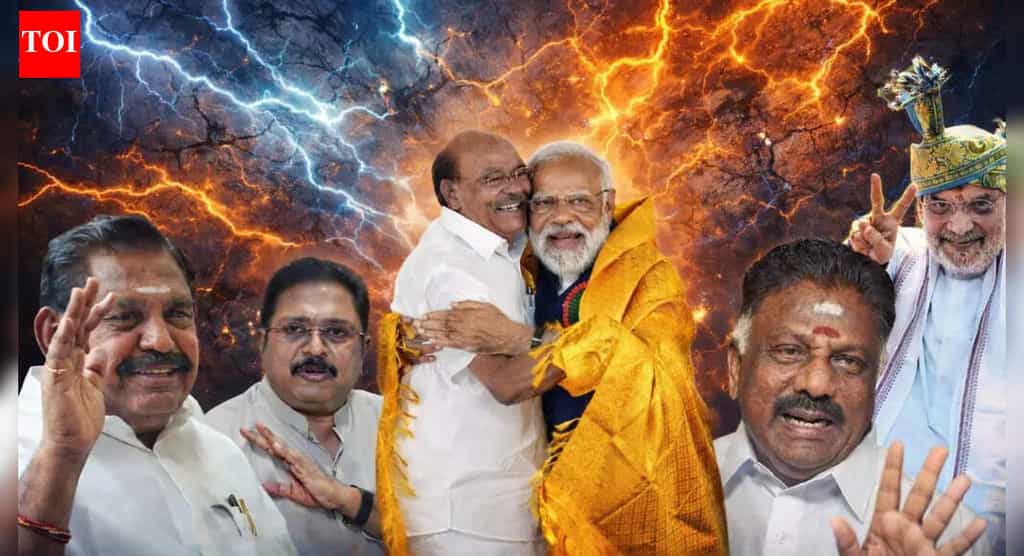
Late-night meetings in Delhi rarely make for calm politics, and the one that unfolded late evening last week between Union home minister Amit Shah and AIADMK general secretary Edappadi K Palaniswami, or EPS, was no exception. In optics, it was another routine round of koottani (alliance) discussions ahead of the 2026 Tamil Nadu Assembly elections. In substance, it revealed how the push for kattuppadu (control) was unsettling the alliance, exposing the deepest fault lines yet in the National Democratic Alliance’s (NDA) attempt to present a credible, unified challenge to the ruling Dravida Munnetra Kazhagam (DMK) government led by chief minister MK Stalin.At the heart of the tension lies a demand that goes beyond the usual arithmetic of seat-sharing. The
reportedly wants a formal power-sharing assurance from the AIADMK, including at least three cabinet berths if an AIADMK-led NDA were to form the next government.
For Tamil Nadu’s political culture, shaped by decades of Dravidian assertion and a strong emphasis on regional autonomy, such an explicit pre-election claim has few precedents.
The reaction within the AIADMK has been wary, if not outright resistant, as the BJP’s clout in the South remains lean.The pre-poll power-sharing deal, however, is only one strand in a much larger and more byzantine political development. With just months to go before the 2026 polls, Tamil Nadu’s political field is unusually crowded and unsettled. The NDA is trying to stitch together a fragmented anti-DMK vote; the DMK is defending its record amid murmurs of alliance unease with the Congress, while actor-turned-politician Vijay has injected a new variable through his fledgling but closely watched Tamilaga Vettri Kazhagam (TVK).
The result is a state on the cusp of a multi-cornered contest, where perception may matter as much as numbers.The BJP’s calculusFor the BJP, Tamil Nadu remains the most challenging large state on the electoral map. Despite steady organisational work over the past decade and a growing vote share, the party has not yet translated presence into power. Its alliance with the AIADMK has therefore always been more than tactical and is seen in Delhi as the primary vehicle for relevance in the southern state.
However, the current BJP strategy, curated mainly by Amit Shah, reflects this urgency.
BJP has consistently maintained that merely contesting a limited number of seats as a junior partner no longer serves the long-term interests of the party. The proposal that the BJP and its own allies together contest around 56 of the state’s 234 assembly seats is part of this thinking.More striking, however, is the reported insistence on cabinet representation, a move intended to signal to cadres and voters alike that the BJP is not just supporting an AIADMK government but would be a stakeholder in governance.
This push has coincided with a renewed effort by Shah and the central leadership to rebuild a broader NDA in the state. Former allies and breakaway factions are being courted again, including leaders who left the alliance last year. The BJP believes that consolidating these forces is essential to prevent vote-splitting that could once again hand the DMK an advantage.Yet, this centralised approach has also revived old anxieties.
In Tamil Nadu, where electoral narratives are often framed around resistance to “Delhi control”, any perception that the BJP is dictating terms risks becoming a political liability rather than an asset for the AIADMK.Alliance arithmetic vs identity politicsFor the AIADMK, the alliance question is as much about survival as it is about strategy. Since the death of J Jayalalithaa, or Amma as she was popularly known, the party has struggled to regain the dominance it once enjoyed. In the 2016 elections, the AIADMK under Jayalalithaa had emerged victorious with 136 seats.The AIADMK-led alliance, in the 2021 state polls, which were fought in the absence of Amma, won 75 seats, of which the AIADMK itself secured 66, while the DMK-led front swept to power with 159 seats. The verdict underlined both the AIADMK’s residual strength and the scale of the challenge ahead.
After the 2021 assembly defeat, EPS moved decisively to consolidate control over the AIADMK, marginalising rivals and asserting himself as the party’s sole authority.
This process effectively pushed out O Panneerselvam (OPS), once a key face of the party and a former chief minister. The EPS–OPS split was not just a leadership clash but a symptom of the AIADMK’s post-Jayalalithaa identity crisis.Palaniswami argued that a single centre of authority was essential for electoral recovery, while Panneerselvam continued to claim legitimacy through loyalty to Jayalalithaa’s legacy and sympathy among sections of the cadre.
EPS emerged stronger within the party, but the split narrowed the AIADMK’s social and political reach at a time when it could least afford division.EPS vs OPS dilemma for BJPFor the BJP, this internal fracture has been an enduring source of discomfort. The party has viewed Panneerselvam as more approachable and politically expendable, someone who could be accommodated without threatening the alliance’s structure. Palaniswami, by contrast, has been guarded and transactional, keen to keep both the BJP and expelled leaders at arm’s length to protect his authority and the party’s regional identity.
This has left the BJP caught between competing compulsions: it cannot ignore EPS without risking the alliance, but it also hesitates to shut the door on OPS, whose limited yet specific influence could matter in a tight contest. The result has been an uneasy balancing act, one that reflects the BJP’s broader struggle to manage Tamil Nadu politics without appearing overbearing.
Against this backdrop, Palaniswami’s reluctance to commit publicly to power-sharing with the BJP is rooted in political instinct. The AIADMK is also cautious about re-inducting expelled leaders and rival factions like the Amma Makkal Munnetra Kazhagam (AMMK). The AMMK did not win seats but polled enough votes in several regions to dent the AIADMK’s prospects, particularly in the southern and delta districts. This residual vote base, drawn mainly from sections of the Thevar community and AIADMK loyalists disillusioned with the current leadership, makes the AMMK less a kingmaker and more a potential spoiler.
For the BJP, bringing Dhinakaran back into the NDA is about preventing further fragmentation of the anti-DMK vote rather than expecting direct seat gains.While the BJP sees figures like O Panneerselvam and TTV Dhinakaran’s AMMK as assets who can consolidate specific caste and regional vote banks, Palaniswami views their return as a threat to internal cohesion and his own authority.
PMK a boon or bane?The re-entry of the Pattali Makkal Katchi (PMK) into the NDA has given the alliance a symbolic boost, but not without complications.
Anbumani Ramadoss’s decision to align with the AIADMK-BJP front was meant to strengthen the NDA’s presence in northern Tamil Nadu, where the PMK traditionally draws support from the Vanniyar community. Though this adds social breadth to the coalition at a time when consolidation is critical, the PMK is far from united.
The sharp and public rift between Anbumani and his father, party founder S Ramadoss, has fractured the cadre and weakened the party’s ability to transfer votes as a bloc.
Rival claims over leadership and legitimacy have created confusion at the grassroots, blunting what was once the PMK’s core electoral strength.For the NDA, the PMK’s return improves optics but not certainty. Without internal cohesion, the party risks becoming an unreliable ally rather than a decisive force against the DMK in 2026.DMK’s quest to quell anti-incumbencyFor the DMK, the turbulence within the NDA offers both opportunity and warning. The party’s sweeping victory in 2021, when it returned to power after a decade in opposition, was built on a broad coalition that included the Congress and several regional players.
Since then, the government has focused on welfare schemes, social justice narratives, Tamil identity and language. However, incumbency carries its own risks. There are murmurs of unease within the DMK-led alliance, particularly the Congress seeking greater seat shares or a more visible role post the 2024 Lok Sabha elections.While these strains are far from a rupture, they are being closely watched by rivals eager to exploit any cracks. The DMK leadership, which is slowly transitioning from MK Stalin to
, is also conscious that a fragmented opposition could paradoxically complicate its task.
A three- or four-cornered contest may lower the winning threshold in individual constituencies, but it also introduces unpredictability. The party’s messaging has therefore doubled down on stability, contrasting its governance record with what it portrays as an unstable and opportunistic opposition camp.The Vijay factor: A promise or perception?Perhaps the most intriguing element in the current churn is the emergence of Vijay as a political actor.
His TVK has yet to contest a major election, but its entry has already altered calculations across the spectrum.Vijay’s appeal cuts across age groups, with particular resonance among younger voters and sections disillusioned with established parties.
His carefully calibrated stance, critical of both the BJP and the DMK, positions the TVK as an alternative rather than an adjunct. This has attracted exploratory overtures from leaders sidelined within traditional formations, adding to the sense of flux.At the same time, the TVK’s strengths remain largely potential rather than proven. Organisational depth, booth-level machinery, and the ability to translate popular enthusiasm into votes are tests that only an election can provide. For now, Vijay’s presence serves as a wildcard, expectedly capable of influencing outcomes even if it falls short of forming a government.Between the numbersTamil Nadu’s recent electoral history offers important context.
In 2016, the AIADMK won 136 seats with around 41 per cent of the vote, while the DMK secured 98 seats with just under 40 per cent. The narrow margin reflected how small shifts in alliances and turnout can have outsized effects.Five years later, in 2021, the pendulum swung decisively. The DMK-led alliance polled close to 46 per cent and won 159 seats, while the AIADMK alliance’s vote share dipped to around 39 per cent, translating into 75 seats.
The BJP, contesting as an ally, won four seats and improved its vote share, but remained dependent on the larger Dravidian partner.
These figures highlight two enduring truths. First, alliances matter enormously in Tamil Nadu’s first-past-the-post system. Second, no single party, outside of peak DMK or AIADMK waves, can easily dominate without a broad coalition.The evolving battleAs the state heads towards the 2026 elections, the political picture remains fluid.
The BJP is betting that a reconstituted NDA, bolstered by returning allies and clearer power-sharing signals, can present itself as a viable alternative. The AIADMK is trying to balance that partnership with its need to project independence and reassure its core electorate. The DMK is defending its turf while watching for signs of opposition consolidation. And Vijay’s TVK is carving out space in a crowded field, its final impact yet to be measured.What is clear is that Tamil Nadu’s politics is entering a phase where old certainties no longer apply automatically. The familiar binary of DMK versus AIADMK is giving way to a more layered contest, shaped by national ambitions, regional identities, and the aspirations of a new generation of voters.Whether the NDA’s current troubles are a prelude to a stronger, more coherent front, or a symptom of deeper contradictions, will become evident only as alliances crystallise and campaigns take shape. For now, the state watches as negotiations continue behind closed doors, aware that in Tamil Nadu, the path to power is rarely straightforward and often decided as much by perception as by pact.
Editorial Context & Insight
Original analysis and synthesis with multi-source verification
Methodology
This article includes original analysis and synthesis from our editorial team, cross-referenced with multiple primary sources to ensure depth, accuracy, and balanced perspective. All claims are fact-checked and verified before publication.
Primary Source
Verified Source
Times of India
Editorial Team
Senior Editor
Dr. Elena Rodriguez
Specializes in India coverage
Quality Assurance
Associate Editor
Fact-checking and editorial standards compliance