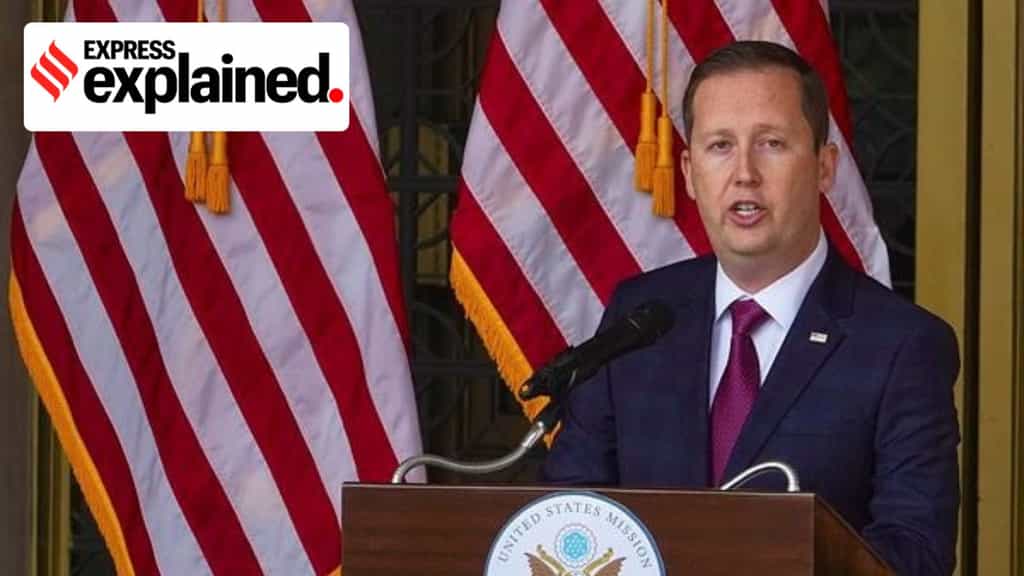
Amid anticipation that India and the US are close to signing the first phase of the long-awaited trade deal, the newly appointed US Ambassador Sergio Gor on Monday said that the “next call” on trade between the two countries is set to happen on January 13. Gor also invited India to the Pax Silica initiative, a month after leaving New Delhi out of the US-led initiative, indicating a softening in tensions between the two countries.
Pax Silica is a US-led initiative focused on securing AI and tech supply chains, aimed at bringing “friendly and trusted” countries together to ensure that key technologies are safe, reliable, and not controlled by hostile play, according to the US State Department.
The strategic initiative, seen as a counter to China’s grip on the global manufacturing supply chain, was launched on December 12 to “reduce coercive dependencies” and build a “secure, prosperous, and innovation-driven silicon supply chain” – from critical minerals and energy inputs to advanced manufacturing, semiconductors, AI infrastructure, and logistics.
However, Washington surprisingly left India out of the initiative that found mention of “allies” such as Japan, the Republic of Korea, Singapore, the Netherlands, the United Kingdom, Israel, the United Arab Emirates and Australia, giving way to concerns that uncertainty around the trade deal is creating broader differences between the two countries. Later in December, India extended a formal invitation to China to join its Artificial Intelligence (AI) Impact Summit in February.
“Many of you have asked me for an update on the ongoing trade deal negotiations. Both sides continue to actively engage. In fact, the next call on trade will occur tomorrow [January 13]. Remember, India is the world’s largest nation, so it’s not an easy task to get this across the finish line, but we are determined to get there,” Gor said at the US Embassy here.
“And while trade is very important for our relationship, we will continue to work closely together on other very important areas…such as security, counterterrorism, energy, technology, education and health. …. Today, I’m pleased to announce that India will be invited to join this group of nations as a full member next month,” the ambassador said.
The West’s scepticism of China’s grip on the manufacturing supply chain had triggered global multinational companies to pursue a China-plus-one strategy since the COVID-19 disruption. The US has been engaged in a trade war with China to decouple due to the widening trade gap, and India has been positioning itself to get a share of the manufacturing supply chain shift.
Experts said that the countries that are part of the US-led initiative are among the top in terms of AI and semiconductor supply chain, and should be a part of such an initiative, as measures under Pax Silica include “pursuing new joint ventures and strategic co-investment opportunities”. India currently lacks a global-scale AI infrastructure and stands to gain from the likely investments and partnerships under the initiative.
The US State Department said that the initiative will also entail protecting sensitive technologies and critical infrastructure from undue access or control by countries of concern and building trusted technology ecosystems, including Information and Communication Technology (ICT) systems, fibre-optic cables, data centres, foundational models and applications. India has had concerns over China’s involvement in India’s critical infrastructure, such as telecom.
“The initiative responds to growing demand from partners to deepen economic and technology cooperation with the United States and understanding that AI represents a transformative force for our long-term prosperity. Recognition that trustworthy systems are essential for safeguarding our mutual security and prosperity,” the US State Department said.
India’s presence in Pax Silica could help New Delhi’s growth in technology-heavy sectors, which it currently lacks, deepening its import dependency. Experts said that the countries that are part of the US-led initiative are among the top in terms of AI and semiconductor supply chain.
Researchers have noted that the countries being roped in for the initiative are among the top countries in the domains of AI and semiconductor supply chains. The US, for instance, leads in design and IP for the semiconductor chips, and the Netherlands is essential for the lithography machines, which are used for printing chips.
“We also recognise that artificial intelligence (AI) represents a transformative force for our long-term prosperity and that trustworthy systems are essential to safeguarding our mutual security and prosperity. We believe that economic value and growth will flow through and across all levels of the global AI supply chain, driving historic opportunity and demand for energy, critical minerals, manufacturing, technological hardware, infrastructure, and new markets not yet invented,” the US State Department said.
India’s entry in Pax Silica comes with considerable investments committed by US companies in Indian AI infrastructure in December alone. Last month, Microsoft announced plans to spend $17.5 billion to expand its AI infrastructure and cloud computing capacity in India over the next four years. The investment, its largest in Asia, comes on top of the $3 billion announced by the tech giant earlier this year, with Microsoft clarifying that it is on track to spend that amount by the end of 2026.
Last month, Google also announced investments worth over $15 billion over five years to establish an artificial intelligence (AI) data centre in Andhra Pradesh, in what would be its biggest investment yet in the country. The tech giant has partnered with the Adani Group and Airtel to build the infrastructure for the project, which also includes the construction of a new international subsea gateway. In a blog post, Google said the data centre will create “substantial economic and societal opportunities for both India and the United States”.
Editorial Context & Insight
Original analysis and synthesis with multi-source verification
Methodology
This article includes original analysis and synthesis from our editorial team, cross-referenced with multiple primary sources to ensure depth, accuracy, and balanced perspective. All claims are fact-checked and verified before publication.
Primary Source
Verified Source
The Indian Express
Editorial Team
Senior Editor
Dr. Elena Rodriguez
Specializes in India coverage
Quality Assurance
Senior Reviewer
Fact-checking and editorial standards compliance