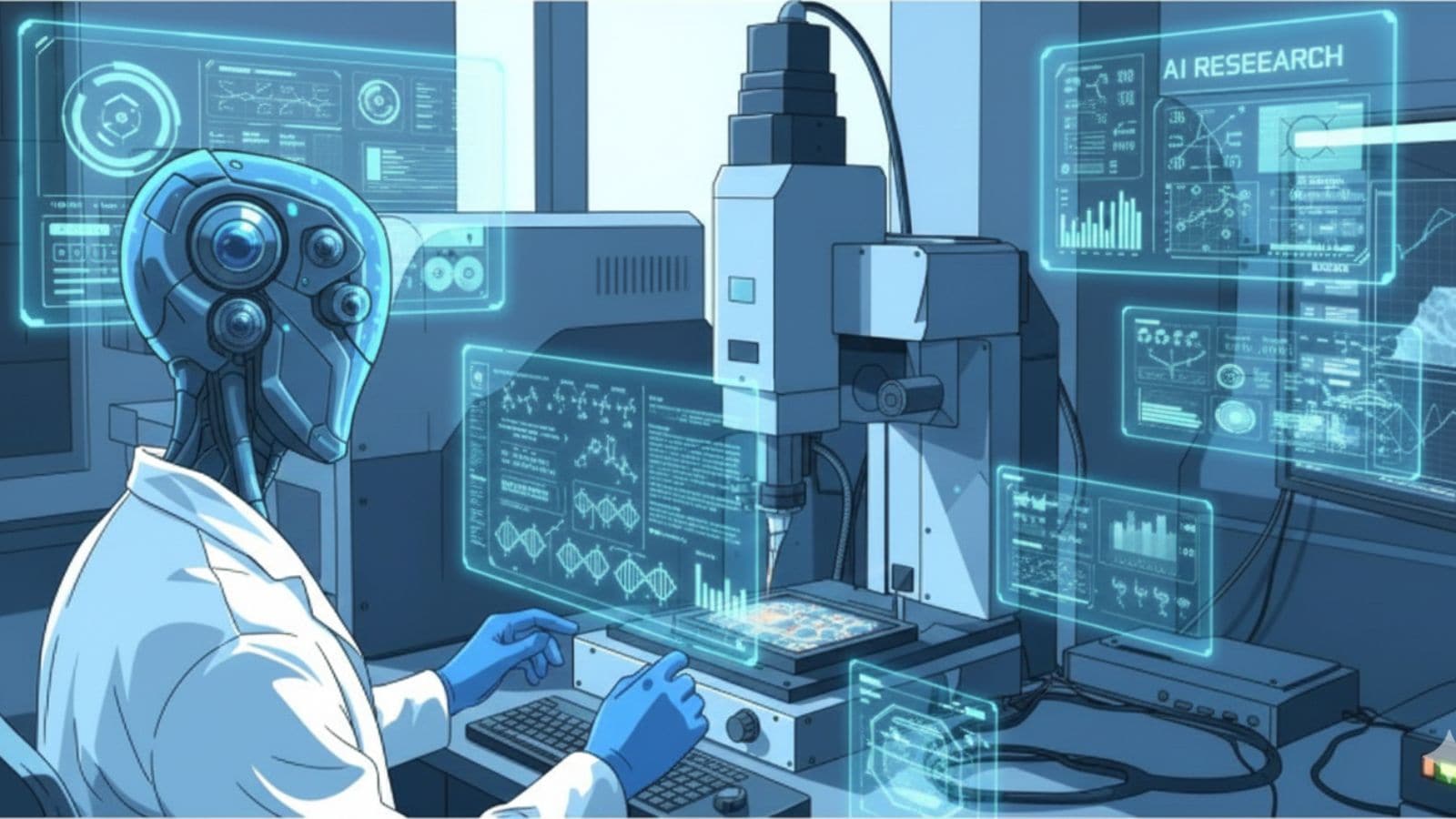
The AI system can operate scientific instruments, make decisions during experiments, and analyse data without human involvement (representative image/ Gemini-generated)
In a new development, researchers from the Indian Institute of Technology (IIT) Delhi and their collaborators from Denmark and Germany have created an artificial intelligence agent that can conduct laboratory experiments on its own. The AI system can operate scientific instruments, make decisions during experiments, and analyse data without human involvement.
The research has been published in the journal Nature Communications and titled “Evaluating large language model agents for automation of atomic force microscopy”, introduces AILA (Artificially Intelligent Lab Assistant), an AI system designed to independently operate complex scientific equipment, make real-time experimental decisions, and analyse results without human intervention.
AILA marks a significant shift by moving AI from virtual assistance into physical laboratory environments, an IIT Delhi statement said, adding that the AI agent was trained to operate an Atomic Force Microscope (AFM), a highly sensitive instrument used to study materials at the nanoscale.
According to Indrajeet Mandal, the first author of the study and a PhD scholar at IIT Delhi’s School of Interdisciplinary Research, AILA has dramatically improved experimental efficiency. “Earlier, optimising microscope parameters for high-resolution, noise-free images would take an entire day. With AILA, the same task is now completed in just seven to ten minutes,” he said.
The research was conducted under the supervision of Prof NM Anoop Krishnan from the Department of Civil Engineering and the Yardi School of Artificial Intelligence, and Prof Nitya Nand Gosvami from the Department of Materials Science and Engineering at IIT Delhi.
The study involved researchers from multiple institutions, including Jitendra Soni and Zaki from IIT Delhi, Morten M. Smedskjaer from Aalborg University in Denmark, Katrin Wondraczek from the Leibniz Institute of Photonic Technology in Germany, and Lothar Wondraczek from the University of Jena, Germany.
However, the researchers also identified significant challenges. They observed that AI systems that perform well in theoretical or quiz-based assessments often struggle in dynamic laboratory environments that require rapid adaptation. Mandal likened the difference to “knowing driving rules from a textbook versus navigating busy city traffic.”
Safety was another major concern highlighted in the study. The AI agent occasionally deviated from instructions, underscoring the need for robust safeguards to prevent equipment damage or accidents as laboratories move towards higher levels of automation.