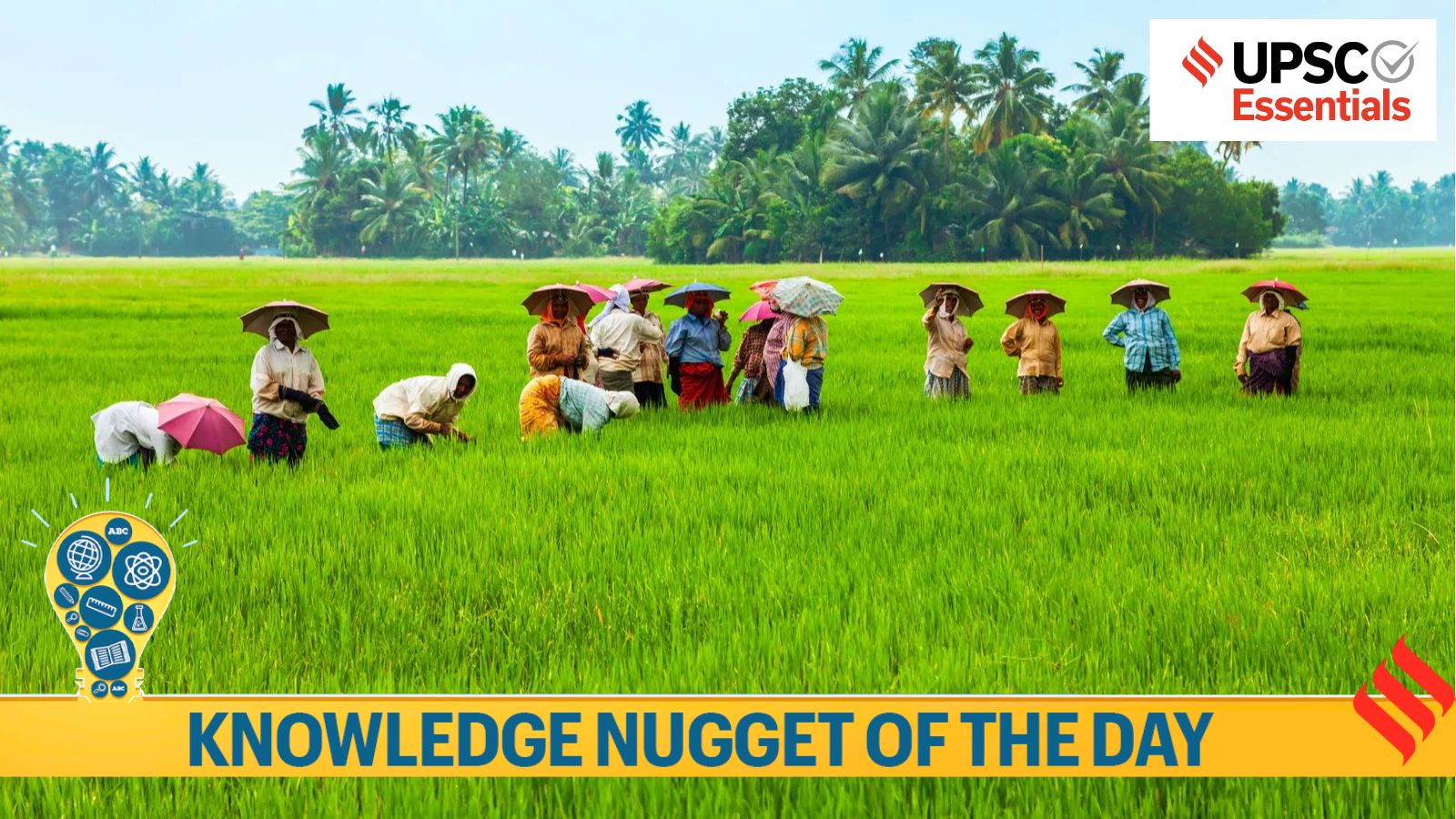
Take a look at the essential events, concepts, terms, quotes, or phenomena every day and brush up your knowledge. Here’s your UPSC Current Affairs knowledge nugget for today on National Farmers’ Day and Sustainable Agriculture.
National Farmers Day, also known as Kisan Diwas, is celebrated on December 23 every year. It is an important observance in India that honours farmers as the backbone of the nation. Indian farmers are revered as ‘annadaataa’, which means ‘giver of food’ in Sanskrit, making them an invaluable source for the country’s growth, economy, and prosperity.
In the context where a number of issues, such as climate change, environmental sustainability, and food security, accelerate the transition to sustainable agriculture, let’s know about sustainable agriculture and its methods.
1. Sustainable agriculture is a system of farming that focuses on meeting the current production demands without compromising on the ability of future generations to meet their needs. It takes into account the aspects related to ecological stability, economic viability, and socio-cultural continuity while preserving natural resources for future generations.
2. Sustainable agriculture is at the centre of India’s economic policy and plays a crucial role in combating climate change by achieving net-zero emissions by 2070.
1. Organic farming: It is a vital aspect of sustainable agriculture that emphasises ecological balance and the use of natural inputs for production. It obliterates the usage of synthetic fertilisers and pesticides thereby promoting soil health. It involves practices like crop rotation and the application of organic fertilisers like manure and compost.
— Organic farming is not only an environmentally sustainable method of agricultural production but also reduces pollution and health risks associated with chemical inputs while supporting rural livelihoods.
— However, agricultural productivity is sometimes a point of concern here. Yields are often lower in organic farming in comparison to conventional methods, however, the long-term benefits of improved soil fertility, reduced environmental impact, and enhanced resilience make organic farming a crucial component of sustainable agricultural practices.
2. Agroforestry: It is the practice of integrating trees into agricultural landscapes, including crop or animal production systems, thereby creating a diverse and resilient farming system. This approach plays an important role in promoting sustainable agriculture by promoting ecological, economic, and social interactions.
— It also helps in enhancing farmers’ incomes by supplementing the production of traditional crops with timber, fruits, and other tree-based products.
— Agroforestry also promotes biodiversity by providing habitats for various species, including beneficial insects that naturally control pests and diseases.
3. Zero tillage: Zero tillage, also known as no-till farming, is the practice of growing crops without disturbing the soil strata through traditional tillage methods. This approach preserves the soil structure and enhances fertility, resulting in numerous environmental and economic benefits.
— This system involves sowing seeds directly into the soil, often using specialised equipment that creates furrows without turning the soil. This method significantly reduces soil erosion and improves the water retention capacity of soil.
4. Integrated pest management (IPM): IPM is a critical component of sustainable agriculture that minimises the use of pesticides while effectively managing pests. IPM is an ecosystem-based approach that combines various techniques, including biological control, cultural practices, habitat modification, and judicious use of pesticides.
— IPM does not seek complete elimination of insect diversity. Instead, it seeks to keep the pest population below levels that may be economically damaging while preserving beneficial organisms and promoting a healthy balance in the ecosystem.
5. Crop rotation: It is the practice of systematically alternating different crops on the same land over successive seasons. This method significantly enhances soil health and fertility by breaking pest and disease cycles, and reducing reliance on chemical inputs.
6. Hydroponics: Hydroponics is the technique of growing plants in a nutrient enriched water medium, without the requirement of soil. This method is highly resource-efficient and requires significantly less water than traditional soil-based farming methods, aligning perfectly with sustainability goals.
— Since this method involves a controlled environmental setting, it significantly reduces the risk of land degradation due to overuse and further reduces the need for pesticides.
7. Aquaponics: It is another advanced technique that combines hydroponics with aquaculture. This is a symbiotic system in which the fish waste provides an organic nutrient source for the plants, while the plants help filter and purify the water for the fish.
8. Agrivoltaic farming: It is the process of producing crops under solar panels. This permits enough light and moisture to reach the crops while still enabling access to farm machinery.
— It grows crops in the shadowed region beneath the solar panels. This boosts land-use efficiency by allowing solar farms and agriculture to coexist rather than compete.
1. National Mission For Sustainable Agriculture (NMSA) is one of the eight missions outlined under the National Action Plan on Climate Change (NAPCC).
2. The NMSA aims at promoting sustainable agriculture through a series of adaptation measures focusing on ten key dimensions encompassing Indian agriculture, namely improved crop seeds, livestock and fish cultures, water use efficiency, pest management, improved farm practices, nutrient management, agricultural insurance, credit support, markets, access to information and livelihood diversification.
With reference to the agrivoltaic farming, consider the following statements: 1. It is the practice of growing crops underneath solar panels.
2. It decreases land-use efficiency.
3. All the crops can thrive when grown in such environments.
4. India has already implemented agri-voltaic farming on a large scale in the southern Indian states.
How many of the statements given above are correct?
🚨 Click Here to read the UPSC Essentials magazine for December 2025. Share your views and suggestions in the comment box or at manas.srivastava@indianexpress.com