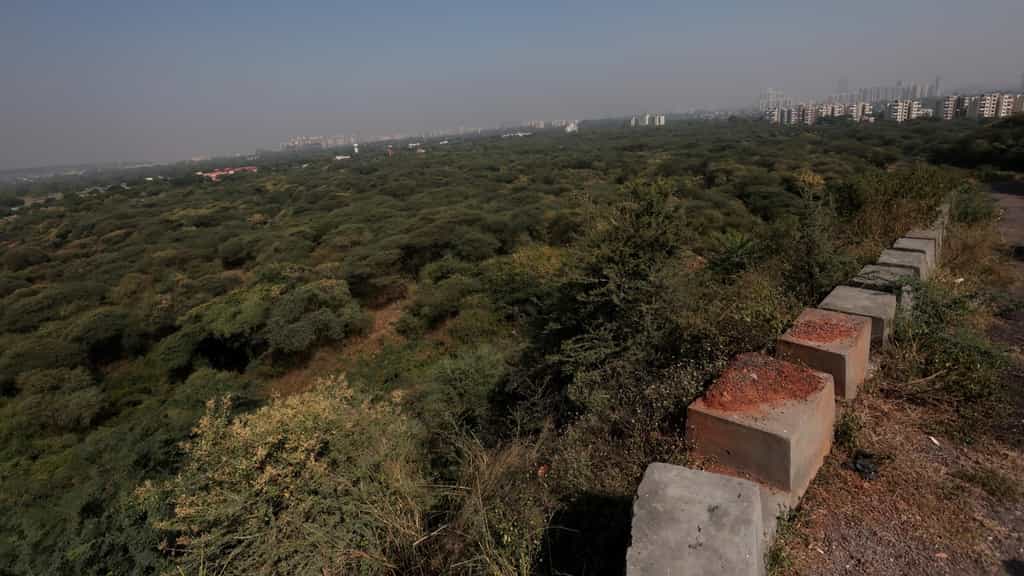
The findings come at a time when protection for the degrading Aravallis is under the spotlight, and a matter of examination in the Supreme Court. (Source: Express Archives)
The Aravalli landscape in Gurgaon’s southern areas has faced environmental degradation over the last decade, with shrinking forest and agricultural cover, a rise in built-up area, and loss of water bodies, a new pilot study has flagged. Four villages – Gairatpur Bas, Naurangpur, Sakatpur and Sikohpur – which are part of the Aravalli landscape in southern Haryana – were assessed through comprehensive baseline studies as part of an eco-restoration plan of not-for-profit Sankala Foundation and the Embassy of Denmark.
These villages are also home to nearly 40 bird species, besides the presence of leopards who use wildlife corridors passing through these areas, underscoring the biodiversity in the peri-urban ecosystem. The findings come at a time when protection for the degrading Aravallis is under the spotlight, and a matter of examination in the Supreme Court.
Bhupender Yadav, Minister for Environment, Forest and Climate Change, formally launched a report on Wednesday on the eco-restoration plan along with Rao Narbir Singh, Environment and Forest Minister, Haryana.
The findings of the baseline assessments will be used to implement local, landscape-specific eco-restoration works, including afforestation with native species, removal of invasive species, soil and moisture conservation, wildlife corridor management, and biodiversity monitoring over the next seven years.
Among the key changes in the environment, the study showed substantial land-use conversion over the past decade. Agricultural land has decreased by approximately 429 hectares, while forest area has shrunk by 114 hectares, the report showed. It was stated that this indicated sustained pressure on natural vegetation. “Barren land shows a modest increase of 22 hectares, whereas built-up area has expanded significantly by 323 hectares, reflecting rapid urbanisation in peri-urban Gurugram,” the report stated.
Minister Yadav said the Centre was focused on implementing the Aravalli Green Wall project, which seeks to restore and undertake greening in the degraded landscapes across 29 districts in the Aravallis from Gujarat to Haryana and Delhi.
The four villages and the landscape across them showed low presence of dense vegetation, as per the report. The rapid urbanisation was also showing an impact on heat stress. The areas recorded peak surface temperatures between 48 to 56 degree Celsius, which, the report said reinforced the need for vegetation buffers, soil moisture retention, and canopy enhancement.
Worryingly, water stress was also considerable. As per the findings, the area has suffered a 20 per cent loss of water bodies in the 2014-2024 period, with seven out of 41 ponds having disappeared. The report noted that encroachments and construction on natural drainage had altered run-off patterns, impacted groundwater availability, and increased water scarcity.
Ecological surveys done as part of the pilot documented 61 floral species across the project area, out of 134 species listed in the Haryana Working Plan 2024. Of these, 77 per cent were native species, while 20 per cent were classified as invasive-alien. Shrubs dominated the vegetation profile, followed by herbs and trees, reflecting forest degradation and altered structure.
Editorial Context & Insight
Original analysis and synthesis with multi-source verification
Methodology
This article includes original analysis and synthesis from our editorial team, cross-referenced with multiple primary sources to ensure depth, accuracy, and balanced perspective. All claims are fact-checked and verified before publication.
Primary Source
Verified Source
The Indian Express
Editorial Team
Senior Editor
Aisha Patel
Specializes in India coverage
Quality Assurance
Copy Chief
Fact-checking and editorial standards compliance