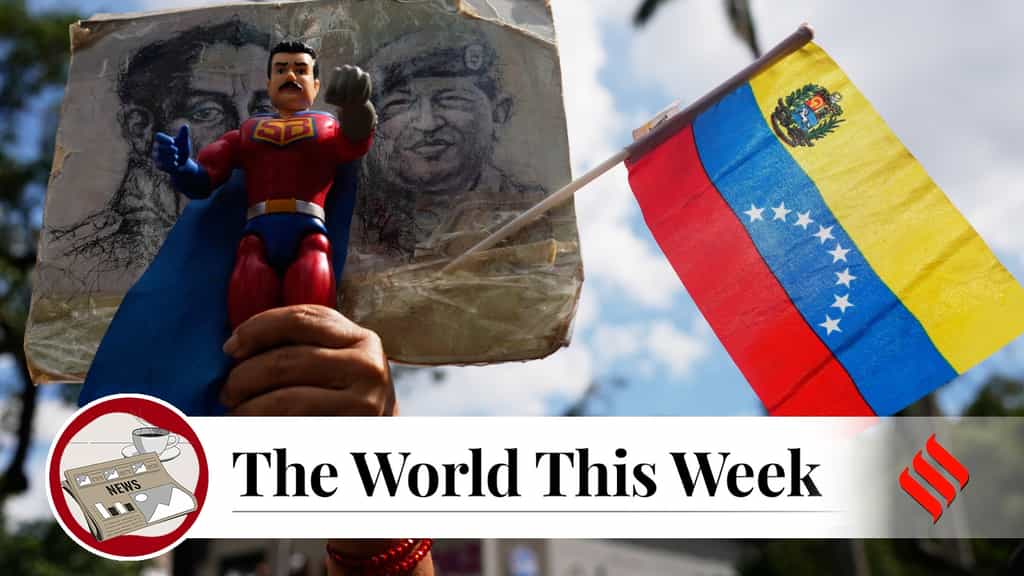
“Who/ where is next?” This is the question most of the world asked this week. That is because the United States gave the world an explosive start to the New Year, which no one was asking for, by capturing Nicolás Maduro, the sitting president of Venezuela, in a nighttime operation. The US has since hinted that it could launch similar operations in more countries. This week also saw NATO, the world’s largest and most powerful military alliance, being tested, with the US doubling down on its plans to acquire Greenland, even if that means a military invasion of another NATO member. Meanwhile, in Iran, the ongoing anti-regime protests are showing no signs of slowing down, and the long-exiled ‘crown prince’ is fast emerging as the next possible leader of the country.
January 3, 2026, will go down in history as the day the US launched one of its most daring military operations ever. Under Operation Absolute Resolve, the US military went into Venezuela and left with President Nicolás Maduro and his wife, all within three hours, which also effectively ended the Bolivarian Republic that was started by Hugo Chávez in 1999.
A government supporter holds a banner with a photo of President Nicolas Maduro during a protest demanding his release from U.S. custody in Caracas, Venezuela, Sunday, Jan. 4, 2026. (AP Photo/Ariana Cubillos)
Nicolás Maduro, who was captured by the US on January 3, was taken to New York. He is currently being held in federal custody at the Metropolitan Detention Center in Brooklyn, New York. Maduro will remain in custody until at least his next scheduled hearing on March 17, 2026. Maduro is being represented by defence attorney Barry Pollack, who is best known for successfully representing WikiLeaks founder Julian Assange.
Former Venezuelan Vice President Delcy Rodríguez was sworn in as interim president on January 5, following Maduro’s removal from power. The move came as a surprise to many, as most expected 2025 Nobel Peace Prize winner María Corina Machado or Edmundo González, the Opposition candidate, whom most of the world sees as the rightful winner of the 2024 general elections, to take over the country.
FILE – Venezuelan Vice President Delcy Rodriguez smiles during a press conference at the Miraflores presidential palace in Caracas Venezuela, Nov. 18, 2024. (AP Photo/Ariana Cubillos, File)
What is the US doing in Venezuela?
The US has outlined a three-step strategy for the transition of Venezuela, but no date has been set for it to be completed. Donald Trump, who made it clear that the US is not afraid to put boots on the ground, said Washington will run Venezuela for a transitional period and exert indefinite control over its oil sales. The US will sell Venezuelan crude oil that was previously under blockade, and the proceeds from it will be placed into US-controlled bank accounts. These funds are intended to be used for rebuilding Venezuela’s infrastructure and reimbursing US costs, at the discretion of Washington.
A macaw stands on a decorative oil drill in Caracas, Venezuela, Tuesday, Jan. 6, 2026. (AP Photo/Matias Delacroix)
The abduction/ capture of the sitting head of a country by the US has sent shockwaves across the world, particularly in countries that are currently at odds with Washington. Many have also asked where the US could launch a similar operation. Here are some of the countries that could be on the list: North Korea (though there were no immediate threats, after the capture of Maduro, North Korea fired ballistic missiles as a ‘justified response’)
On January 3, shortly after the capture of Nicolás Maduro, Katie Miller, the wife of White House Deputy Chief of Staff Stephen Miller, posted an image on X showing a map of Greenland draped in the American flag with the caption “SOON”, reigniting the controversy over the possible US acquisition of the autonomous territory of Denmark. The Trump administration has insisted that the US “needs” Greenland for national security and defence, and has refused to rule out the use of force.
FILE – A woman walks near a church in Nuuk, Greenland, on March 7, 2025. (AP Photo/Evgeniy Maloletka, File)
Greenland’s Prime Minister Jens-Frederik Nielsen and Denmark’s Prime Minister Mette Frederiksen have repeatedly made it clear that the world’s largest island is not up for sale and has no plans to become a part of the US.
Trump’s threat to use military force to acquire Greenland has put the North Atlantic Treaty Organization (NATO) in an awkward position, as both the US and Denmark are founding members of the organisation.
According to NATO’s collective defence principle, enshrined in Article 5 of the North Atlantic Treaty, an attack on one member is an attack on all, and other members are obliged to assist the attacked country. It has only been used once, in 2001, following the 9/11 terror attack on the US.
If the US invades Denmark, it will put a NATO member against another. Danish Prime Minister Frederiksen said an attempted US military takeover of Greenland would lead to the end of NATO and the collapse of the post-WWII security architecture.
Jared Kushner, second left, US Special Envoy Steve Witkoff, left, and NATO Secretary General Mark Rutte, right, arrive for a meeting of the Coalition of the Willing at the Elysee Palace in Paris, France, Tuesday, Jan.6, 2026. (Yoan Valat, Pool photo via AP)
European countries like France, Germany, Poland, and the UK have expressed firm solidarity with Denmark over Greenland.
Reuters reported that the US is even considering buying support from Greenlanders by paying figures ranging from $10,000 to $1,00,000 per person.
The US on Wednesday (January 7) intercepted and captured two sanctioned Russia-linked oil tankers. The first ship, now called Marinera, was seized off the coast of Iceland while attempting to flee the US Navy blockade of Venezuela.
The vessel tanker Bella 1 at Singapore Strait, after US officials say the U.S. Coast Guard pursued an oil tanker in international waters near Venezuela. (Reuters Photo)
The 333-metre-long crude oil tanker, originally called Bella 1, was sanctioned in 2024 for transporting illicit oil from Iran and weapons for Hezbollah. Marinera was flying a Russian flag when it was captured, making it the first Russian vessel to be seized by the US. On the other hand, the second tanker, the M/T Sophia, which was seized by the US in the Caribbean Sea, was described as a ‘stateless or Panama-flagged vessel’.
The protests across Iran, which were triggered by an economic crisis and the Iranian rial hitting a record low of 1.45 million to the US dollar is well into the second week. The protests began on December 28 in Tehran’s Grand Bazaar and have since spread to over 111 cities and all 31 provinces. At least 42 people have been killed, and more than 2,270 people have been detained as the Iranian authorities try to crack down on the demonstrations that are turning out to be one of the biggest the country has seen in years.
People in Tehran walk past a display sign at a currency exchange bureau as the value of the Iranian rial drops (Photo: Reuters)
The protests come at a time when the government of President Masoud Pezeshkian and Ayatollah Ali Khamenei, the Supreme Leader of Iran, are still on the backfoot following the 12-day war with Israel and the US strikes that targeted the Islamic Republic’s nuclear weapons capabilities.
Though protests are not new in Iran, this time, things are looking different, with the anger being directed at the Ayatollah and his theocratic administration, which has been in power since the 1979 Islamic Revolution.
Iran’s Supreme Leader Ayatollah Ali Khamenei blasted protesters in a speech aired Friday. (Source: Express Archives)
Ali Khamenei is 86 years old, and his advanced age and health have been a growing concern for his inner circle. There were also reports that he was planning to flee to Russia if the ongoing protests reached his doorstep.
Ali Khamenei’s potential successor, former president Ebrahim Raisi, was killed in a 2024 helicopter crash. This has left Mojtaba Khamenei, the second son of Ali Khamenei, and Hassan Khomeini, the grandson of the Islamic Republic’s founder, Ruhollah Khomeini, as the favourites to succeed him.
But protesters on the street are calling for the return of Reza Pahlavi, the ‘crown prince’ of Iran, who was exiled in 1979 following the Islamic Revolution.
Reza Pahlavi, the exiled son of the last Shah of Iran, speaks during a press conference about the situation in Iran and the need to support Iranians, in Paris, France, June 23, 2025. REUTERS/Abdul Saboor
Reza Pahlavi, the son of Mohammad Reza Pahlavi, the last Shah of Iran, has been living in exile in the US and in recent days become the de facto leader figure of the protests that had been without a face so far. Reza Pahlavi has made it clear that he is ready to return to Iran and lead a transitional government, if the protesters force regime change in Tehran.
Send your feedback and ideas to bobins.abraham@indianexpress.com
🚨 Click Here to read the UPSC Essentials magazine for December 2025. Share your views and suggestions in the comment box or at manas.srivastava@indianexpress.com🚨
Editorial Context & Insight
Original analysis & verification
Methodology
This article includes original analysis and synthesis from our editorial team, cross-referenced with primary sources to ensure depth and accuracy.
Primary Source
The Indian Express