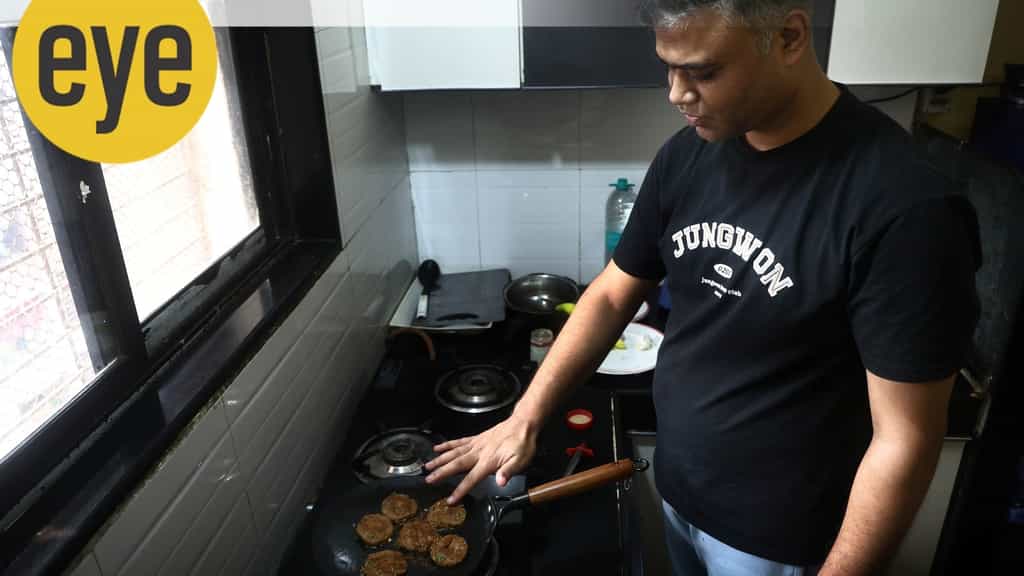
In his two-bedroom apartment in Kurla West, chef Sarfaraz Ahmed transports both himself and this writer back to his childhood in Chotta Shimla as he prepares vegetarian shami kebabs. The kitchen fills with the aroma of warm spices as he works methodically, shaping the kebabs while narrating the story behind the dish.
The recipe, he explains, was born out of his mother’s culinary experimentation. “My mother grew up in Kanpur, in a household where mornings began with biryani and nihari, where vegetables were cooked only with gosht and always as curries,” he says. Marriage brought her to Himachal Pradesh, into a largely vegetarian family that ate non-vegetarian food just once a week.
Naturally, adapting to her in-laws’ food habits wasn’t easy. “She missed those flavours,” says Ahmed, “So she recreated them.” Meat was replaced with soybean chunks and chana dal. As he speaks, he folds chopped onions and coriander into the boiled and mashed kebab dough, followed by two house-made spice blends — one fragrant with javitri and elaichi, the other fiery, made from whole spices. The kebabs hit a ghee-slicked tawa, sizzling gently. Meanwhile, paranthas are being warmed on another pan. “This combination was one of my most popular school lunches,” says the 37-year-old chef, “My classmates would polish off my lunchbox in no time.”
Today, Ahmed is the Corporate Chef, India, for Passion F&B — the parent company behind restaurants such as Tresind Studio, Tresind, Carnival by Tresind and Avatara that have outlets in the Middle East as well. But growing up, his career choices were limited to a few familiar options. “It was either the army, the police force or hotel management,” he says.
The idea of becoming a chef crystallised when he came across a magazine interview of chef Bakshish Dean, a family friend whom he and his siblings affectionately called chachu. “I was fascinated by the glamour of that life,” he recalls. By the time he finished Class XII, he was determined to be a chef.
That resolve was tested early. Around the same time, the family was facing financial difficulties. “My brother had to start working very young. My father wasn’t sure how we would manage the fees,” Ahmed says. It was Ahmed who suggested taking a loan so he could enrol at IHM Lucknow.
By the time campus placements came around three years later, he was confident—wasn’t chachu going to get him a job? It was a miscalculation. “This was soon after the 2008 terror attacks. Jobs were scarce, competition was intense, and I failed the final round of every interview,” he recalls.
Needing an income, Ahmed enrolled in a two-month Certified Hospitality Training Programme that paid Rs 10,000 a month and offered a pathway into teaching. “It didn’t seem like a bad idea,” he says. But two months later, he returned to Plan A.
He applied for a commis position at The Park Hotel in New Delhi and was selected. Two years later, when The Leela Chanakyapuri opened Le Cirque, he applied. “Twenty to twenty-five commis were competing for one position.” He made the cut, and the experience proved formative.
At The Leela, Ahmed set his sights on the group’s leadership development programme — an intensely competitive track that fast-tracks chefs into leadership roles. He was rejected twice. The third attempt would be his last.
“It’s like the IAS for chefs,” he explains. This time, he worked on his communication and personality skills and refined his cooking. Luck intervened too. “Just before my final interview, I read about a flight that had made an emergency landing that morning. When they asked me about current affairs, I had all the answers.” He was selected and sent to Leela Bengaluru.
The following 15 months were exhausting and enriching in equal measure. The financial strain, however, was severe. “My salary dropped from Rs 22,000 to Rs 14,000 because I went from a permanent employee to a trainee. I had a loan to repay, and we were required to make detailed presentations —laptops were essential.” He shared one with his roommate. “We worked from 6 am to 11 pm. He used the laptop from 11 pm to 1 am. I woke up at 1 am, worked till 3 am, then slept for two hours,” says Ahmed. When the programme ended, he was offered a role at Leela Kovalam, managing one of the restaurants. Three years later came a phone call that, he says, changed everything. It was from chef Himanshu Saini.
“I had received a call from Passion F&B in 2014, but I was still in training and couldn’t accept it. Also, back then, hotels held far more prestige than independent restaurants,” he says. “By 2017, that had changed. I couldn’t say no.” Ahmed moved to Kuwait to help launch Tresind. Two years later, he was asked to move to Mumbai to helm Tresind Mumbai. Initially, menu development was collaborative. “Either I would fly to Dubai or chef Himanshu would come to Mumbai. But since 2023, I’ve been doing it independently.” There’s pride in his voice, tempered by respect.
One of Ahmed’s proudest moments came during a recent visit to Tresind Studio, when Saini asked him to sign the restaurant’s iconic panda painting — signed by chefs he considers industry greats. “It was something I’ll never forget.”
At Tresind, Ahmed’s menus reflect both ambition and memory — dishes like coastal lobster paired with a rich tomato and shellfish curry and Pazham Pori, a polished reinterpretation of Kerala’s banana fritters, transformed into a dessert served with hazelnut and dark chocolate ice cream.
Back in his Kurla kitchen, the kebabs are ready. The paranthas are golden. For a moment, the corporate titles and international kitchens fall away. What remains is a plate of food shaped by nostalgia, resilience and a long, determined climb.
Veg Shami kebabs
1. In a pressure cooker, combine the soya chunks, soaked chana dal, ginger-garlic paste, roughly chopped onion, and all whole spices with about 1.5–2 cups of water
- Cook until the chunks and dal are completely done. Once done, sauté on high heat until all excess water evaporates. The mixture must be dry
- Remove large whole spices (like cinnamon and bay leaf). Grind the cooled mixture into a fine, smooth paste
- Mix in the finely chopped onions, green chillies, coriander, and mint. If the mixture is too soft add roasted chana powder to bind. Add garam masala and rest it for 15 min
- Divide the mix into small balls and shape the mixture into round, flat patties
- Heat ghee on a heavy-based tawa. Shallow fry the kebabs on medium-low heat until they develop a dark, crispy brown crust on both sides
- Serve with mint chutney. Lemon and onion on side
Editorial Context & Insight
Original analysis & verification
Methodology
This article includes original analysis and synthesis from our editorial team, cross-referenced with primary sources to ensure depth and accuracy.
Primary Source
The Indian Express