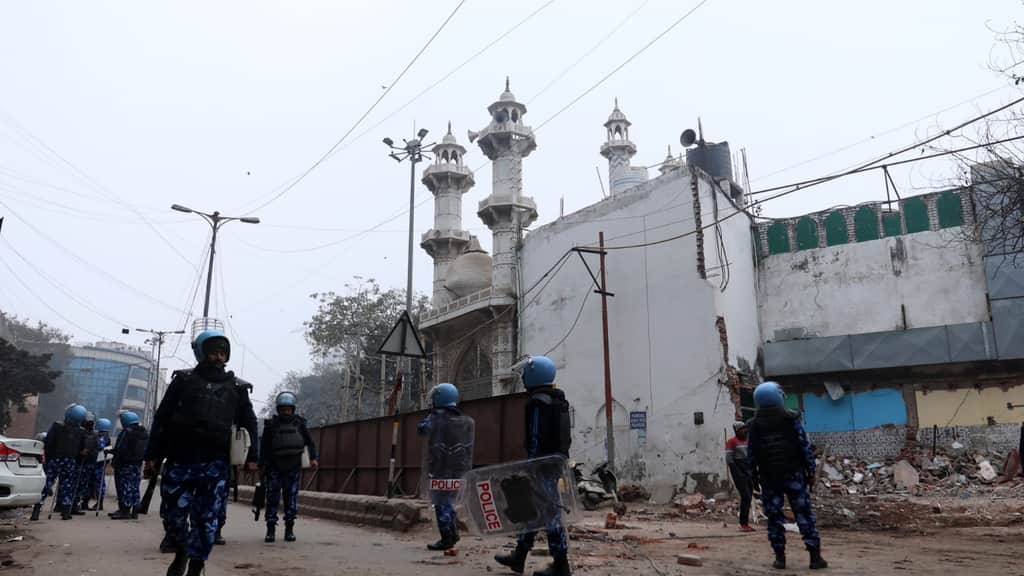
The MCD action triggered violence; people of the area allegedly threw stones, and police responded with mild tear gas. An FIR has been registered and five people have been arrested.
The demolition came within hours of the Delhi High Court declining a plea for an interim stay on the proposed action by the MCD.
Incidentally, the Faiz-e-Ilahi Masjid was in the news less than two months ago, after CCTV cameras captured Umar Nabi, the main accused in the blast outside the Red Fort on November 10, making a 15-minute visit to the mosque before heading to the parking area from where he drove out in the white Hyundai i20 car that exploded at a traffic signal, killing more than a dozen people.
What is the background of the demolition, and what violations have the civic authorities targeted?
Where and when did this sequence of events begin?
In May 2025, an organisation called Save India Foundation complained to government authorities that a large “Mosque/ Markaz structure”, a banquet hall, a charitable dialysis and diagnostic centre, and multiple commercial pathology laboratories were operating illegally on government land at the site near Ramlila Maidan.
The Save India Foundation is registered as a trust, and its founder is one Preet Singh. The organisation claims to be working on “raising issues for the enforcement of rights” of citizens.
Taking cognizance of the NGO’s complaint, officials of the Land and Development Office (L&DO) under the Union Ministry of Housing and Urban Affairs, Delhi Development Authority (DDA), and MCD carried out a joint survey at the site on October 16 last year.
The survey confirmed roughly 2,512 square feet of encroachment on the road and footpath maintained by the Public Works Department (PWD) of the government of Delhi, and another 36,248 sq ft of encroachment on the Ramlila ground adjoining the premises of the mosque.
Armed with this joint survey report (JSR), the Save India Foundation moved the High Court seeking directions to the authorities to remove these illegal encroachments.
On November 12, the HC directed that in respect of the land under the MCD (i.e., the Ramlila Maidan), “appropriate action for removal of such encroachment as also removal of illegal commercial activity as mentioned in JSR shall be taken by the MCD and the same shall be concluded expeditiously”.
What have the authorities in charge of the mosque said about the land?
The managing committee of the Masjid & Dargah Syed Faiz-e-Ilahi has claimed that the Masjid, Dargah, and a Muslim graveyard at the site were established as Waqf more than a century ago, and that the properties had been used by the local community of Muslims ever since.
According to the committee, the graveyard had stopped being in use over time, but the mosque and dargah – which is the tomb or shrine of a Muslim saint – continued to be functional.
The open ground, which, according to the committee, is the part of “Waqf land”, has been used for community activities such as carrying out free medical check-ups, distribution of ration and, occasionally, weddings.
And what events led to the government move to urgently remove the encroachments?
In its direction issued to the Masjid committee to remove the encroachments in November 2025, the PWD mentioned the “critical importance” of Asaf Ali Road, on which the mosque is located.
Asaf Ali Road, which runs from Delhi Gate to Kamla Market in central Delhi, is a “high priority carriageway and forms a crucial link between central Delhi zones”, the PWD notice said. The busy road is “routinely” used for “VVIP and VIP movement, including emergency convoys and designated security routes”, and “any obstruction on this road has the potential to impede national-level security movement, delay emergency response operations, and disrupt core city mobility”, the notice said.
Following the JSR and after hearing the Masjid committee, the MCD, in an order issued on December 22, said that “by no stretch of imagination, masjid or dargah or graveyard can be used as marriage venue or clinic”, and that was a “blatant misuse of public land”.
Therefore, the MCD said, “any structure beyond 0.195 acre of land is an encroachment and deserves to be removed.”
This “0.195 acre” of land – which was referred to in the lease deed of February 1940 – lies at the heart of the dispute.
While the government has assured that it would not touch this 0.195-acre area, it has said that both the mosque and the graveyard are included in this patch of land. The Masjid committee, however, contends that the graveyard lies outside this 0.195 acre.
And what is the view of the Delhi Waqf Board?
The managing committee of the Masjid Dargah Faiz-e-Ilahi has been constituted by the Delhi Waqf Board. On October 29, 2025, the Waqf Board noted that “there have been various complaints of misuse of (this) Waqf property…right since the year 2000 onwards.”
According to the Board, there were two notified Waqf properties near Ramlila Maidan in 1970 – one, the “Khawaja Faiz Elahi Mosque alias Mosque Ghosian and Graveyard”, and the other, “Masjid and graveyard Fazal Mahmood Ram Lila Ground, Turkman Gate”.
According to the gazette notification, both these properties were more than 100 years old. In respect of the latter property, however, it was recorded in 1970 that “the mosque has since been demolished and a temple with compound wall is constructed over the premises.”
With regard to the former property, the gazette notification does not mention the specific areas under the mosque and graveyard, the Board has conceded. The absence of a record of specific measurements has created a grey area with regard to the limits of the property notified as Waqf.
Editorial Context & Insight
Original analysis & verification
Methodology
This article includes original analysis and synthesis from our editorial team, cross-referenced with primary sources to ensure depth and accuracy.
Primary Source
The Indian Express