It's day two of German Chancellor Friedrich Merz's two-day maiden state visit to India.
While it's still early in the day, the German leader is on his way to the southern city of Bengaluru — often referred to as India's Silicon Valley.
During the day, Merz will visit the premises of German engineering company Bosch and the Center for Nano Science and Engineering at the Indian Institute of Science.
These visits are meant to highlight the strong technology-based ties between Berlin and New Delhi.
Stick with us as we continue to report on Chancellor Merz's India visit.
We’re pausing our live coverage of Friedrich Merz’s trip to India, his first as chancellor.
Coverage will resume tomorrow when he visits the southern city of Bengaluru to explore projects involving German companies.
India's Prime Minister Narendra Modi has welcomed German Chancellor Friedrich Merz, who is on a two-day visit. Merz is traveling with a large business delegation as Germany seeks to deepen economic and security ties.
To view this video please enable JavaScript, and consider upgrading to a web browser that supports HTML5 video
The big win of the visit was the clear commitment by India to get the trade agreement with the European Union done by the end of January.
Following last week's EU vote in favor of Mercosur, this is much needed proof that the European Union can find other strong partners alongside — but not instead of — the US.
Overall, 27 declarations of intent and announcements were signed by Merz and Modi. They ranged from defense cooperation to rare earth supply chains — better promotion of hockey talent — the recruitment of health workers — to artificial intelligence.
Just hours later, the US Ambassador in New Delhi announced Washington was inviting India to join a new American-led AI supply chain initiative.
Overall the biggest win for Merz is that India — for now — wants to stick with the rules-based international order supported by Europe.
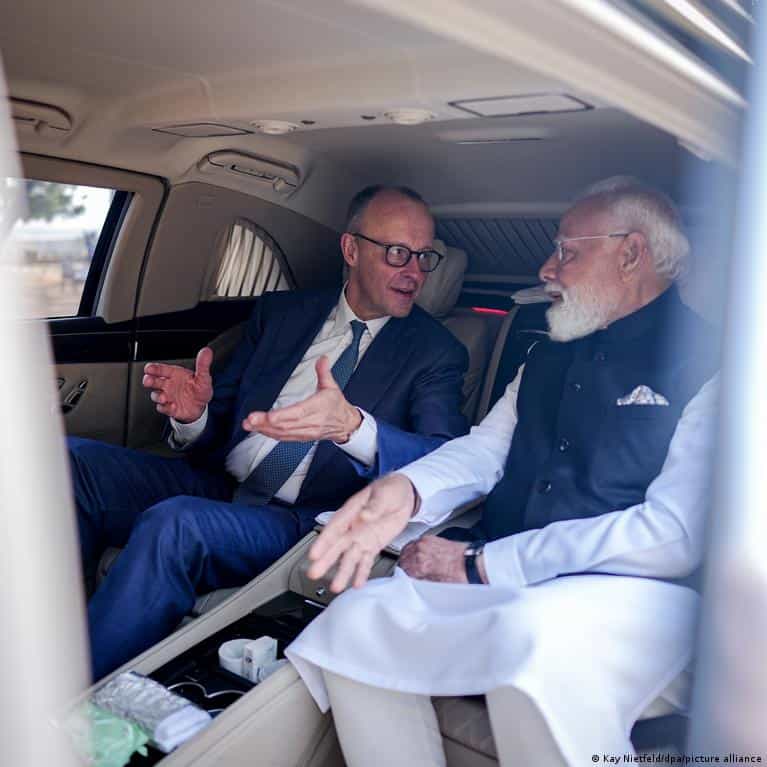
On Russia, Merz didn’t get as clear an answer as he would have liked during his 40 minute one-on-one car ride with Modi.
Merz wants Modi to stop buying Russian oil that indirectly funds Putin's war on Ukraine. Merz emerged from the vehicle with a conciliatory tone. He understands that a country with 1.4 billion people and few own natural resources can’t be picky about where their energy comes from.
DW correspondent Adil Bhat spoke to the former Indian ambassador to Germany Gurjit Singh about German Chancellor Friedrich Merz's visit to India this week.
Singh said the visit came at a moment when global relations are "in flux" and countries are seeking stability through trusted partnerships.
"This relationship is looking at strategic balance and stability based on mutual respect for values and bilateral trust," he said, adding that the agreements signed during the visit show "a truly diversified and strategic partnership in many more areas than ever before."
On differences over Russia and other international issues, Singh said: "Our differences remain, but they are not hurdles to intensification of a relationship whose time has truly come."
The former Indian ambassador downplayed suggestions that Berlin’s India push is mainly about replacing China in supply chains, saying the relationship has its own strategic logic.
"I think it is futile to look at the Indo-German relationship in the context of China for either of them," he told DW, while emphasizing that the Indo-German relationship "stands on its own."
On the issue of Russia, Ukraine and other diplomatic and strategic differences between India and Germany, Singh said, "Our differences remain, but they are not hurdles blocking the partnership."
He noted that defense and security cooperation has been given top priority in the joint statement, and said Germany’s "clear preference for India as a partner in the Indo-Pacific" is shaping the next phase of the bilateral ties.
Singh said defense and security cooperation has become a key pillar in India-Germany ties, even though an expected submarine-related announcement did not materialize during Chancellor Merz’s visit.
"The expected announcement of a deal on the submarines did not happen... nevertheless, in the joint statement, point one is defence and security cooperation," Singh told DW.
He said closer cooperation is now envisaged through personnel exchange, joint exercises, and Germany’s "clear preference for India as a partner in the Indo-Pacific."
Indian Prime Minister Narendra Modi said in a statement that German Chancellor Friedrich Merz's visit came at "a particularly significant time" and close cooperation of economies such as those of India and Germany "is important for all of humanity."
Modi said bilateral trade with Germany had reaching its highest level ever, crossing the $50 billion mark in 2024.
The prime minister also highlighted cooperation in renewable energy and said a decision had been made to establish the India-Germany Centre of Excellence, which he said would become a "shared platform for knowledge, technology, and innovation."
Modi thanked Merz for "simplifying the processes related to defense trade" and said there would be work on a road map to enhance cooperation in the countries defense industries, which would see new opportunities for co-development and co-production.
Modi highlighted the contributions that Indians are making in Germany.
"India's talented young workforce is making a significant contribution to Germany's economy," Modi said adding that a joint declaration of intent had been made for the Global Skills Partnership that would "facilitate the mobility of healthcare professionals."
The Indian leader said that there had been agreement that terrorism was a serious threat to the world and vowed to "fight it together with full determination."
India's External Affairs Ministry of released a statement providing details on where things stand as German Chancellor Friedrich Merz made his first official visit.
The ministry said the leaders reaffirmed "reaffirmed the shared democratic values, commitment to a rules-based international order and mutual respect underpinning the Strategic Partnership."
In matters of defense and security, the ministry said, Merz and Modi back a commitment to "deepen military-to-military cooperation" with joint exercises and exchanges of senior officials.
They also welcomed the signing of a joint declaration of intent to develop a road map dealing with cooperation in the defense industry.
This would include long-term collaboration in tech partnerships, and co-developing and co-producing defense platforms and equipment.
Regarding trade and economy the leaders "welcomed the sustained growth in bilateral trade and investment and noted that bilateral trade reached a record high in 2024," the statement said.
That positive trend had carried over into 2024 and bilateral trade with Germany in 2024 amounted more than 25% of Indian trade with the EU.
Modi and Merz reiterated their support to conclude the India-EU Free Trade Agreement as a key outcome of the upcoming EU-India Summit. The leaders gave confirmation that this agreement would be signed by the end of the month.
DW's Delhi bureau chief, Sandra Petersmann, noted that during the joint press statements there was visible warmth and mutual appreciation displayed between German Chancellor Friedrich Merz and Indian Prime Minister Narendra Modi.
That said, the language between the two leaders remained notably formal.
Chancellor Merz addressed the Indian leader as "Dear Narendra Modi" and "Dear Mr. Modi," stopping short of using his first-name during their joint address.
Prime Minister Modi mirrored that formality.
There was also no trademark Modi bear hug — something he has reserved for leaders like US President Donald Trump, Russia's Vladimir Putin and French President Emmanuel Macron, whom he often addresses by their first names.
That might be explained by the fact that it is only Merz and Modi's third in-person meeting, the first two taking place at the G7 summit in Kananaskis, Alberta Canada, and then the most recent being the G20 summit in Johannesburg last year November.
Indians make up the largest group of international job seekers and students interested in working and studying in Germany.
According to recent figures by SWP, Germany's leading independent foreign policy think tank, about 280,000 Indian nationals were living in Germany in early 2025. Of these, roughly 60,000 are students, making Indians the largest group of international students in the country.
Indian students now form the largest group of international students in Germany, with a strong focus on science, technology, engineering and mathematics (STEM subjects).
"Going ahead, Germany may become an even more important education destination as the US imposes restrictions on Indian students," said Shairee Malhotra, Deputy Director at the Observer Research Foundation in New Delhi, in an interview to DW.
More than 152,000 Indians are employed in jobs covered by Germany's social security system, meaning they are working legally as skilled or regular employees. A recent study by Institute of the German Economy (IW) shows thatIndian employees are highest earners among foreign workers in Germany.
With the German government actively seeking talent from India — and growing uncertainty over career prospects in the United States — these numbers are widely expected to rise even further.
"It's a win-win situation of matching Germany's demographic decline and shortage of workers with India's demographic dividend," Malhotra said.
Germany is also India's second most important research partner, after the United States.
Both leaders used their joint press conference to call out the Iranian government for its clampdown on popular protest, which has killed hundreds of demonstrators.
Modi said he condemned the violence in the "strongest of terms."
Merz called the use of violence against protesters a "sign of weakness."
German Chancellor Friedrich Merz and Indian Prime Minister Narendra Modi held a joint press conference in Ahmedabad, in India's western state of Gujarat, after a delegation-level bilateral meeting.
The meeting, which included several German CEOs, resulted in several "memorandums of understanding" (MoUs) signed between the countries. These include a long-term binding agreement between German state-owned energy company Uniper and India's AM Green to purchase green ammonia.
Modi welcomed the closer business ties and welcomed the German leader to the country once again.
"India and Germany are working together to build secure, trusted and resilient supply chains. The MoUs being signed today on all these issues will give new momentum and strength to our cooperation," the prime minister said.
Modi added that the meeting included discussions on the situations in Ukraine and Gaza, among other topics, adding India continued to support peaceful resolutions.
The world is going through "a renaissance of protectionism," said Merz, which hurts both India and Germany.
Meanwhile, Merz said Germany wants closer security cooperation with India so that India is less reliant on Russia.
Russia is the largest defense supplier of India and has historically enjoyed close security ties with New Delhi.
Speaking on trade, Merz said India and the European Union must urgently conclude negotiations on a free trade agreement. The comment comes ahead of an EU-India summit later this month, where a long-awaited free trade agreement is widely expected to be signed.
German Chancellor Friedrich Merz is visiting India. In the face of US tariffs, Russian threats and an uncertain China, Germany is courting the Asian giant as a trading and geopolitical partner. But it's not so easy.
Read more on what Merz hopes to achieve during his first trip to India as a chancellor in our report.
Both leaders have now settled in for a meeting, along with their delegations.
Trade and defense ties are expected to be at the forefront of talks.
Video clips posted by Indian media showed the leaders seated across from each other.
Modi was flanked by Minister of External Affairs, Subrahmanyam Jaishankar to the right and National Security Advisor Ajit Doval to the left.
Moving on from the Sabarmati Ashram, Chancellor Merz and Prime Minister Modi indulged in a lighthearted moment at the International Kite Festival at the Sabarmati riverfront in the western city of Ahmedabad.
Videos of Modi flying a kite beside Merz surfaced on social media.
Several kites surfed the skies, including some sporting motifs of the leaders, motifs of Hindu deities and flags of India and Germany.
Editorial Context & Insight
Original analysis and synthesis with multi-source verification
Methodology
This article includes original analysis and synthesis from our editorial team, cross-referenced with multiple primary sources to ensure depth, accuracy, and balanced perspective. All claims are fact-checked and verified before publication.
Primary Source
Verified Source
Deutsche Welle
Editorial Team
Senior Editor
Shiv Shakti Mishra
Specializes in World coverage
Quality Assurance
Copy Chief
Fact-checking and editorial standards compliance