Friedrich Merz is due in Bengaluru, often called India's Silicon Valley, after meeting PM Modi in Ahmedabad.
The visit comes just weeks ahead of plans to sign a long-awaited free trade agreement between India and the EU.
Heavy snows last week brought German trains to a halt in large parts of the country's north.
Lawmakers from across the spectrum have called for Germany's rail network operator Deutsche Bahn (DB) to be held to account.
For its part, DB said it was well prepared for such extreme weather, with more than three-quarters of rail switches being heated to prevent freezing up, German public broadcaster Tagesschau reported.
The problem, the company said, is that northern Germany is so flat that it is hit worse by cold weather and even heated switches cannot function when covered in snow.
To view this video please enable JavaScript, and consider upgrading to a web browser that supports HTML5 video
Hundreds of DB employees were sent out to manually clear tracks of snow, but the rail passenger association Pro Bahn told the Spiegel magazine there were not enough employees for this job, and fewer than there used to be.
Dirk Flege, the head of the interest group Allianz pro Schiene, said the main reason for the widespread cancellation of trains was the focus on punctuality figures, since cancelled trains aren't included in the statistics and therefore don't bring down the overall punctuality score, something DB has struggled with for years.
Flege also criticized, as quoted by Tagesschau, that DB is expected to make a profit. Under the pressure to cut costs, the vehicle fleet is not expanded enough to meet the needs of extreme weather.
He also pointed to countries like Austria and Switzerland, where the kind of travel chaos seen last week rarely happens. But DB says this argument doesn't hold up since the impacted rail network in northern Germany alone is almost as big as Austria's entire rail network.
Strict protocol normally governs trips like this. Schedules are choreographed to the minute, printed in advance, and rarely adjusted—except in moments of acute geopolitical turbulence, as during the recent Middle East escalation. The structure provides predictability for everyone involved: diplomats, advisers, drivers, logisticians, journalists, and their newsrooms at home.
But keeping the US engaged—and ensuring Germany stays engaged with the US—demands a different approach. For a German foreign minister, representing the world’s third-largest economy, and his team, flexibility becomes the currency of access. And in Washington, one thing is unmistakable: the Germans want something from the Americans. Some would say more than the Americans want from them. So they take whatever slot, however small, is offered.
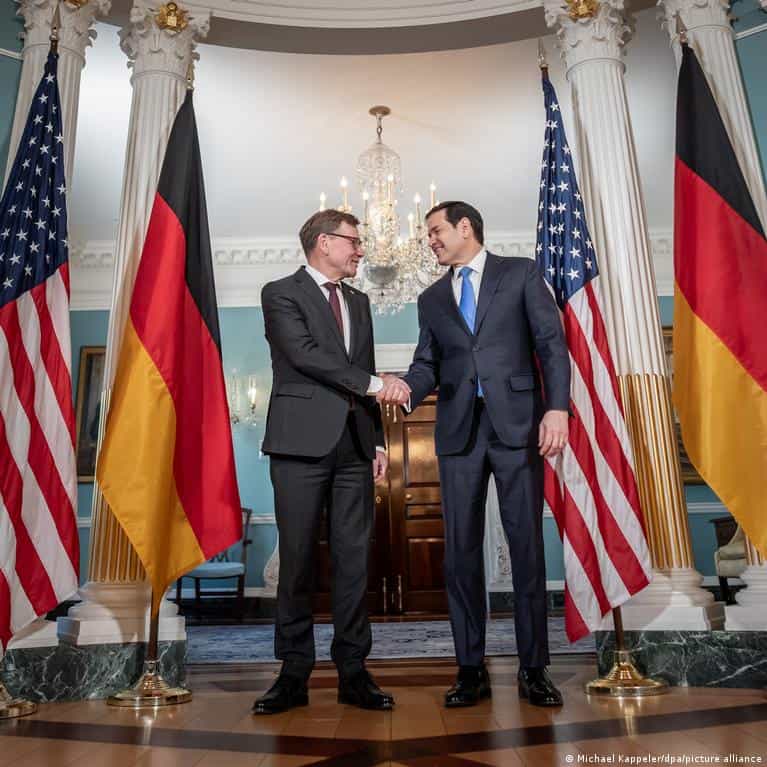
On Sunday, word comes that Secretary of State Marco Rubio won’t make the planned Monday morning meeting. Schedules are tossed, security checks reshuffled, driver logistics reworked for the afternoon. At least that frees up time for the World Bank president. Rubio ends up talking slightly longer with Wadephul than planned? No complaint—they grab every minute, skip their train to New York, and rebook everything for a later departure. A potential opportunity for further political talks on Tuesday? The entire trip is extended.
Until the final hours, the German foreign minister keeps his schedule open, determined to stay responsive to Washington’s shifting priorities and messaging. Wadephul wants to wring every drop of political value out of his US visit.
Substantively, his message remains steady: both sides need each other. Disagreements—whether over Venezuela, Greenland, or Russia—are normal among partners. What you won’t hear from him is the German finance minister’s phrase “alliance in dissolution.”
The dynamic is clear: the Germans are seeking something from the Americans, perhaps more than vice versa. After meeting Rubio, Wadephul appears alone before the press and spends 15 minutes describing the shared interests binding the transatlantic partners. Two hours later, the State Department releases a 14-line readout.
German Foreign Minister Johann Wadephul on Monday played down suggestions that the United States could invade Greenlandwith its military.
Speaking after a meeting with US Secretary of State Marco Rubio, Wadephul said there was "no reason" to believe that such action was being "seriously considered" and insisted that NATO members shared a common interest in ensuring security in the Arctic.
"The United States stands at Europe's side and is fully committed to defending law and freedom in the western world," Wadephul said. "Of that there is absolutely no doubt. I would advise us Europeans not to start doubting things which aren't being doubted in Washington."
Looking ahead to talks between Rubio and the Danish foreign minister later this week, Wadephul said he had "no doubt that these will take place in a friendly and cooperative manner," and rejected suggestions that the United States under President Donald Trump has turned its back on the common values underpinning NATO.
A jury of linguistic experts in the western German town of Marburg are set to announce their "word of the year" – in a negative sense.
There are several "word of the year" (Wort des Jahres) competitions in Germany, with the 2025 prize going to KI-Ära (AI era) in recognition of the emergence of artificial intelligence into the public mainstream, and "Das crazy" winning Youth Word of the Year.
But the negative non-word of the year (or Unwort des Jahres) aims to raise awareness of less pleasant phrases or terms which may be discriminatory or inappropriate but which have nevertheless established themselves among German speakers.
The first ever "Un-Word" of the year was crowned in 1991, with the dubious prize going to ausländerfrei (foreigner-free), while last year's "winner" followed an unfortunately similar theme: biodeutsch ("biologically German" as opposed to naturalized German citizens).
Other controversial terms which have been highlighted in recent years include: Remigration, Klimaterroristen (climate terrorists), Klimahysterie (climate hysteria) and alternative Fakten (alternative facts).
Guten Morgen! Welcome to DW's coverage of what Germany is talking about on Tuesday, January 13.
While German Chancellor Friedrich Merz has been in India, Vice Chancellor and Finance Minister Lars Klingbeil and Foreign Minister Johann Wadephul are in Washington. Wadephul met US Secretary of State Marco Rubio on Monday and will meet United Nations chief Antonio Guterres on Tuesday.
Back in Germany, Defense Minister Boris Pistorius is due to meet the European Union's foreign policy chief Kaja Kallas in Berlin on Tuesday afternoon, while Bundestag President Julia Klöckner is set to meet with Polish Parliament President Wlodzimierz Czarzasty.
Elsewhere, a suspected member of the Lebanese Islamist group Hezbollah is set to go on trial in Berlin while, in Düsseldorf, six suspected members of a left-wing extremist organization are accused of attempted murder.
Editorial Context & Insight
Original analysis and synthesis with multi-source verification
Methodology
This article includes original analysis and synthesis from our editorial team, cross-referenced with multiple primary sources to ensure depth, accuracy, and balanced perspective. All claims are fact-checked and verified before publication.
Primary Source
Verified Source
Deutsche Welle
Editorial Team
Senior Editor
Sofia Andersson
Specializes in World coverage
Quality Assurance
Associate Editor
Fact-checking and editorial standards compliance