As India’s consumer base continues to grow, and the country is increasingly seen as a manufacturing alternative to China, major tech companies are diversifying their supply chains, setting up plants in the country, and catering to local demand.
In fact, according to the government, India has become the world’s second-largest mobile phone manufacturer.
However, India still lacks the kind of ecosystem China has — one that spans product design from the concept stage to advanced manufacturing and market deployment. South Korean tech behemoth Samsung is trying to change that by placing greater emphasis on locally designed products tailored for the Indian market.
J B Park, President and CEO, Samsung Southwest Asia, addressing a select group of journalists from India in Las Vegas. (Image: The Indian Express/ Anuj Bhatia)
“We have a Samsung Design Centre in Noida that handles all local design in mobile phones, refrigerators and washing machines,” J B Park, President and CEO, Samsung Southwest Asia, told indianexpress.com on the sidelines of the recently concluded CES tech show in Las Vegas.
“Our teams in Noida work with a two-year lead time, which is then integrated into product planning, followed by manufacturing. If you go to the shops, you will see designs that are specifically created for Indian consumers and are not available anywhere else globally.”
While it may seem like a small step, its impact could be huge, in line with India’s growing ambitions to position itself as a manufacturing hub for electronic goods. Experts say India needs stronger prowess in industrial design to compete with China, which is not only the factory of the world but also home to world-class industrial design teams.
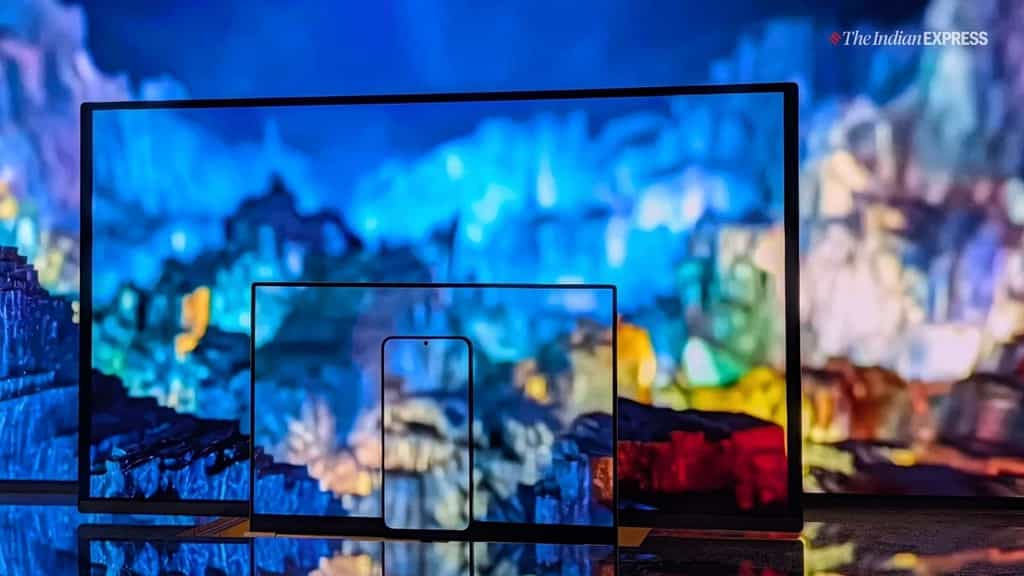
The 130-inch MicroRGB TV was Samsung’s star launch at CES 2026 in Las Vegas. (Image: The Indian Express/ Anuj Bhatia)
From sleek smartphones to smart refrigerators and connected washing machines, design plays an important role in the products we use every day. However, as technology continues to evolve rapidly, the role of industrial designers is changing as well. Today, industrial designers need to be proficient not only in traditional design but also in programming, robotics, and data analytics. It is no longer enough to simply have an eye for design — designers must also possess strong computational skills.
At the same time, as manufacturing becomes increasingly automated, designers play a crucial role in collaborating across multiple departments, including design, engineering, and manufacturing. The goal is no longer just to improve efficiency, but also to create products that are customisable at scale.
With its large, young workforce and a government placing greater emphasis on manufacturing through incentives such as the Production-Linked Incentive (PLI) scheme, Samsung’s approach — manufacturing and designing products in India — signals how tech companies are diversifying their operations. It also highlights how companies like Samsung are investing heavily in research and development.
Samsung has plans to brings its flagship Galaxy Z TriFold smartphone to more markets including Dubai and Singapore. However, the company has no plans to launch the device in India for now. (Image: The Indian Express/ Anuj Bhatia)
India, in particular, plays a central role in the company’s future AI strategy. Samsung currently employs more than 10,000 engineers in the country.
“We have invested heavily in R&D; we have our consumer electronics-focused R&D in Delhi, mobile R&D in Noida, while in Bengaluru, it’s more advanced technology that involves multiple categories. The role of the R&D centre is to upgrade the software, architect it, and develop it in a way that it is used in the Indian market or globally,” said Park.
According to Park, India’s role has evolved significantly over the decades. “In the 1970s and 80s, it was all about manufacturing, production and efficiency. Now the industry has shifted towards software engineering.”
Editorial Context & Insight
Original analysis and synthesis with multi-source verification
Methodology
This article includes original analysis and synthesis from our editorial team, cross-referenced with multiple primary sources to ensure depth, accuracy, and balanced perspective. All claims are fact-checked and verified before publication.
Primary Source
Verified Source
The Indian Express
Editorial Team
Senior Editor
Shiv Shakti Mishra
Specializes in India coverage
Quality Assurance
Copy Chief
Fact-checking and editorial standards compliance