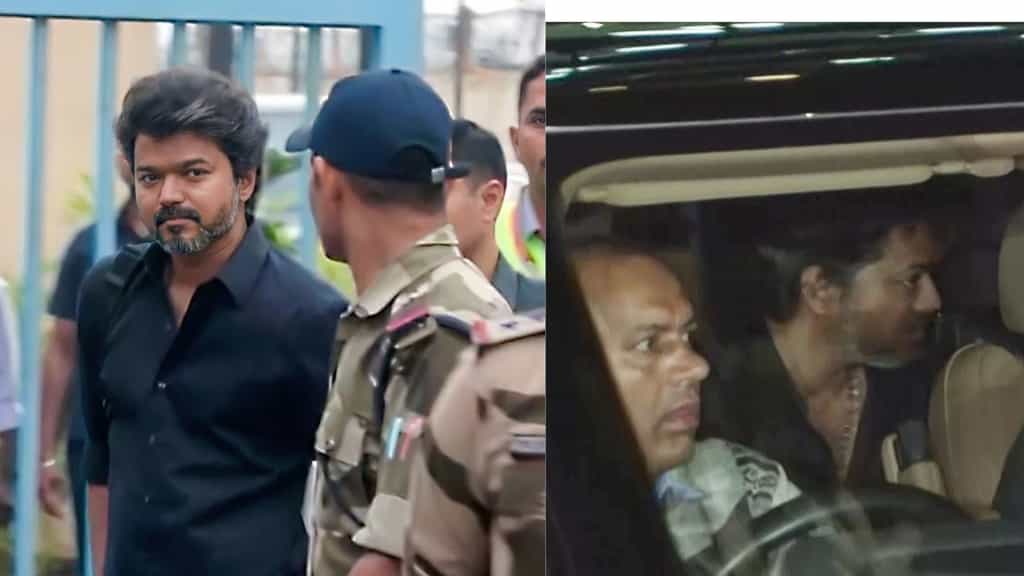
The interrogation began at 11.30 am and stretched into the evening at the CBI’s headquarters, with Vijay leaving the premises around 6.15 pm, officials said. (ANI Photos, enhanced with AI)
He had lunch at 4 pm, hours after the questioning had begun, inside a tightly controlled room on the 10th floor of the CBI headquarters. For Vijay, the questions that followed on Monday were not unexpected – 90 of them, laid out in a booklet – but the atmosphere, sources close to him say, was unmistakably challenging and intimidating, as investigators retraced every decision and delay on the day the Karur rally turned fatal.
According to a top source close to Vijay who was familiar with Monday’s developments, the questioning was intense, structured and narrowly focused on the sequence of events surrounding the stampede that claimed 41 lives last September. “The questioning will happen for one more day, but after Pongal, which falls on January 15. Vijay will return to Chennai tomorrow,” the source told The Indian Express.
In a departure from the usual conversational format, the agency relied on a written framework. “CBI gave him a booklet containing 90 questions. A stenographer was given assistance to record his answers in English, and those were typed and duly signed later,” the source said, underscoring the formal and documentary nature of the exercise.
The questions, the source said, followed a chronological arc of the rally day. “Questions were mainly about what happened on the day of the stampede. Questioning began from why he was late on that day in arriving at his scheduled rally venues, and ended at why he rushed back to Chennai the same night,” the source said.
While Vijay, who arrived in Delhi on a chartered flight from Chennai, was “prepared,” the source described the setting as mentally taxing. “The atmosphere was challenging. He had his lunch at 4 pm. The CBI had allowed him to bring food from outside,” the source said.
The CBI, officials indicated, wanted Vijay to continue his deposition on Tuesday, but agreed to defer it until after Pongal at his request. He is expected to be called again to clarify certain aspects of his statement.
Monday’s session was part of a broader probe that the Central Bureau of Investigation took over in October following directions from the Supreme Court of India, after the stampede at a TVK campaign event in Karur left dozens dead and over 60 injured.
According to officials, investigators are examining whether delays in the programme and lapses in planning and crowd control contributed to the tragedy. The agency is probing the alleged gap between the scheduled start of the rally and Vijay’s actual arrival, and whether the delay led to dangerous crowd build-up and confusion at the venue.
The questioning has also extended to organisational responsibility – who conceived the event, how permissions were obtained, and how coordination with the district administration and police was handled. Crowd management measures, including barricading, entry and exit routes, availability of drinking water and medical facilities, are under scrutiny, as is the movement of Vijay’s campaign caravan through densely packed supporters.
As part of the same investigation, the CBI has questioned several TVK office bearers, the driver of Vijay’s campaign vehicle, and former Tamil Nadu Additional Director General of Police (Law and Order) S Davidson Devasirvatham. Video footage from the rally and related documents are being examined alongside statements from party functionaries and officials.
Anticipating a large gathering of supporters, security around the CBI headquarters was tightened on Monday, with Delhi Police and Central Armed Police Forces deployed in strength. A small group of fans managed to mingle with journalists outside the building to catch a glimpse of the actor-politician.
The case has unfolded under close judicial supervision. The Supreme Court had earlier directed the CBI director to appoint a senior officer to lead the probe and constituted a three-member supervisory committee headed by former Supreme Court judge Ajay Rastogi. Observing that the incident had “wide ramifications,” the court said restoring public faith in the criminal justice system required an investigation that was “completely impartial, independent and unbiased”.
Editorial Context & Insight
Original analysis and synthesis with multi-source verification
Methodology
This article includes original analysis and synthesis from our editorial team, cross-referenced with multiple primary sources to ensure depth, accuracy, and balanced perspective. All claims are fact-checked and verified before publication.
Primary Source
Verified Source
The Indian Express
Editorial Team
Senior Editor
Shiv Shakti Mishra
Specializes in India coverage
Quality Assurance
Associate Editor
Fact-checking and editorial standards compliance