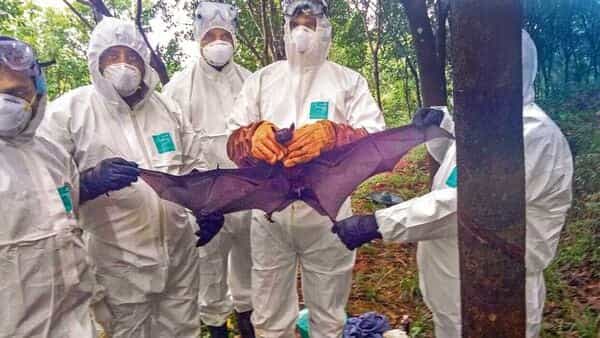
New Delhi: The Centre has deployed a multi-disciplinary team to West Bengal following the identification of two suspected Nipah virus cases at AIIMS Kalyani, according to two people familiar with the matter.
The National Joint Outbreak Response Team includes experts from the National Institute of Virology (NIV), the National Institute of Epidemiology (NIE), and the wildlife division under the environment, forest and climate change ministry to support containment efforts and public health response measures.
Given the virus's high mortality rate and zoonotic nature, enhanced laboratory testing for rapid confirmation, intensive surveillance through contact tracing, and specialized infection prevention and control protocols have been adopted.
Nipah virus infections are caused from animals—specifically fruit bats—to humans, often resulting in severe respiratory illness and fatal encephalitis.
“Given the serious nature of Nipah virus infection, which is a zoonotic disease with high mortality and potential for rapid spread, the situation is being handled with utmost priority. A National Joint Outbreak Response Team has been deployed to support the State Government in containment and public health response measures,” the official said.
The ministry of health & family welfare is maintaining a 24-hour vigil over the situation through seamless coordination with state authorities. Union health secretary Punya Salila Srivastavais in talks with state chief secretary and principal secretary (health) to ensure technical and logistical support.
The Public Health Emergency Operations Centre (PHEOC) in Delhi has been activated, while specific Nipah containment guidelines have been issued to the state’s surveillance unit.
Queries sent to the health ministry spokesperson were not immediately answered.
West Bengal reported Nipah outbreaks in Siliguri in 2001 and Nadia in 2007. After several quiet years, the virus resurfaced dramatically in Kerala in 2018, recording a fatality rate of about 91%. Kerala has since reported clusters in 2019, 2021, 2023 and 2025.
Although West Bengal has not reported confirmed clusters in recent years, the recurring outbreaks elsewhere underscore the virus’s persistent threat and the urgent need for local vigilance.
Union health minister Jagat Prakash Nadda has also spoken to chief minister Mamata Banerjee, assuring full central support to manage the situation.
Earlier, Mint reported that Indian Council of Medical Research (ICMR) is actively exploring partnerships with domestic pharmaceutical firms to manufacture monoclonal antibodies (mAbs) locally.
Currently, India relies on imports from Australia for these life-saving proteins, which are administered intravenously to treat the infection.
With no vaccine available and fresh cases reported in Kerala earlier this year, the suspected cases in West Bengal have put the national health system on heightened alert.
Editorial Context & Insight
Original analysis and synthesis with multi-source verification
Methodology
This article includes original analysis and synthesis from our editorial team, cross-referenced with multiple primary sources to ensure depth, accuracy, and balanced perspective. All claims are fact-checked and verified before publication.
Primary Source
Verified Source
mint - news
Editorial Team
Senior Editor
Shiv Shakti Mishra
Specializes in India coverage
Quality Assurance
Quality Assurance Editor
Fact-checking and editorial standards compliance