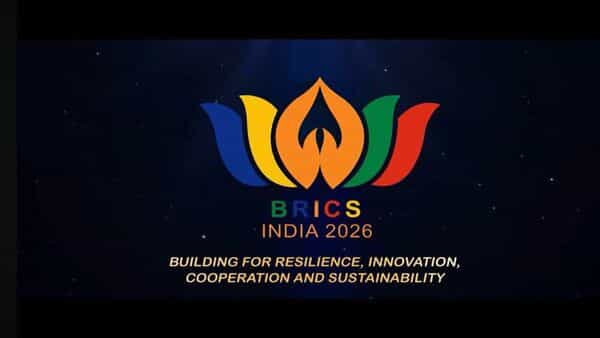
External Affairs Minister (EAM) S Jaishankar launched the official website and logo for BRICS 2026 on Tuesday, with the event being scheduled to take place this year. India is chairing the multilateral forum in 2026, which was formed 20 years ago.
Brazil, Russia, India, China, and South Africa are the five major countries leading the BRICS nations. Other full members of the forum who joined later include Egypt, Ethiopia, Iran, the UAE, and Indonesia
Jaishankar launched the logo and the website at a time when India seeks to strengthen its outreach and collaboration among the BRICS members as it gears up to lead the forum in 2026.
According to officials, the emblem embodies a people-centric vision, emphasising cooperation, mutual respect, and solidarity as India leads BRICS in 2026, with the tagline accompanying the logo reading, "Building for Resilience, Innovation, Cooperation and Sustainability."
The website launch aims to provide a central platform for information on BRICS initiatives, projects, events, and official documents.
The EAM, following the launch, stated that the BRICS chairmanship will focus on advancing global welfare as the grouping marks its 20th anniversary in 2026.
According to the Ministry of External Affairs, BRICS, the grouping of major emerging economies, has grown into a significant global platform, now bringing together eleven member nations that collectively represent around 49.5 per cent of the world's population, approximately 40 per cent of global GDP, and nearly 26 per cent of global trade.
The acronym BRIC was first coined in 2001 by Goldman Sachs in their Global Economics Paper, "The World Needs Better Economic BRICs", based on analyses projecting that Brazil, Russia, India, and China would individually and collectively occupy a larger share of the global economy and become among the world's largest economies over the following decades.
The grouping took formal shape after a meeting of the leaders of Russia, India, and China in St. Petersburg during the G8 Outreach Summit in 2006, and was further institutionalised during the first meeting of BRIC Foreign Ministers on the margins of the UN General Assembly in New York later that year.
The first BRIC Summit was subsequently held in Yekaterinburg, Russia, in 2009.
In 2010, it was agreed to expand BRIC to BRICS, with South Africa joining at the 3rd BRICS Summit in Sanya in 2011.
The grouping expanded further in 2024, with Egypt, Ethiopia, Iran, and the UAE becoming full members on January 1, 2024. Indonesia joined as a full member in January 2025, while Belarus, Bolivia, Kazakhstan, Cuba, Malaysia, Nigeria, Thailand, Uganda, and Uzbekistan were inducted as partner countries of BRICS.
Over the years, BRICS has evolved into a dynamic forum that promotes cooperation in trade, investment, technology, and sustainable development, and provides a platform for dialogue among emerging economies to address global challenges and reform multilateral institutions.
With India set to lead BRICS in 2026, the grouping is poised to further strengthen its global footprint and advance cooperation across economic, technological, and geopolitical domains.
Editorial Context & Insight
Original analysis and synthesis with multi-source verification
Methodology
This article includes original analysis and synthesis from our editorial team, cross-referenced with multiple primary sources to ensure depth, accuracy, and balanced perspective. All claims are fact-checked and verified before publication.
Primary Source
Verified Source
mint - news
Editorial Team
Senior Editor
Shiv Shakti Mishra
Specializes in India coverage
Quality Assurance
Associate Editor
Fact-checking and editorial standards compliance