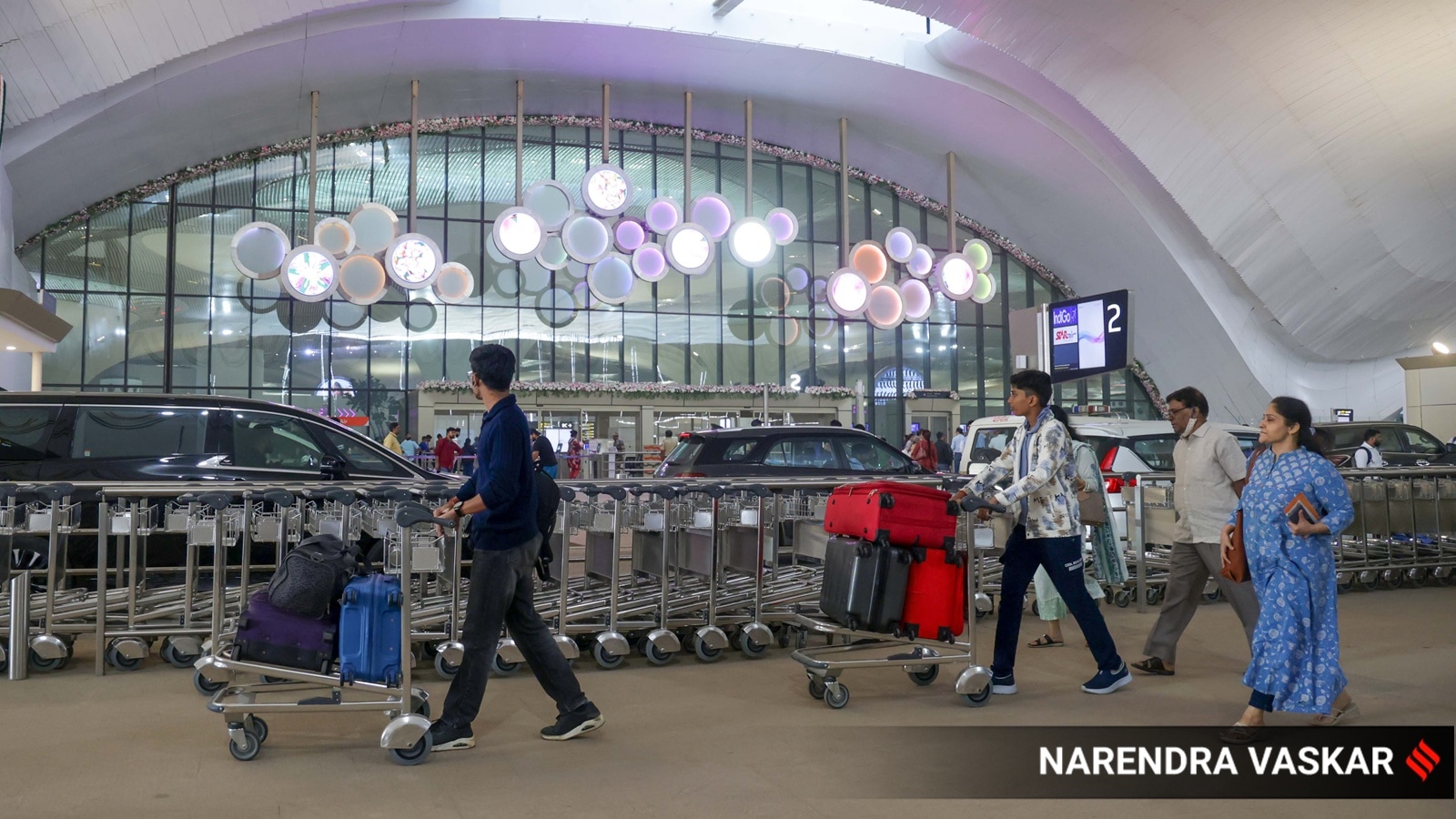
As the Indigo 6E460 from Bengaluru made a historic first landing at the Navi Mumbai International Airport (NMIA) at 8am, it was greeted with a water cannon salute for being the first commercial flight to grace the runway. The familiar chatter of passengers and cries of children filled the halls of Mumbai’s much needed second airport, with 33 flight movements, arrivals and departures, planned for the day.
1. At 2,866 acres large, the NMIA is equivalent to the size of 1,650 football fields (at an approximate 1.7 acres each) put together.
2. By its final phase, the airport will be able to handle a capacity of 90 million passengers per annum. This is ten times London’s entire population (around 9 mil) every year. Mumbai’s current carrying capacity is 50 million ppa (passengers per annum). In the first phase, however, the airport is equipped to handle 20 million ppa.
3. Mumbai’s current international airport, the Chatrapati Shivaji Maharaj International Airport (CSMIA), with its single runway runs to its full capacity and even exceeds it during peak times. In its initial stages, the airport will take the load off peak-hour traffic from the CSMIA, operating between 8am to 8pm. As the months go, flight operations at the NMIA will slowly pick up pace. International operations are expected to begin in March.
4. The airport will be capable of making safe landings in poor visibility conditions, like dense fog and rains, due to its Category II Instrument Landing System (ILS). The chief operating officer, NMIA, explained the system gives landing aircrafts precise lateral and vertical guidance so much so that landings can take place in visibility as low as 300 meters. The CSMIA, on the other hand, requires a minimum visibility of 550 meters for landing and 400 meters for take off, often leading to diversions in other cities.
5. Around Rs 20,000 crore went into the making of the airport, which was done through a public private partnership between Navi Mumbai International Airport Pvt Ltd. The joint venture is led by Adani Airports Holdings Ltd with 74% stake, and CIDCO which holds the remaining 26%.
6. The NMIA has been four decades in the making. The need for a second airport in Mumbai was recognised as far back as 1986. The location of Navi Mumbai was the first considered in 1996, with a pre-feasibility study. Approvals and regulatory challenges caused delays, with construction only beginning in 2021 when the Adani Group took over the project.
7. The next phase – of the total five – will focus on adding a second runway and terminal to the airport, bumping its carrying capacity to 50 million ppa. This is expected to be done by 2029.
8. The airport will soon begin a key component in cargo operations in the MMR. Beginning with a capacity of 0.5 million tonnes (MT) which will escalate upto 3.25 MT till the final phase, its unique advantage comes from its proximity to the Jawaharlal Nehru Port Authority (JNPA). The Atal Setu and connecting Ulwe coastal road, to be ready tentatively by September 2026, increase its connectivity to the Greater Mumbai city. Currently, the airport has seven dedicated freighter stands, to be taken up to 11 in the final phase. Its temperature controlled corridors will maintain cold-chain integrity, essential for vaccines and perishables.
9. The airport will generate up to 40MW of solar power by its final phase. This is enough to power around 70,000 average Indian households every year, each using an approximately 1,000 kWh of electricity annually.
10. A planned smart city, the Navi Mumbai Airport Influence Notified Area (NAINA) is scheduled to come up in the vicinity of the airport, with real estate, warehousing, IT (Information Technology) parks, and commercial developments on the cards.