UPSC Essentials brings to you its initiative for the practice of Mains answer writing. It covers the essential topics of static and dynamic parts of the UPSC Civil Services syllabus covered under various GS papers. This answer-writing practice is designed to help you as a value addition to your UPSC CSE Mains. Attempt today’s answer writing on questions related to topics of GS-1 to check your progress.
🚨 Click Here to read the UPSC Essentials magazine for December 2025. Share your views and suggestions in the comment box or at manas.srivastava@indianexpress.com🚨
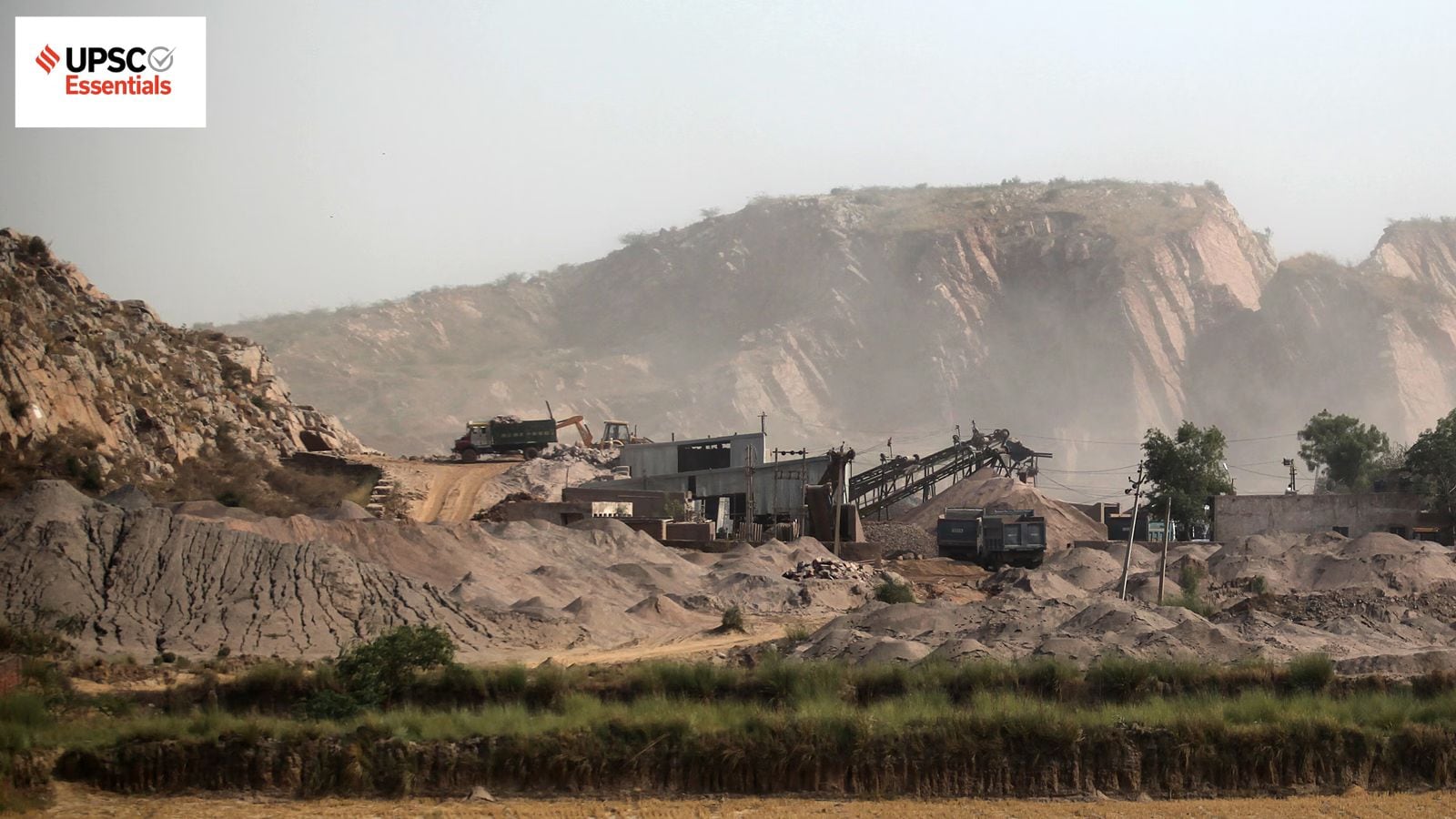
The Aravalli Range is often described as an ecological shield for North India. Discuss its role in controlling desertification, regulating climate, and maintaining groundwater systems.
Discuss the historical process through which Ladakh transitioned from an independent Himalayan kingdom to a part of the princely state of Jammu and Kashmir.
Note: This is not a model UPSC answer. It only provides you with a thought process which you may incorporate into the answers.
— At over a billion years old, the Aravallis are one of the oldest mountain ranges in the world, formed during the Precambrian Era due to the collision of tectonic plates of the earth’s crust. The 700-odd-km range stretches across four states (Gujarat, Rajasthan, Haryana and Delhi) and 37 districts, with 560 km lying in Rajasthan.
— The present-day range, however, is much eroded compared to what the Aravallis were at their birth. Their degradation is due to both natural factors and human activities. However, the Aravallis provide priceless ecological services.
— The range acts as a shield for the northern plains against the incursion of sand from the Thar desert in the west. This also protects air quality in the North. Any rising incursion of sand would be disastrous for the Delhi-NCR Region, which is already struggling to contain local sources of pollution.
— The hills also bring in a healthy amount of rainfall, which is essential for agriculture and drinking water needs of settlements that are located around them. As per studies, deforestation, quarrying and erosion has already led to 12 major gaps in the Aravallis. These gaps extend from Magra hills in Ajmer district to Khetri-Madhogarh hills in Jhunjhunu district and northern most hillocks in Mahendragarh district of Haryana.
— The hills’ rocky formations are essential to recharge aquifers and groundwater levels, and sustain seasonal rivers of Rajasthan and Gujarat.
— The Aravalli range is one of the main watersheds, separating the drainage of the Bay of Bengal, through rivers like the Chambal, and other tributaries of the Yamuna, from that of the Arabian Sea through the Mahi, Sabarmati, Luni, and other rivers,” the action plan states. The region is also home to important lakes and wetlands including Sambhar, Sultanpur, Pushkar, Fateh Sagar, and Jaisamand.
— Aravallis are highly fractured, weathered and porous, allowing rainwater to percolate deep into the ground instead of running off the surface.
— The new definition of the Aravallis, proposed by the Centre and accepted by the Supreme Court, effectively excludes almost 90% of the range from protections against mining and other development activities, as per an internal assessment of the Forest Survey of India.
— The Aravallis are already under immense pressure, and have faced degradation over the years due to urbanisation, industrial clusters, and mining, both legal and illegal. The Union government has itself accepted the large-scale degradation in its action plan under the ‘Aravalli Green Wall’ project.
What policy and governance measures are required to ensure their long-term protection?
The groundwater potential of the Gangetic valley is on a serious decline. How may it affect the food security of India? (2024)
Briefly mention the alignment of major mountain ranges of the world and explain their impact on local weather conditions, with examples. (2021)
(ANI)
— Historically, Ladakh was an independent kingdom, deeply connected with Tibet until its integration into Jammu and Kashmir in 1834. Its strategic importance to India is derived from the fact that it sits on the route linking Central Asia and Kashmir.
— Ladakh became part of Jammu and Kashmir through a complex historical process. As the Sikhs acquired Kashmir in 1819, Emperor Ranjit Singh turned his ambition towards Ladakh. Until then, it was an independent Himalayan kingdom, similar to Bhutan and Sikkim.
— It was made a part of Jammu and Kashmir in 1834 when Gulab Singh, the Dogra feudatory of the Sikh kingdom in Jammu and Kashmir, conquered the territory and made it a part of the Sikh empire.
— After the first Anglo-Sikh war of 1845-46, the state of Jammu and Kashmir, including Ladakh, was taken out of the Sikh empire and brought under British rule. “The state of Jammu and Kashmir was essentially a British creation, formed as a buffer zone where they could meet the Russians.
— The economic significance of Ladakh to India is rooted in the fact that it served as an entrepôt or a centre for trade between Central Asia and Kashmir. “Tibetan pashm shawl wool was carried through Ladakh to Kashmir. At the same time, there was a flourishing trade route across the Karakorum pass to Yarkand and Kashgar to Chinese Turkestan,” historian John Bray wrote in his research paper, ‘Ladakhi history and Indian nationhood’ (1991).
— Upto 2013, India’s infrastructure development in Ladakh was minimal. Since then, India has been carving out several infrastructure projects in the region, and from 2015 onwards, Ladakh has turned into a major defence priority for India. The defence role of Ladakh is further heightened by Chinese interest in the region since the former’s annexation of Tibet in 1950, and more so after the 1959 Tibetan uprising, when the Dalai Lama fled into exile and was granted political asylum in India.
— Protests in Leh, Ladakh, over the statehood demand and its inclusion in the Sixth Schedule of the Constitution spiralled beyond control, with the region experiencing its worst spree of violence in decades.
— The issue dates back to August 2019, when Article 370 was repealed and the Jammu and Kashmir Reorganisation Act, 2019, was passed. Consequently, the state of Jammu and Kashmir was split into two Union Territories—Jammu and Kashmir with a legislature and Ladakh without one. Since then, the legal status of Ladakh has remained a bone of contention. The ongoing protests are a reflection of a wider frustration among the Ladakhi people, especially their youth, over political representation, unemployment, and the protection of tribal rights.
How did changes in trade routes and political control affect Ladakh’s economy over time?
Trace India’s consolidation process during the early phase of independence in terms of polity, economy, education and international relations. (2025)
The political and administrative reorganization of states and territories has been a continuous ongoing process since the mid-nineteenth century. (2022)