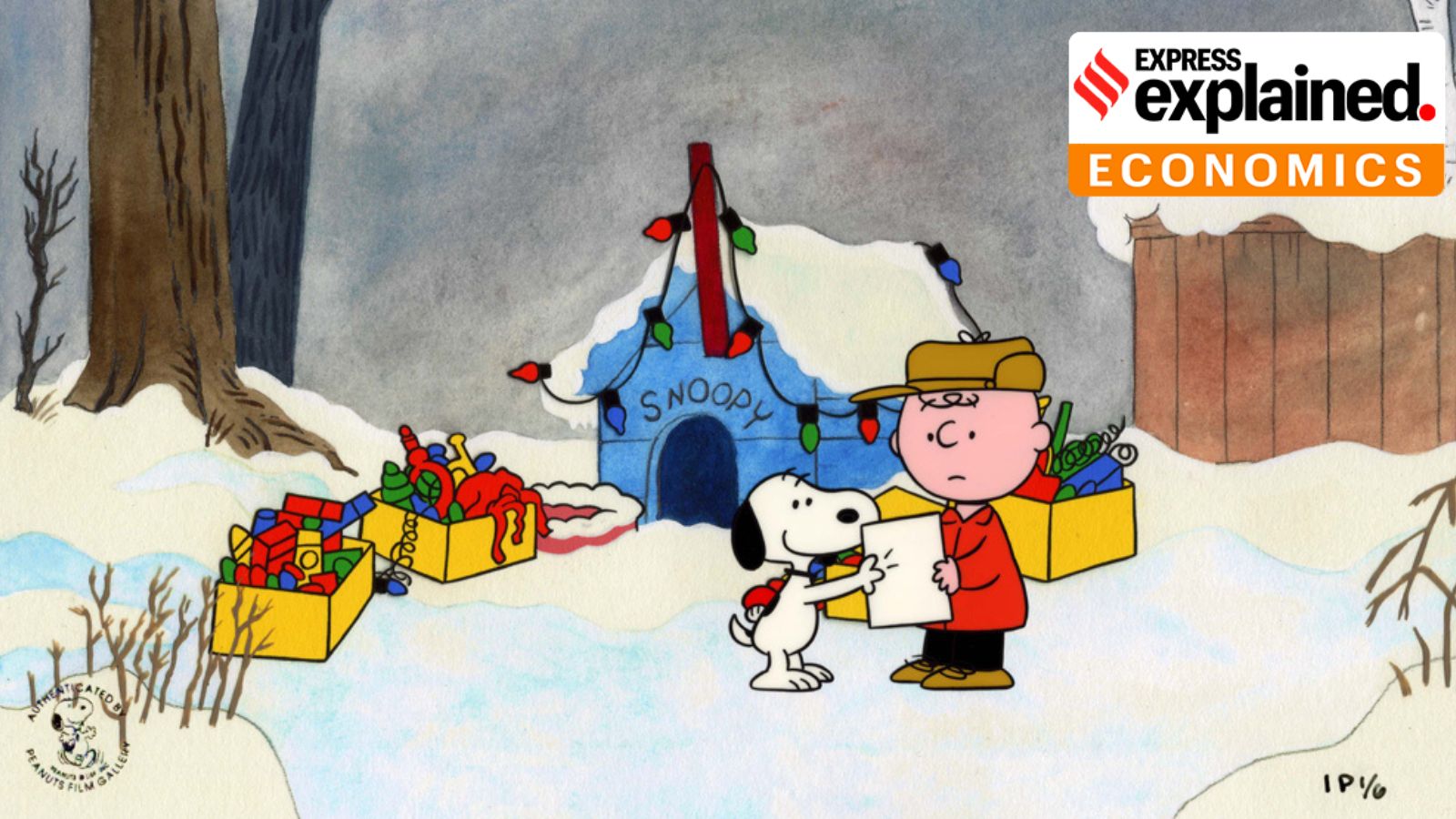
Sony announced last week it would acquire the majority stake in Peanuts Holding, the brand behind the iconic Snoopy and Charlie Brown characters.
The $457.5 million deal grants Sony 41% of the Peanuts brand from Wildbrain, its current owner and the Canadian children’s entertainment group. Sony’s stake in the brand, which it began building in 2018, would thus rise to 80%, and Peanuts would become a Sony subsidiary. The Schulz family, which owns the intellectual property created by cartoonist Charles Schulz, will continue to own the remaining 20 per cent.
The announcement aligns with the Japanese group’s larger vision of becoming the world’s foremost entertainment company, stepping away from its origins as a consumer electronics brand. Here is what to know.
The company was founded in 1946 as Tokyo Tsushin Kogyo or TKK, until it changed its name to Sony in 1958. It became known early on as a formidable electronics company sought by consumers for their transistor radios and video cameras, and eventually the ubiquitous Walkman cassette and CD players. Under the leadership of co-founder Akio Morita, the company grew to become a giant of consumer electronics.
Beyond electronics, the company began its efforts to expand its cultural footprint decades ago: Sony acquired Columbia Records in 1988 and Columbia Pictures in 1989. In 1994, it launched the PlayStation, which forever changed the landscape of home video gaming. All these efforts made it a conglomerate with sizable interests in the entertainment industry.
Morita’s vision for “convergence” guided the company’s strategy over the following decades, even as it sought to link its film and music businesses with digital electronics. The effort did not immediately pay off, and the company saw its share in its core consumer electronics sector tapering. Sony appointed its first non-Japanese CEO, Howard Stringer, in 2005. He made efforts to reduce costs and streamline operations. This did little to stem this decline. Sony ended up ceding ground to Apple in computing and digital media and to Samsung in the television space.
Stringer was succeeded in 2012 by Kazuo Hirai, who led the PlayStation division at the time. Hirai had a proven track record of success, having successfully turned around every business he led, and was instrumental in PlayStation’s return to form following its ill-fated PS3 launch in 2006.
Hirai made drastic changes to the company’s landscape, going on to sell the loss-making Vaio laptop business, scaling back smartphone production, and converting the TV and audio businesses into subsidiaries. At the same time, he pushed for more innovation. Under his leadership, the company made a successful turnaround, extending PlayStation’s lead over the gaming industry, as well as a successful streak of films from Sony Pictures.
He also oversaw a deal to integrate the Sony-owned Marvel character, Spiderman, into the larger Marvel Cinematic Universe by Marvel Studios. The deal allowed Sony to distribute and retain creative control over MCU films featuring Spider-Man in the lead. Tom Holland was thus introduced as the new Spider-Man in the MCU film Captain America: Civil War (2016), before his solo outing in Sony’s standalone Spider-Man: Homecoming (2017).
Kenichiro Yoshida, who took over as Sony CEO in 2018, had a similar reputation to Hirai. His mandate was simple – maintain Sony’s momentum, and transform it into a global entertainment giant.
Over the next seven years, the company invested over $10 billion into building a massive repository of music, movies and games, the three segments contributing about 60% of its annual revenue. Sony leveraged its acquired intellectual property (IP) to make massive profits, with popular games The Last of Us and Uncharted translating into wildly successful TV and film adaptations, respectively.
Spiderman: No Way Home (2021), uniting the three “variants” of the character to have graced the big screen, became Sony’s highest-grossing release of all time and grossed $1.92 billion worldwide. As one of the first MCU films to release after the seminal Avengers Endgame (2019), No Way Home captured the enthusiasm of MCU fans returning to the theatres post Covid.
Instead of venturing into the streaming business directly, Sony sold its film and TV rights to Disney and Netflix, allowing the company to focus on original content production. These moves were accompanied by its acquisition of anime streaming service CrunchyRoll in 2021 from AT&T. In an interview with The Financial Times in September 2024, Hiroki Totoki, Yoshida’s successor, noted that the company would now focus on generating original IP.
Sony’s successes were not limited to film during this period: the PlayStation 5, which it launched in 2020, has now sold over 84 million units worldwide. Sony’s game software revenue increased to ¥629.3 billion ($4 billion) in the quarter ended September 2025. And Sony’s image sensors continue to be the industry standard for makers of major smartphones, such as Apple and Samsung , and digital cameras, including its direct rivals, Nikon and Fujifilm.
American cartoonist Charles Schulz debuted the Peanuts cartoon strip on October 2, 1950, with four characters – Charlie Brown, and his two friends, Patty and Shermy. Snoopy the dog would make his debut on October 4.
Snoopy first appeared in the October 4, 1950 comic as a puppy. (Charles Schulz/Peanuts)
Over the next 50 years, Peanuts grew from a comic strip published in newspapers to become a household name worldwide, spawning toys and merchandise, TV programmes and films based on the characters. The comic celebrated its 75th anniversary this year.
Peanuts holds a special status in Japan. The comic made its debut in the country in 1969, with the cartoons translated by Shuntarō Tanikawa, the legendary poet. Japanese entertainment company, Sanrio, was inspired to design and launch Hello Kitty and associated characters after seeing how beloved Snoopy and his friends were.
Today, Japan is home to the lone museum outside the US featuring exhibits based on the characters.
In his 1999 essay for Bungei Shunjū magazine, Japanese cartoonist Fusanosuke Natsume ponders the relatability of the characters in Peanuts to generations of Japanese readers, even comparing the comic’s appeal with Doraemon, the blue robot cat. “I bet we can say that we all grew up living out the scenes drawn in Peanuts, worrying about the same stuff, and finding joy in the same stuff Charlie Brown and the gang did,” he wrote.