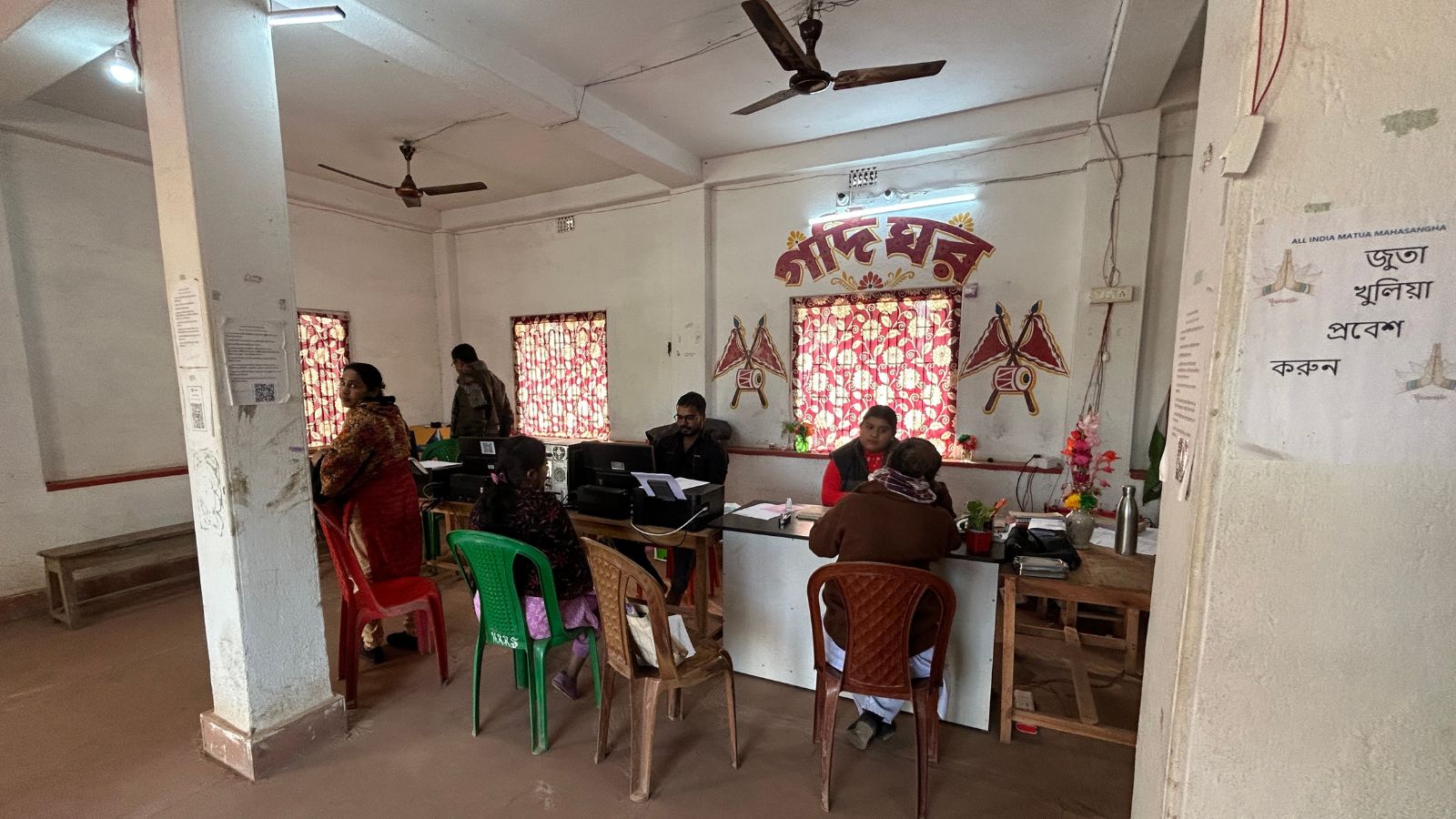
Holding his papers and sitting on a plastic chair inside a help centre set up at the Matua headquarters of Thakurbari in Thakurnagar, 75-year-old Motilal Haldar asks how much time it would take for a person to get citizenship under the Citizenship Amendment Act (CAA). Haldar says he crossed over from Bangladesh to West Bengal in 1997 and, with his name not being in the 2002 electoral rolls, the current round of Special Intensive Revision (SIR) of the voters’ list has him deeply concerned.
And Haldar is not alone. Like him, thousands of Matuas in and around the Matua heartland of Thakurnagar in North 24 Parganas district, about 90 km from Kolkata and close to the Bangladesh border, are spending their days in uncertainty over the SIR exercise. And so are Muslims, who have been wary ever since the Election Commission (EC) said it would focus on the border districts in the claims and objections phase, citing abundant “logical discrepancies” in the enumeration forms submitted. The Indian Express travelled from Bongaon near the Bangladesh border along Jessore Road (NH 35) to speak to members of both communities that will play a crucial role in the Assembly elections next year.
For the Matuas, the disquiet has increased since the draft rolls were published this month, with 58 lakh names struck off the rolls, including in the Assembly constituencies of Kasba and Sonarpur Dakshin in South 24 Parganas district and Bongaon Uttar in North 24 Parganas that have sizable numbers of community members. The unease in the electorally influential group intensified after Union Minister and Bongaon MP Shantanu Thakur, a member of the Thakur family that leads the community, on Monday asked, “If excluding 50 lakh Pakistani, Bangladeshi Muslims and Rohingyas means that 1 lakh people from my community are temporarily deprived of voting rights, which option is more beneficial?”
On Wednesday, after Thakur reiterated that no one could deny the names of several Matuas would be deleted from the voters’ list during SIR and that’s why “we are asking all to apply under CAA”, a clash took place between the BJP and Trinamool Congress (TMC) workers in Thakurnagar. While the TMC’s Rajya Sabha MP Mamata Bala Thakur, Shantanu’s aunt, told Express that the party’s supporters got beaten up when they went to the Union Minister to seek clarification, the BJP leader accused his aunt of sending goons to assault him.
Since August, both sides have been organising camps to help people like Haldar get papers in case they find their names struck off the voters’ list. While the TMC and Chief Minister Mamata Banerjee have alleged that the SIR marks the “backdoor entry” of the proposed National Register of Citizens (NRC) that may see thousands of Matuas lose their citizenship, the BJP has jumped in to allay the community’s concerns, accusing the TMC of spreading misinformation and pointing out that CAA will ensure Matuas receive citizenship.
“I have filed out an application under CAA. I have also filled out the SIR form. My two sons were born in India. We three have voter id cards. They were born here, so they will be allowed to stay. But I have no proof here except one related to the land I purchased here in 2014. If I am not allowed to have a voter card and then not allowed to live here, where will I go? They said it would take four to six months (for the CAA application to be processed). Will I be pushed out if I get my name deleted from the voter list?” Halder asks.
One of the volunteers at the camp set up by the All India Matua Mahasangha at Thakurbari, 31-year-old Arghyadip Mondal, also says it will take four to six months to get citizenship under CAA. He claims that more than 2,000 applications have been filed in the last four months.
Nadia resident Fulmoni Roy, 55, says she does not have a voter card. “I have only the Matua card and the Hindu card that they (the Mahasangha) gave us. Since my name is not in the electoral roll here, no enumeration form was issued for my name. I do not know what to do.”
Near the Gaighata bus stand, Barasat resident Sonali Rani Biswas, 45, says she has also applied for citizenship under CAA and that she can only provide registration documents of a land her family purchased here in 2014 if the EC summons her. “We don’t know what will happen after that,” she adds.
The Matuas form the largest chunk of the Namashudras, the largest Scheduled Caste group in the state. They are electorally crucial to the BJP’s plans since the party wants to build a pan-Hindu support base with Matuas at its core (their support had helped it win 18 Lok Sabha seats in West Bengal in 2019). Thus, the BJP is trying its best to allay the concerns among Matuas about the SIR and counter the TMC’s attempts to blame it for the alleged attempts to disenfranchise members of the community. While the state government estimates that the Matuas form around 17% of the electorate in the state and have a sizable presence in 30 Assembly constituencies, the community’s own estimate is that it comprises around 20% of the electorate, with a likely impact in 40-45 seats.
Though the draft rolls showed that deletion rates in Muslim-dominated Assembly seats, the EC’s planned hearings into alleged discrepancies in enumeration forms have led to concerns among the minority community too in North 24 Parganas.
In the town of Duttapukur, Ansar Ali Mollah, 56, says he fears being summoned because his name in the 2002 rolls was Md Ansari Ali Mollah. A mismatch in father’s name is also a cause of concern for Md Abul Kalam, 45.
One of the “logical discrepancies” that the EC is looking at, according to sources in the poll body, is electors with more than six children. “We are 10 brothers and sisters,” says schoolteacher Jahangir Hossain, 37. “We may be called in for a hearing and that is the reason for anxiety. We have every document, but it is a harassment to go there to stand in a queue for hours and show papers.”
Some in the area also claim that those who had moved across the border in the last two decades had their names up in the draft rolls. “Here, almost all Muslims are old residents and have land documents. But those we know came from Bangladesh in the last decade or two, their names are already included in the draft list. Then what is the purpose of an SIR?” asks 43-year-old Saheb Ali.