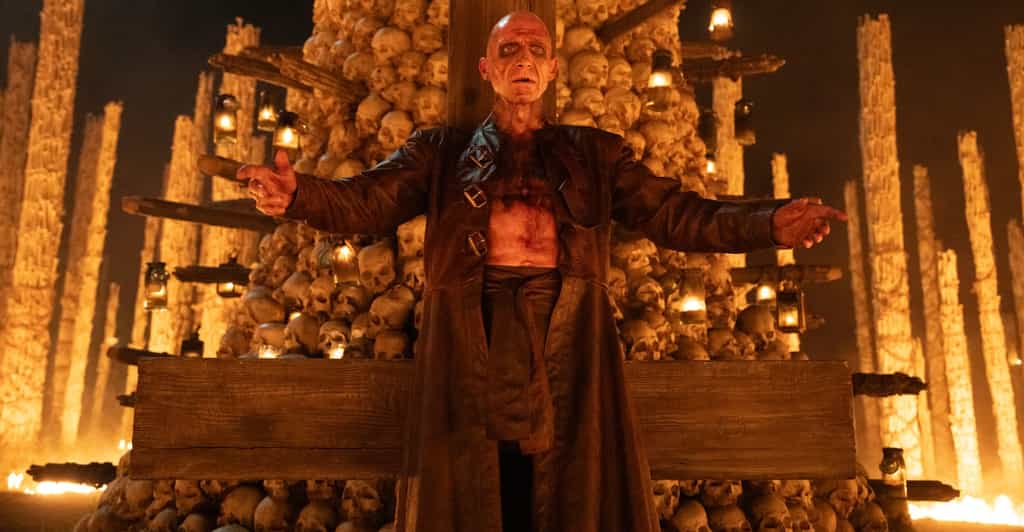
Because there was such a long gap between the releases of 28 Weeks Later and 28 Years Later, it was surprising to hear that writer-director duo Alex Garland and Danny Boyle already had plans for their latest collaboration to be the first chapter of a new horror trilogy. Sony seemed keen on fast-tracking the pair’s idea, as 28 Years Later and its sequel began shooting back to back. But it also felt like the studio wanted to bring a different kind of energy into the franchise when it tapped Nia DaCosta to direct the new film.
That energy and its distinctness from Boyle’s directorial voice is palpable in 28 Years Later: The Bone Temple — a film that understands how much more potent horror is when it’s laced with goofy humor. Though there’s no shortage of gore and stomach-turning violence, leaning into comedy is one of the movie’s more clever ways of illustrating what its characters are fighting for. Each of The Bone Temple’s jokes is a reminder of how, in a world full of flesh-eating ghouls, human connection and community are the kinds of things people are willing to die for.
The Bone Temple picks up soon after 28 Years Later to find teenager Spike (Alfie Williams) trying to make sense of his life as a newly inducted member of Sir Lord Jimmy Crystal’s (Jack O’Connell) roving cult of platinum blonde wig-wearing droogs who all go by “Jimmy.” Spike can handle himself alright against a couple of the infected lurking in the English wilderness, but his skills with a bow and arrow are nothing compared to the Jimmys’ ultraviolent approach to dealing with anything that crosses their path.
Murdering people — infected or not — at Jimmy Crystal’s command has become second nature for Jimmy Ink (Erin Kellyman), Jimmima (Emma Laird), and the rest of their demented crew. Spike finds it hard to buy Jimmy Crystal’s claims of being spoken to and directed by a higher, unseen power, but he knows that he has no choice but to join the gang and dress up like a sexual predator when they ask him to join their ranks.
It’s through the Jimmys as a unit that 28 Years Later starts exploring the ways that faith can be weaponized to harm the very same people that it provides psychological comfort to. The Jimmys are a twisted family bound by a genuine fondness for one another and an understanding that they’re safer as a group. But the movie presents their willingness to follow Jimmy Crystal as being born out of fear and a more general gullibility caused by society’s collapse.
One of the most striking things about O’Connell’s performance is how — for all of Jimmy Crystal’s psychopathy and moments of delusion — he makes the character come across as a scared boy trapped inside an unhinged man’s body. The movie says as much through Jimmy’s frequent mentions of the Teletubbies and the way he insists that his father, Satan, is whispering commands into his ear. Jimmy’s delusional rantings are convincing to his relatively young followers because they have grown up in a world where level-minded authority figures who can teach them fact from fiction are few and far between. But the cult leader’s bluster is less effective when it’s aimed at older people with more life experience and memories of the pre-plague world, like Dr. Ian Kelson (Ralph Fiennes).
It’s through Kelson that The Bone Temple starts to ask and answer a number of fascinating questions about those infected with the plague virus, like Samson (Chi Lewis-Parry), the hulking, spine-ripping Alpha introduced in 28 Years Later. The new movie spends much more time with these returning characters to give us a better understanding of what their lives have been like and how they’ve both been changed by meeting one another. Fiennes and Lewis-Parry are tremendous together as The Bone Temple moves Kelson and Samson closer in ways that are surprising, alarming, and unexpectedly funny. But as much levity as the pair bring to this story, The Bone Temple also uses them to remind you what humanity has lost in the 28 years since the Rage contagion got loose.
Whereas 28 Years Later felt very much like a film that was in conversation with zombie narratives inspired by 28 Days Later, The Bone Temple draws much of its inspiration from older pieces of the undead canon. DaCosta punctuates scenes of Samson’s berserker hunt for flesh with unsettling moments of stillness and tight, nauseating shots of him cracking skulls open to scarf down his victims’ brains. In the context of the movie, Samson is a new kind of infected — one with more intelligence and the ability to socialize with others like him. But as a screen presence, the character comes across a lot like a tribute to the shambling corpses that made George Romero a cinematic icon.
Though DaCosta inherited much of this story from Boyle and Garland’s last collaboration, she makes it her own by leaning into a less frenetic style of visual storytelling. Some of the movie’s biggest scares work because of how slowly they’re revealed. But just when it seems like the movie is at its most disturbing, DaCosta defuses some of that tension with a handful of perfectly placed needle drops.
It was hard to get a sense of how 28 Years Later might grow into a compelling trilogy. But The Bone Temple makes it clear that Boyle and Garland have been cooking with heat from the very beginning of this new chapter of the larger franchise. DaCosta masterfully sets up a number of promising developments for the trilogy’s conclusion, which will see Boyle return to wrap things up. And if the next film manages to inject a similar level of life into the undead genre, it will all have been worth the wait.
28 Days Later: The Bone Temple also stars Louis Ashbourne Serkis, Maura Bird, Ghazi Al Ruffai, Sam Locke, and Cillian Murphy. The film hits theaters on January 16th.
Follow topics and authors from this story to see more like this in your personalized homepage feed and to receive email updates.
Editorial Context & Insight
Original analysis and synthesis with multi-source verification
Methodology
This article includes original analysis and synthesis from our editorial team, cross-referenced with multiple primary sources to ensure depth, accuracy, and balanced perspective. All claims are fact-checked and verified before publication.
Primary Source
Verified Source
The Verge
Editorial Team
Senior Editor
James Chen
Specializes in Technology coverage
Quality Assurance
Associate Editor
Fact-checking and editorial standards compliance