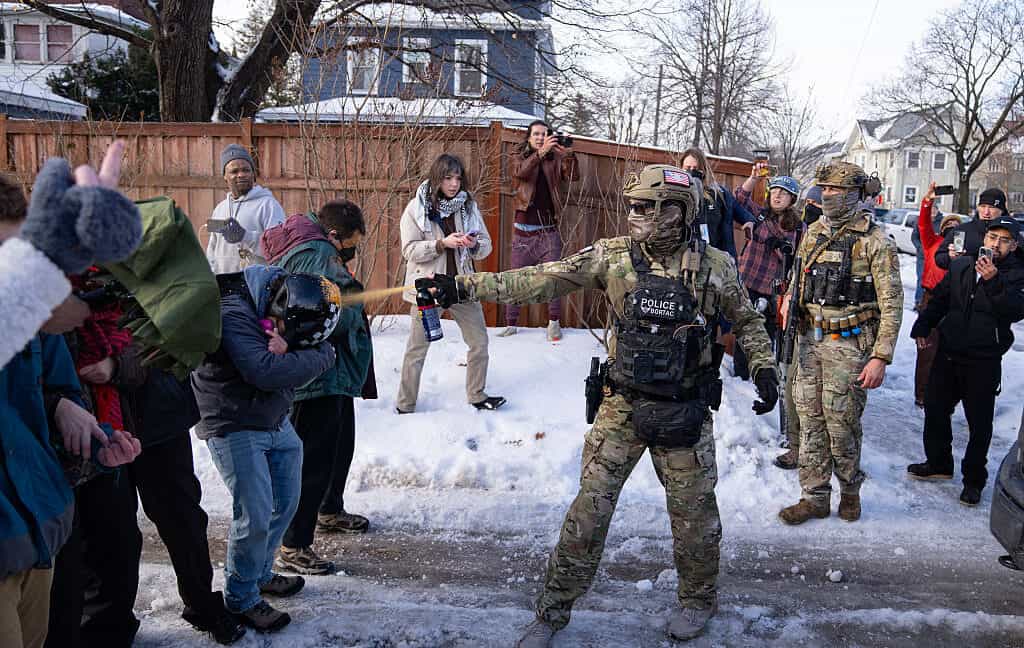
DHS is weirdly using import/export rules to expand its authority to identify online critics.
The US Department of Homeland Security (DHS) is fighting to unmask the owner of Facebook and Instagram accounts of a community watch group monitoring Immigration and Customs Enforcement (ICE) activity in Pennsylvania.
Defending the right to post about ICE sightings anonymously is a Meta account holder for MontCo Community Watch, John Doe.
Doe has alleged that when the DHS sent a “summons” to Meta asking for subscriber information, it infringed on core First Amendment-protected activity, i.e., the right to publish content critical of government agencies and officials without fear of government retaliation. He also accused DHS of ignoring federal rules and seeking to vastly expand its authority to subpoena information to unmask ICE’s biggest critics online.
“I believe that my anonymity is the only thing standing between me and unfair and unjust persecution by the government of the United States,” Doe said in his complaint.
In response, DHS alleged that the community watch group that posted “pictures and videos of agents’ faces, license plates, and weapons, among other things,” was akin to “threatening ICE agents to impede the performance of their duties.” Claiming that the subpoena had nothing to do with silencing government critics, they argued that a statute regulating imports and exports empowered DHS to investigate the group’s alleged threats to “assault, kidnap, or murder” ICE agents.
DHS claims that Meta must comply with the subpoena because the government needs to investigate a “serious” threat “to the safety of its agents and the performance of their duties.”
On Wednesday, a US district judge will hear arguments to decide if Doe is right or if DHS can broadly unmask critics online by claiming it’s investigating supposed threats to ICE agents. With more power, DHS officials have confirmed they plan to criminally prosecute critics posting ICE videos online, Doe alleged in a lawsuit filed last October.
DHS alleged that the community watch group posting “pictures and videos of agents’ faces, license plates, and weapons, among other things,” was akin to “threatening ICE agents to impede the performance of their duties.” Claiming that the subpoena had nothing to do with silencing government critics, they argued that DHS is authorized to investigate the group and that compelling interest supersedes Doe’s First Amendment rights.
According to Doe’s most recent court filing, DHS is pushing a broad reading of a statute that empowers DHS to subpoena information about the “importation/exportation of merchandise"—like records to determine duties owed or information to unmask a drug smuggler or child sex trafficker. DHS claims the statute isn’t just about imports and exports but also authorizes DHS to seize information about anyone they can tie to an investigation of potential crimes that violate US customs laws.
However, it seems to make no sense, Doe argued, that Congress would “silently embed unlimited subpoena authority in a provision keyed to the importation of goods.” Doe hopes the US district judge will agree that DHS’s summons was unconstitutional.
“The subscriber information for social media accounts publishing speech critical of ICE that DHS seeks is completely unrelated to the importation/exportation of merchandise; the records are outside the scope of DHS’s summons power,” Doe alleged.
And even if the court agrees on DHS’s reading of the statute, DHS has not established that unmasking the owner of the community watch accounts would be relevant to any legitimate criminal investigation, Doe alleged.
To convince the court that the case was really about chilling speech, Doe attached every post made on the group’s Facebook and Instagram feeds. None show threats or arguably implicit threats to “assault, kidnap, or murder any federal official,” as DHS claimed. Instead, the users shared “information and resources about immigrant rights, due process rights, fundraising, and vigils,” Doe said.
Ariel Shapell, an attorney representing Doe at the American Civil Liberties Union of Pennsylvania, told Ars that “if you go and look at the content on the Facebook and Instagram profiles at issue here, it’s pretty innocuous.”
DHS claimed to have received information about the group supposedly “stalking and gathering of intelligence on federal agents involved in ICE operations.” However, Doe argued that “unsurprisingly, neither DHS nor its declarant cites any post even allegedly constituting any such threat. To the contrary, all posts on these social media accounts constitute speech addressing important public issues fully protected under the First Amendment,” Doe argued.
“Reporting on, or even livestreaming, publicly occurring immigration operations is fully protected First Amendment activity,” Doe argued. “DHS does not, and cannot, show how such conduct constitutes an assault, kidnapping, or murder of a federal law enforcement officer, or a threat to do any of those things.”
Doe’s motion to quash the subpoena arrives at a time when recent YouGov polling suggests that Americans have reached a tipping point in ending support for ICE. YouGov’s poll found more people disapprove of how ICE is handling its job than approve, following the aftermath of nationwide anti-ICE protests over Renee Good’s killing. ICE critics have used footage of tragic events—like Good’s death and eight other ICE shootings since September—to support calls to remove ICE from embattled communities and abolish ICE.
As sharing ICE footage has swayed public debate, DHS has seemingly sought to subpoena Meta and possibly other platforms for subscriber information.
In October, Meta refused to provide names of users associated with Doe’s accounts—as well as “postal code, country, all email address(es) on file, date of account creation, registered telephone numbers, IP address at account signup, and logs showing IP address and date stamps for account accesses"—without further information from DHS. Meta then gave Doe the opportunity to move to quash the subpoena to stop the company from sharing information.
Editorial Context & Insight
Original analysis and synthesis with multi-source verification
Methodology
This article includes original analysis and synthesis from our editorial team, cross-referenced with multiple primary sources to ensure depth, accuracy, and balanced perspective. All claims are fact-checked and verified before publication.
Primary Source
Verified Source
Ars Technica
Editorial Team
Senior Editor
James Chen
Specializes in Technology coverage
Quality Assurance
Associate Editor
Fact-checking and editorial standards compliance