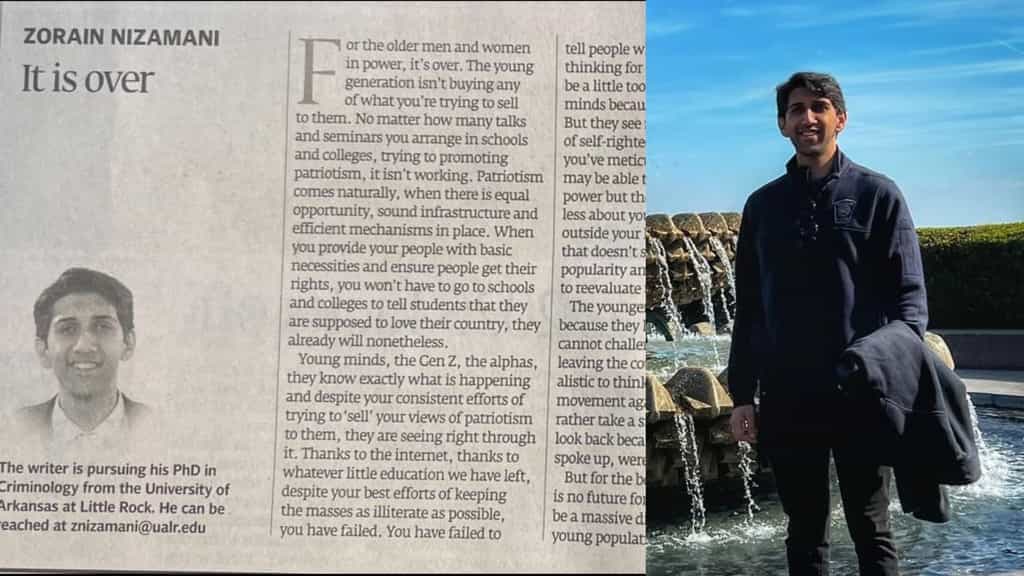
An opinion piece by Zorain Nizamani, a Pakistani PhD scholar based in the United States and son of actors Qaiser Khan Nizamani and Fazila Qazi, has unexpectedly set off a national debate after drawing sharp criticism of how Pakistan’s institutions engage with young people. The article’s swift removal has only intensified its impact, turning Nizamani into an unlikely youth symbol almost overnight.
Titled ‘It Is Over’, the op-ed appeared in The Express Tribune on January 1 before being taken down within hours. Although the publication offered no public explanation, the removal was widely attributed to pressure from the military. By then, screenshots of the printed column had already spread rapidly across social media, triggering outrage.
In the article, Nizamani, who is pursuing a PhD in criminology at the University of Arkansas, Little Rock, described what he sees as a widening gap between Pakistan’s ruling elite and its younger generations. He argued that traditional methods used by the state to shape public opinion, particularly among students, no longer resonate.
“For the older men and women in power, it’s over. The young generation isn’t buying any of what you’re trying to sell to them,” he wrote, adding that repeated seminars and patriotic messaging in schools and colleges have failed to inspire genuine loyalty.
Without directly naming the army, Nizamani questioned the idea that patriotism can be imposed through slogans or speeches. Instead, he said, it develops organically when people experience fairness and stability in their everyday lives. “Patriotism comes naturally when there is equal opportunity, sound infrastructure and efficient mechanisms in place,” he noted, arguing that citizens do not need to be told to love their country when their basic rights and needs are met.
A significant portion of the piece focused on Gen Z and Gen Alpha, whom he described as politically alert and far less susceptible to official narratives. According to Nizamani, widespread internet access and exposure to information have made it harder for authorities to control how young people think.
“Young minds, the Gen Z, the alphas, they know exactly what is happening… you have failed to tell people what to think, they are thinking for themselves,” he wrote, while also acknowledging the fear many feel about speaking openly. “They might be a little too scared to speak their minds because they prefer breathing.”
He went on to argue that frustration among the youth has reached a breaking point, with many choosing to leave Pakistan rather than confront powerful institutions directly. “They’d rather take a silent, quiet exit and not look back because their friends, who spoke up, were silenced,” he said.
The article’s removal prompted sharp reactions from journalists, activists and political groups. Rights activist Mehlaqa Samdani pointed out the irony of the situation, writing that the column’s disappearance from The Express Tribune was “exactly the kind of censorship Zorain talks about.”
Please read this brilliant article by Zorain Nizamani, a PhD student at the University of Arkansas, in which he bluntly tells Pakistan’s ruling elite that Gen Z is no longer falling for their attempts to manipulate and control narratives.
Not surprisingly, this article is no… pic.twitter.com/EV7nFWeQyt
— Mehlaqa Samdani (@MehlaqaCAPJ) January 1, 2026
Imran Khan’s Pakistan Tehreek-e-Insaf also amplified the piece online, posting that “Gen Z sees corruption, inequality, and hypocrisy clearly. Without justice, jobs, and dignity, propaganda fails.”
As the controversy grew, Nizamani issued a clarification on LinkedIn, distancing himself from party politics. He said the op-ed reflected only his personal observations. “My article was based on my personal views and my take on things. I do not carry disdain against anyone; there is enough hatred in the world,” he wrote, adding, “truth is always controversial.”
Editorial Context & Insight
Original analysis & verification
Methodology
This article includes original analysis and synthesis from our editorial team, cross-referenced with primary sources to ensure depth and accuracy.
Primary Source
The Indian Express