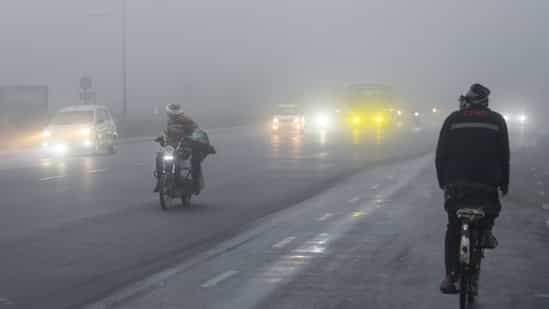
Cold wave conditions continued to grip north India on Sunday as Delhi residents woke up to a chilly morning as the minimum temperature fell to 4.8 degrees Celsius, as moderate fog covered the region, according to the India Meteorological Department (IMD). While the overall air quality index (AQI) improved to the ‘poor’ category, Delhi’s Indira Gandhi International (IGI) Airport issued an advisory for passengers.
On Saturday, Delhi saw its coldest morning of the season. The temperature slipped to 4.2 degrees Celsius, which was 2.7 degrees Celsius lower than usual, as per data from the India Meteorological Department. Air quality, however, worsened and reached the higher end of the ‘very poor’ category. The air quality index stood at 346 on Saturday, according to the Sameer application created by the Central Pollution Control Board (CPCB).
Several areas of the capital were colder than the city average, leading the IMD to announce cold wave conditions at isolated locations. Ayanagar saw the lowest minimum temperature at 2.9 degrees Celsius, followed by Palam at 3 degrees Celsius and the Ridge station at 3.7 degrees Celsius, the report said.
The Regional Meteorological Centre in the national capital said skies are expected to remain mostly clear through the day. It also forecast cold wave conditions in isolated areas and moderate fog during the morning hours.
Notably, cold wave conditions are expected to continue across parts of north and northwest India, including the Delhi-NCR region, over the next few days.
Nehru Nagar recorded the highest pollution level at 348. It was followed by Anand Vihar (338), Jahangirpuri (337), and Pusa (335).
Delhi’s Indira Gandhi International Airport issued an advisory on Sunday for passengers as fog and cold wave conditions affected the national capital. However, there have been no flight disruptions, according to the advisory.
“Low Visibility Procedures are in progress at Delhi Airport. All flight operations are presently normal. Passengers are advised to contact their respective airlines for the latest flight updates,” it said in the advisory.
Editorial Context & Insight
Original analysis & verification
Methodology
This article includes original analysis and synthesis from our editorial team, cross-referenced with primary sources to ensure depth and accuracy.