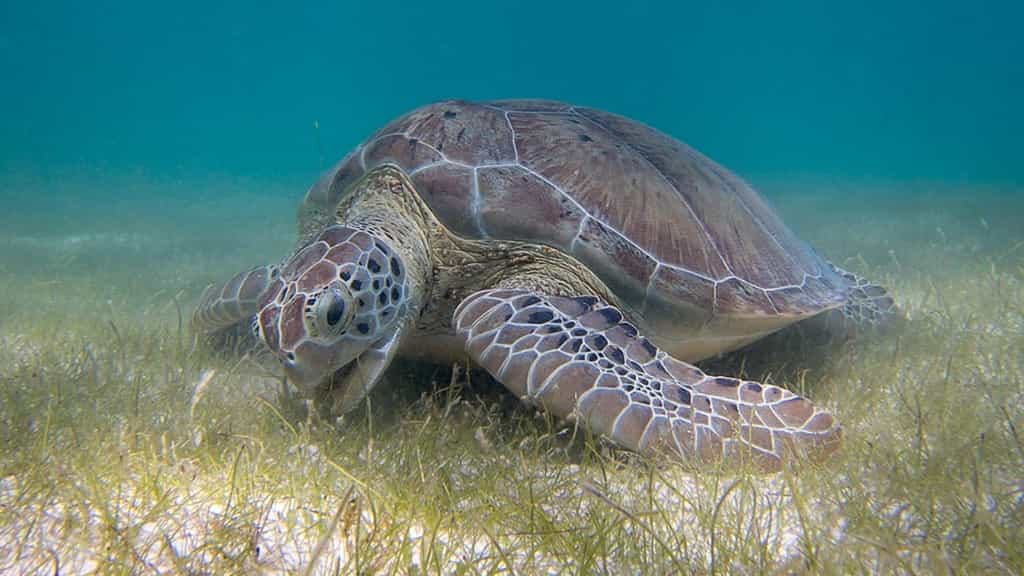
After years of decline in their number caused by overexploitation, habitat loss, and trade, the green sea turtle (Chelonia mydas) is now showing signs of recovery worldwide. The International Union for Conservation of Nature (IUCN) reported in October 2025 that the species’ status has improved from Endangered to Least Concern, making this one of the biggest marine conservation successes in recent years.
Found in tropical and subtropical oceans around the world, green sea turtles have seen their global population increase by approximately 28 per cent since the 1970s, a rebound attributed to sustained international conservation efforts spanning more than half a century, according to the conservation watchdog.
Green sea turtles are keystone species, meaning they help shape entire marine ecosystems. When they graze on seagrass meadows, they keep the grass from overgrowing and help create healthier habitats for fish, invertebrates, and coral reefs. Green turtles are also important to many coastal communities, which have valued them for cultural, culinary, spiritual, and recreational reasons for thousands of years.
A green sea turtle (Photo: Wikipedia)
This recovery was not accidental. Conservation efforts targeted the turtles’ most vulnerable stages. Nesting beaches were protected to stop egg harvesting, and nesting females were shielded from hunting and disturbance.
“The ongoing global recovery of the green turtle is a powerful example of what coordinated global conservation over decades can achieve to stabilise and even restore populations of long-lived marine species. Such approaches must focus not only on the turtles but on keeping their habitats healthy and their ecological functions intact. Sea turtles cannot survive without healthy oceans and coasts, and humans can’t either. Sustained conservation efforts are key to assuring that this recovery lasts,” said Roderic Mast, Co-Chair of IUCN’s Species Survival Commission Marine Turtle Specialist Group.
Community programs helped reduce unsustainable use of turtles and eggs, while international rules limited commercial trade. In fisheries, Turtle Excluder Devices (TEDs) and other tools have significantly reduced accidental turtle deaths.
Remarkable recoveries have happened in places like Ascension Island, Brazil, Mexico, and Hawai’i, where turtle numbers are now close to what they were before large-scale commercial hunting.
Even with their improved status, the IUCN warns that green sea turtles are not fully recovered. Their current numbers remain much lower than before European colonisation and widespread hunting.
Serious threats remain. In some areas, illegal and commercial harvesting of turtles and eggs still happens, and many turtles die as bycatch in fisheries. Coastal development is also destroying nesting beaches and feeding areas, leaving turtles with less space to survive.
Climate change is now one of the biggest challenges for green sea turtles. Higher temperatures alter the sand on nesting beaches and influence the sex ratio of hatchlings. On Raine Island in Australia, which is the world’s largest green turtle nesting site, fewer hatchlings have been produced for several years, worrying conservationists.
Rising sea levels, stronger storms, and warmer oceans threaten both nesting and feeding areas, showing how fragile this recovery is.
Editorial Context & Insight
Original analysis and synthesis with multi-source verification
Methodology
This article includes original analysis and synthesis from our editorial team, cross-referenced with multiple primary sources to ensure depth, accuracy, and balanced perspective. All claims are fact-checked and verified before publication.
Primary Source
Verified Source
The Indian Express
Editorial Team
Senior Editor
Dr. Elena Rodriguez
Specializes in India coverage
Quality Assurance
Associate Editor
Fact-checking and editorial standards compliance