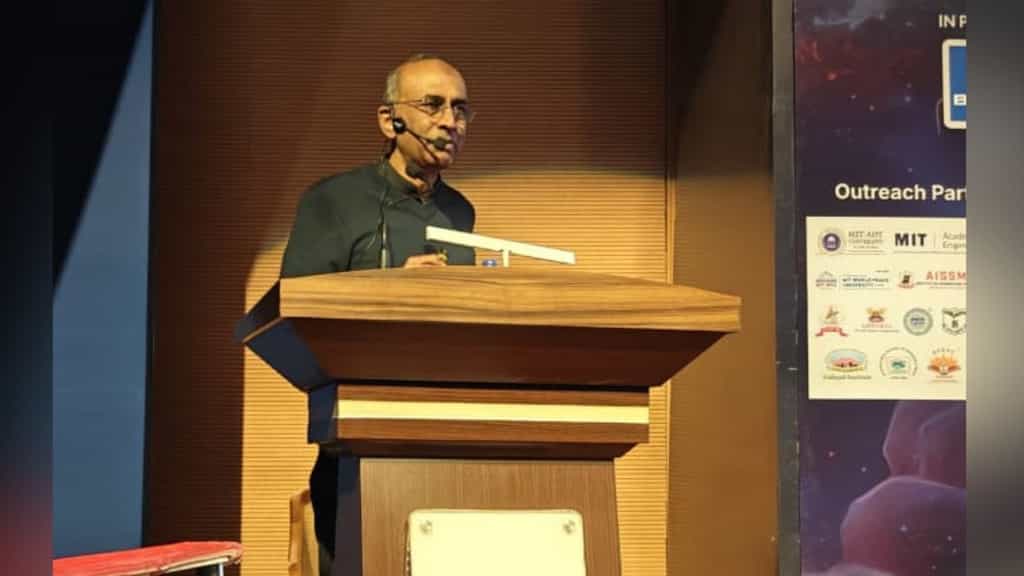
Dr Venki Ramakrishnan. (Express Photo)
Nobel laureate Dr Venki Ramakrishnan on Sunday said that decades of ageing research point to simple, robust advice: “Adequate sleep, sensible diet, regular physical activity, early detection of common metabolic disorders, evidence-based cancer screening, social engagement and a sense of purpose consistently do more for health span than any unproven anti-aging product.”
The eminent biologist was speaking at a lecture during the India Science Festival at IISER Pune.
The well-attended lecture, titled ‘Why We Die: The New Science of Ageing and the Quest for Immortality’, resisted what Dr K M Paknikar, noted scientist and one of the first recipients of the Prime Minister Professorship, described as “the temptation to offer a neat answer”.
Prof Ramakrishnan’s central message was that ageing is not a single problem waiting for a single cure.
“There is no master ageing gene, no universal biological clock that can simply be reset. Over the years, many hopeful interventions have emerged. Early studies linked mitochondrial damage and oxidative stress to cognitive decline in aging animals. Certain dietary supplements improved biochemical markers and even memory in rodents. Modern biology has given us extraordinary insight into how life works at the molecular level. We can sequence genomes, reprogram cells, and manipulate metabolism with remarkable precision. Yet aging remains stubbornly resistant to simple explanations or solutions,” Dr Ramakrishnan said.
He added that despite impressive laboratory results and the rapid growth of a global anti-aging market, there is still no convincing evidence that such interventions meaningfully extend human life.
The lecture also focused on health span — the number of years lived in reasonably good health. “In many countries, people are living longer but spending more years also with poor health,” Dr Ramakrishnan said.
According to Dr Paknikar, the lecture’s most important contribution was its intellectual honesty. “It did not answer why we die. Instead, it showed why that question has no simple answer and why chasing immortality may be the wrong goal altogether,” he said.
“Understanding aging, paradoxically, brings clarity. It reminds us that life is finite, that biology has limits, and that progress lies not in defeating death but in reducing suffering, preserving dignity and ensuring that longer lives, when achieved, are worth living,” Dr Paknikar said, referring to Dr Ramakrishnan’s talk.
The lecture also foregrounded a larger question — not how long we live, but how well. Social and economic conditions shape ageing as powerfully as genes or molecules. Longevity, far from being a purely scientific goal, is deeply entwined with ethics, economics and governance. According to Dr Ramakrishnan, the science of ageing ultimately teaches something deeply human: how we live matters far more than how long we live.
Editorial Context & Insight
Original analysis and synthesis with multi-source verification
Methodology
This article includes original analysis and synthesis from our editorial team, cross-referenced with multiple primary sources to ensure depth, accuracy, and balanced perspective. All claims are fact-checked and verified before publication.
Primary Source
Verified Source
The Indian Express
Editorial Team
Senior Editor
Shiv Shakti Mishra
Specializes in India coverage
Quality Assurance
Associate Editor
Fact-checking and editorial standards compliance