



Key takeaways
- Viral videos of the World Humanoid Robot Games show sprinting robots beating the human 100-meter record held by Usain Bolt—but also feature…
- That demonstration of both robotic prowess and limitations came from the second edition of the World Humanoid Robot Games hosted in Beijing…
- This year’s games also tested robots in more humdrum practical scenarios like washing and hanging laundry, where they appeared to lag…
What happened
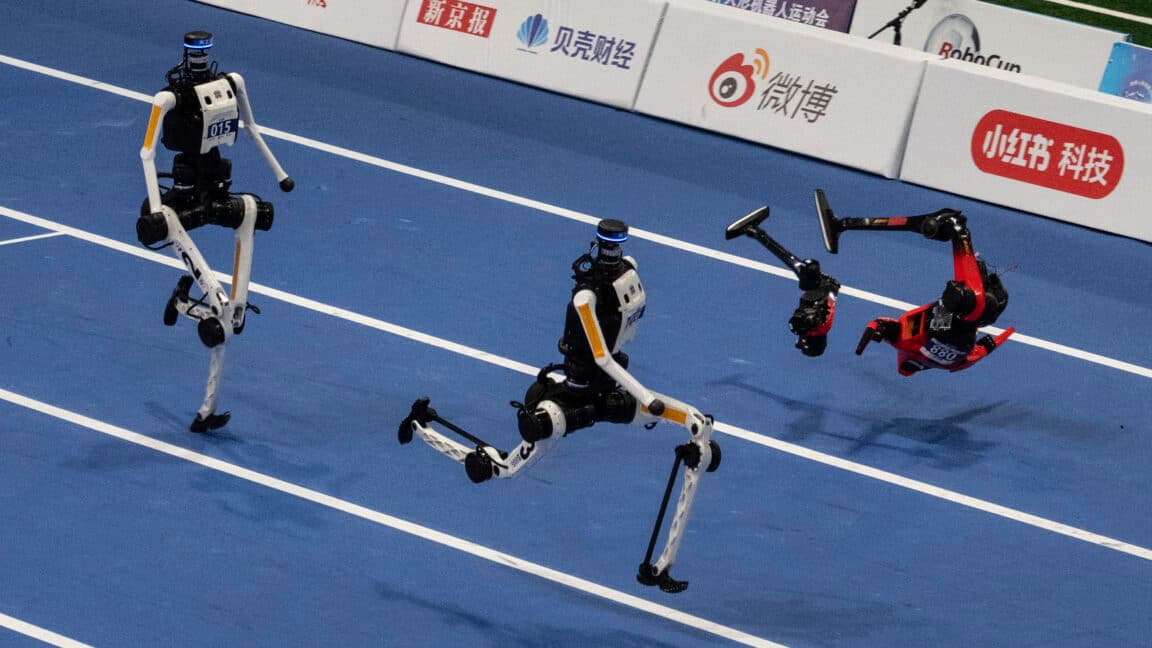
Viral videos of the World Humanoid Robot Games show sprinting robots beating the human 100-meter record held by Usain Bolt—but also feature running robots crashing into barriers and falling down because they cannot readily stop running. A few fallen robots even break at the waist in a shower of sparks or catch on fire.
One type of humanoid robot developed by the Beijing-based company X-Humanoid gained viral online fame for winning the small-group 400-meter race with an unusual “shy person hiding behind their hands” posture.
The robot’s developers told the Global Times that the robot learned through reinforcement learning trials in simulation to shift from a human-style runner’s arm swing to holding its arms up near its face and swinging them back and forth through hip rotations. Measures of robotic progress at the games could prove even more meaningful if, for example, they challenged robots to run the same race 10 times, Patel suggested.
That would require the robots to demonstrate they have the software and hardware to perform reliably over multiple trials—and maybe even learn to slow down safely without endangering themselves or any bystanders. The less flashy events that debuted during the World Humanoid Robot Games this year may ultimately prove more useful benchmarks for robotic progress.
Such scenario competitions included household chores, like washing laundry, folding clothes, and cleaning up living rooms, according to the Chinese state media publication the Global Times. Robots were also challenged by an unscheduled interruption when they had to bring a delivery package inside. That required them to switch tasks from the household chores to deal with receiving the delivery.
The Beijing Continental Grand Hotel provided robots with a different set of timed challenges, including moving wheeled luggage to assigned hotel rooms, cleaning up beds and restocking supplies. The Global Times also reported that a separate library shelving event challenged robots to collect book returns and put them in the correct place as a test of visual recognition and reasoning.
One of the livelier practical scenarios involved an outdoor firefighting and rescue event. Robots had 30 minutes to identify hazardous substances, locate and shut off three open valves of different types, spot a fire, and then find a fire extinguisher to put it out. Only three out of 12 competing robot teams completed the entire challenge, according to the Global Times.
Why it matters
That demonstration of both robotic prowess and limitations came from the second edition of the World Humanoid Robot Games hosted in Beijing from August 22–26. Like the inaugural event held in 2025, this year’s event challenged humanoid robots to run fast, perform kung fu or dance moves, fight one another in kickboxing, and play soccer or table tennis.
This year’s games also tested robots in more humdrum practical scenarios like washing and hanging laundry, where they appeared to lag behind typical human working speeds. That suggests the event organizers, including Chinese state media and the Beijing city government, are keen to showcase the commercial potential of humanoid robots at a time when China’s robotics industry is rapidly developing and testing such robots.
The fact that humanoid robots went from lagging behind human record-holders last year to surpassing human world records in the 100-meter sprint and standing high jump events this year suggests significant progress in robotic whole-body control for accomplishing specific tasks, Dipam Patel, a PhD candidate in computer science at Purdue University and a research assistant at the US Army DevCom Army Research Lab, told Ars.
“All of that does display whole body control, because you need to move all the joints, hands, legs, arm, body, everything to accomplish that task,” said Patel, who is also a graduate student member of IEEE. ” However, the robots on display in the World Humanoid Robot Games are still very far from general-purpose autonomous robots capable of handling practically any task.
Instead, these robots were engineered to accomplish just one task, as shown by the fact that the running robots sprinted in a straight line and could not even slow down by continuing around the track after the finish line. “If you cross the finish line, that’s the goal—it doesn’t matter if you stop and it doesn’t matter if you fall into different pieces,” Patel told Ars.
” The robotic races and other flashy events provide for an entertaining spectacle that can lead to easy news headlines and viral video clips. They also give robotics companies an opportunity to attract more publicity and investor money by potentially standing out from the competition, Patel said.
What to watch
Robots even participated in six events challenging hand dexterity, including picking up beans and driving screws. They also competed to precisely hammer nails into a corkboard without driving them in at an angle. But Patel observed that many of the robotic competitors were still being teleoperated by human operators who directly controlled the robots’ actions.