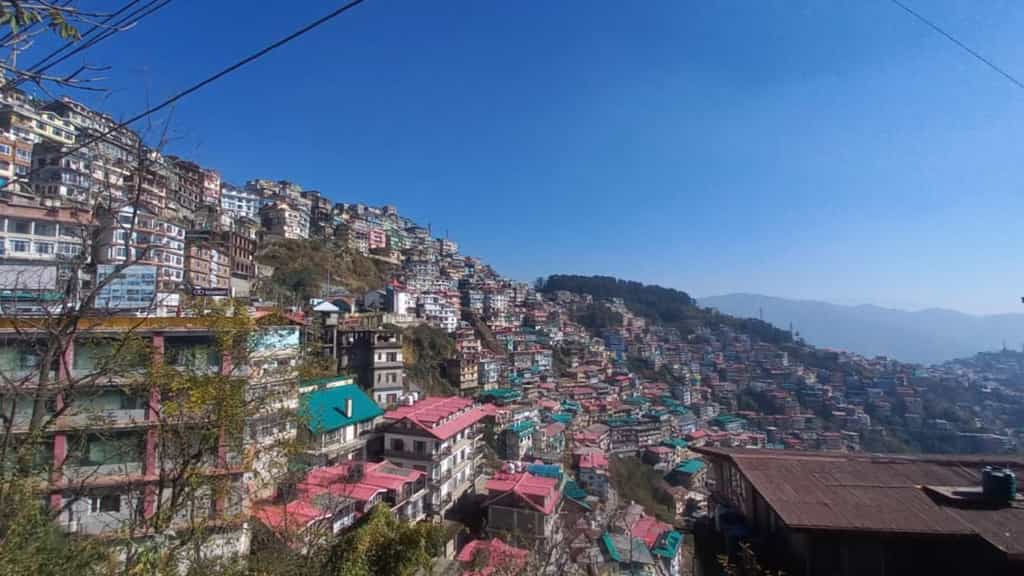
At a time when people in neighbouring states like Punjab and Haryana and the Union Territory of Chandigarh are battling poor visibility and severe cold conditions caused by dense to very fog, hilly regions of Himachal Pradesh bear a strikingly different weather pattern, marked by bright sunshine and clear skies.
Meteorological experts attribute this sharp contrast between the plains and the hills to a combination of topography, wind patterns, moisture levels and pollution load.
According to experts, stagnant air and moisture accumulation make the plains prone to fog formation, whereas the downward flow of winds from higher elevations to lower, the absence of large waterbodies, and relatively low levels of pollutants in the hill regions are the primary reasons behind the clearer conditions in Himachal’s higher reaches.
However, not all areas of Himachal are spared. Several low-lying regions in the state, like Una, Bilaspur, Kangra, Nalagarh, Baddi (Solan district) and Paonta Sahib (Sirmaur district), among others, are vulnerable to dense fog, low visibility and intense cold — much like the adjoining plains.
Traffic moves smoothly on a bright sunny day at Kandaghat in Solan district on Wednesday. (Expres photo)
Una recorded dense fog with 50m visibility, while Paonta Sahib recorded shallow fog with a 500m visibility on Wednesday morning.
Explaining the phenomenon, scientist Sandeep Kumar Sharma of the India Meteorological Department (IMD), Shimla, said the contrast between the plains and hill regions became particularly evident in recent days.
“The hills of Himachal Pradesh, including Shimla, Kasauli, Chail and Dharamshala, are experiencing bright sunshine and clear skies. There are three main reasons behind this,” Sharma said. “First, winds flow from higher elevations to lower. Second, these winds are weak and largely motionless, so they descend easily towards the plains, but lose momentum there, leading to a drop in temperature. Third, the presence of rivers, streams, waterbodies and higher pollutant content in the plains increases moisture, which aids fog formation.”
Sharma said fog-prone conditions are not limited to plains alone. “Similar situations also develop in valleys — low-lying areas between hills or mountains — even in mountainous states like Himachal Pradesh,” he said.
Offering further insight, scientist Surinder Paul, in-charge of the IMD Chandigarh, told The Indian Express, “Weak northerly winds play a crucial role in fog formation. The northerly wind, which blows from north to south, is weak. When it reaches the plains and valleys and comes into contact with moisture, fog forms. The presence of pollutants further increases the density of fog.”
Paul explained that during winter, plains frequently experience temperature inversion, a phenomenon in which colder air becomes trapped near the ground while warmer air remains above it. “This inversion restricts vertical air movement, allowing moisture, pollutants and cold air to accumulate near the surface, leading to persistent fog and smog,” he said.
Drawing a comparison with monsoon conditions, Paul, who previously served as an IMD in-charge in Shimla, said hills do experience fog-like conditions during the monsoon, but these are actually low clouds. “These clouds typically form at a height of around two kilometres and fall under the category of low clouds,” he said.
“In winter, hill stations remain above the inversion layer. At higher elevations, the air is relatively warmer and drier, allowing sunlight to pass through easily,” he added.
While western disturbances may occasionally bring cloud cover or snowfall to higher reaches, meteorologists say in their absence, hill regions often enjoy crisp, sunny days, even as the plains below remain shrouded in fog for prolonged periods.
Editorial Context & Insight
Original analysis and synthesis with multi-source verification
Methodology
This article includes original analysis and synthesis from our editorial team, cross-referenced with multiple primary sources to ensure depth, accuracy, and balanced perspective. All claims are fact-checked and verified before publication.
Primary Source
Verified Source
The Indian Express
Editorial Team
Senior Editor
James Chen
Specializes in India coverage
Quality Assurance
Copy Chief
Fact-checking and editorial standards compliance