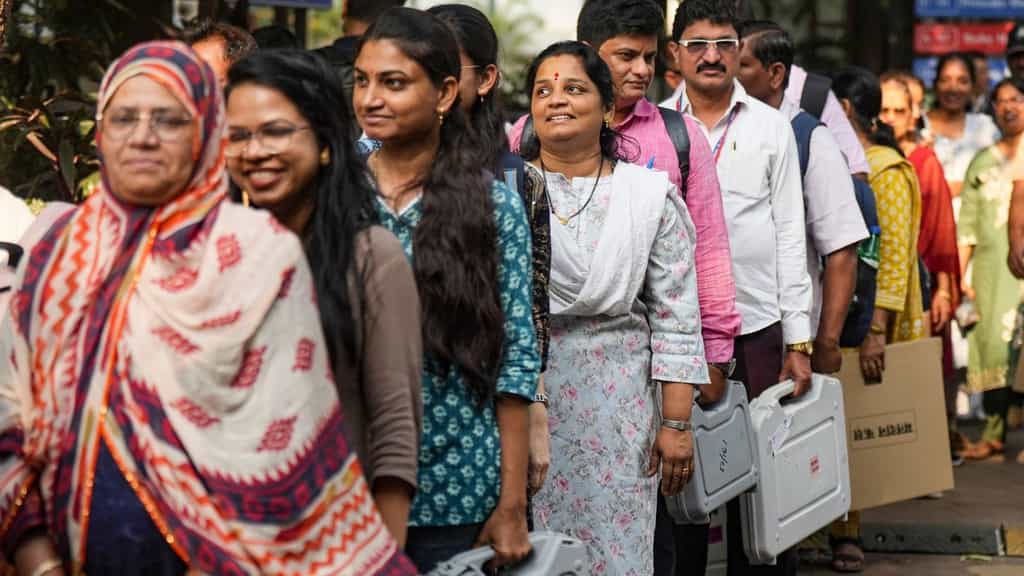
The 29 municipal corporations, including the Brihanmumbai Municipal Corporation (BMC) in Mumbai, which goes to polls in Maharashtra on Wednesday will see the ruling alliance try to retain supremacy despite clear faultlines within its three allies and a struggling Opposition try to keep up the political heat and stay relevant. A high-octane campaign for the urban civic bodies witnessed alliances breaking and new ones forming.
While elections were originally scheduled for 2,869 seats, including 227 in the BMC, polls will now be held for 2,801 seats as 68 candidates were elected unopposed. No polling will occur for these 68 seats.
The poll season that kicked off with the controversy over the unopposed election of corporators with the Opposition alleging the use of money and muscle power culminated with yet another controversy as the State Election Commission (SEC) allowed door-to-door campaign even after campaigning ended on January 13. The SEC has clarified it has sought reports from municipal commissioners on the unopposed polls and that the rule for door-to-door campaign has been there since 2012.
The last day before polling witnessed widespread allegations of the ruling BJP and Shiv Sena led by Deputy Chief Minister Eknath Shinde distributing money. Areas such as Vasai, Dombivli, Thane, Panvel, Akola, Nagpur, Pune and Pimpri-Chinchwad reported such instances.
In a never-seen-before political development in the state, the traditional battlelines of Maharashtra politics have dissolved into chaos during these polls. The ruling Mahayuti and Opposition Maha Vikas Aghadi (MVA) have not only failed to maintain a uniform political equation across different regions, but neighbouring cities are also witnessing a political shift, with an ally in one city emerging as the main opponent in the next.
For example, the BJP and Shinde-led Shiv Sena have formed an alliance in Mumbai, Thane and Kalyan-Dombivli, but will be fighting against each other in Mira-Bhayander and Navi Mumbai. The BJP and the Ajit Pawar-led NCP will take on each other in Pune and Pimpri-Chinchwad, but have an alliance in Ahilyanagar and Kolhapur.
The violence between Shinde-led Sena and BJP marked campaigning in Thane, Navi Mumbai and Kalyan-Dombivli. In Pune, Deputy Chief Minister Ajit Pawar took on the BJP aggressively, prompting state BJP chief Ravindra Chavan to repent the decision of allying with Pawar in the state government.
Similarly, while an Opposition party is squaring against a ruling party in one city, it seek votes in alliance with the ruling party in another. For example, the Sharad Pawar-led NCP (SP) has allied with the NCP in Pune, Pimpri-Chinchwad (PCMC) and Parbhani and will take on Opposition partners Congress and the Uddhav Thackeray-led Shiv Sena (UBT). The Congress has walked out of the MVA in Mumbai, Thane, Nagpur, and Chandrapur, among others.
The NCP and NCP (SP) joining hands in Pune and PCMC has reignited the talks of merger between the two parties. While the leaders from both the parties have maintained silence, sources hint that the process of two parties coming together has begun.
The Congress too joined hands with the Prakash Ambedkar-led Vanchit Bahujan Aghadi (VBA) in Latur, Nanded and Mumbai.
Top leaders of all the parties joined the campaign with Chief Minister Devendra Fadnavis leading for the BJP across the state. Shinde too ensured his presence by visiting over 51 places. Ajit Pawar on the other hand chose to concentrate his power to safeguard his bastion of Pune and PCMC.
From the Opposition, Maharashtra Congress chief Harshvardhan Sapkal held rallies in all municipal corporations where the elections will be held. Ambedkar and his son Sujat too travelled extensively, focusing on Akola, Amaravati, Solapur and Mumbai.
Except for Mumbai, elections in the other 28 municipal corporations are being conducted under the multi-member ward system. In Mumbai, voters will cast only one vote as each ward elects a single representative. In the remaining 28 corporations, most wards will have four seats, while some may have three or five.
The Assembly constituency voter lists prepared by the Election Commission of India (ECI) are used for local body elections. As per legal provisions, the SEC fixed July 1, 2025 as the notified date and divided the existing Assembly lists into ward-wise lists. A double asterisk (**) mark has been placed next to the names of potential duplicate voters in the ward-wise lists. These voters were urged to clarify which polling station they intend to vote at. Door-to-door verification was conducted, and applications were collected in a prescribed format. Such voters will only be allowed to vote at their specified station. If an application was not collected for some reason, the voter must provide an undertaking at the polling station stating they have not voted elsewhere. They will be allowed to vote only after strict identity verification.
Editorial Context & Insight
Original analysis and synthesis with multi-source verification
Methodology
This article includes original analysis and synthesis from our editorial team, cross-referenced with multiple primary sources to ensure depth, accuracy, and balanced perspective. All claims are fact-checked and verified before publication.
Primary Source
Verified Source
The Indian Express
Editorial Team
Senior Editor
Shiv Shakti Mishra
Specializes in India coverage
Quality Assurance
Associate Editor
Fact-checking and editorial standards compliance