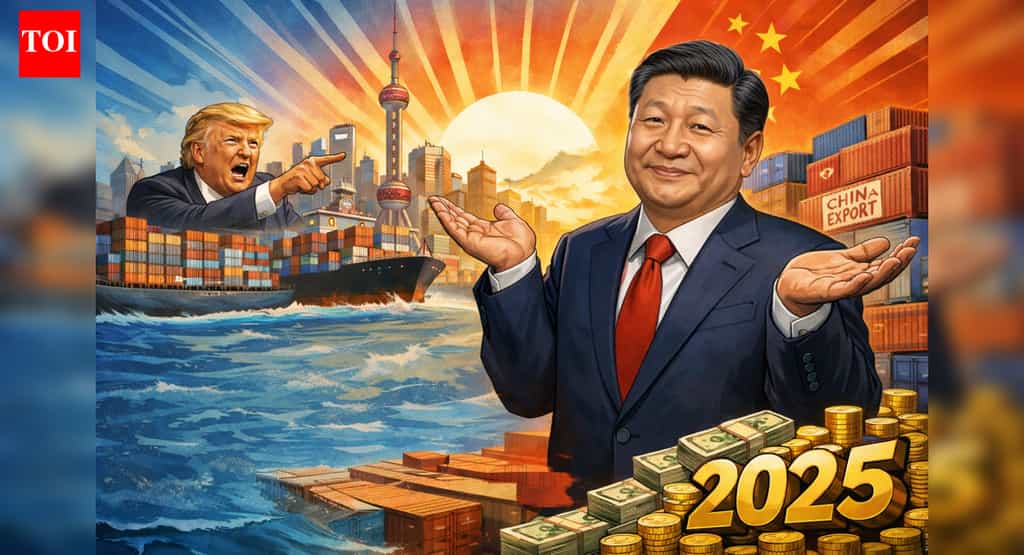
China closed 2025 with a trade surplus of roughly $1.2 trillion, the largest ever recorded by any country.Driving the newsChina’s highest-ever trade surplus is a sharp reminder that higher US tariffs under President Donald Trump have so far failed to derail Beijing’s export-led growth.
Customs data released on Wednesday showed exports rising 6.6% in December from a year earlier, the fastest pace in three months and well above expectations, according to Bloomberg News. Economists surveyed by Bloomberg had forecast a 3.1% increase.Imports also surprised to the upside, climbing 5.7%, leaving a $114 billion surplus for December alone - the biggest in six months and one of the highest monthly readings on record.For the full year, China’s surplus rose about 20% from 2024, breaking through the trillion-dollar mark before December and cementing a run of trade dominance unmatched by any major economy.Zoom inDecember’s figures capture how quickly Chinese exporters adapt under pressure.Monthly trade surpluses exceeded $100 billion seven times in 2025, up from just once in 2024, Reuters reported. Export growth beat forecasts even as US-bound shipments slumped, underscoring the effectiveness of China’s market diversification strategy.
Imports rebounded more than expected, but not nearly enough to offset the export surge.China has not posted a trade deficit since 1993. Even adjusted for inflation, its 2025 surplus dwarfs historical peaks elsewhere. Japan’s surplus topped out at the equivalent of about $214 billion in today’s dollars in the early 1990s, while Germany’s peaked near $364 billion after Europe’s debt crisis - both a fraction of China’s current level, the New York Times noted.
The big pictureChina’s record surplus reflects a collision of structural forces that tariffs alone cannot easily reverse.1. First: manufacturing dominanceChina has spent years building scale, supply-chain depth and cost advantages across key industries - from autos and electronics to batteries, solar panels and lower-grade chips. Reuters reported that vehicle exports jumped 19.4% in 2025, with pure electric vehicle shipments surging nearly 49%, keeping China on track to remain the world’s top auto exporter for a third straight year.2. Second: weak domestic demandImports remain constrained by a prolonged property downturn, falling investment and cautious consumers. Since a housing market crash began in 2021, many households have seen their savings evaporate, curbing demand for imported goods - and even dampening purchases of domestic products.Bloomberg noted that Beijing’s long-running industrial policies aimed at import substitution and self-reliance have further suppressed inbound trade, reinforcing the surplus.3. Third: currency dynamicsA relatively weak yuan has boosted export competitiveness. While the currency has edged up against the dollar, it lost more than 7% against the euro last year. Adjusted for deflation at home and higher inflation elsewhere, China’s real effective exchange rate -a key measure of export competitiveness - sits near its weakest level in years, according to Bloomberg.What they are sayingChinese officials argue the surplus reflects resilience, not distortion.Vice customs minister Wang Jun told reporters in Beijing that trade in 2025 “surpassed 45 trillion yuan ($6.4 trillion) for the first time, setting a new historical high”. He blamed weak imports in part on foreign restrictions, saying, “Some country has politicised trade issues and limited high tech exports to China, if they hadn’t, we would have imported more.”Looking ahead, Wang said China’s market would “open more” in 2026 and would “still be an opportunity for the world.”Private-sector economists see exports continuing to do heavy lifting. “We continue to expect exports to act as a big growth driver in 2026,” Jacqueline Rong, chief China economist at BNP Paribas, told AP.International institutions are more cautious. After China’s surplus passed $1 trillion late last year, International Monetary Fund Managing Director Kristalina Georgieva warned in Beijing that China should rely less on exports and more on domestic consumption.“As the second-largest economy in the world, China is simply too big to generate much growth from exports, and continuing to depend on export-led growth risks furthering global trade tensions,” she said.
China’s stronger-than-expected export growth in December shows its export engine continued to support the economy in the final quarter of 2025 when domestic drivers weakened. Higher shipments to non-US markets again more than offset the tariff-driven slump in exports to the US. Looking ahead, export resilience is likely to extend into 2026.
Eric Zhu, a Bloomberg economist
Between the linesThe scale of the surplus helps explain why markets have largely shrugged off Trump’s latest tariff threats.This week, Trump announced a 25% tariff on countries trading with Iran, a move that risks complicating relations with China, the world’s top buyer of Iranian oil.
Bloomberg reported that the threat could undermine a one-year trade truce between Washington and Beijing.Yet stocks and bonds barely reacted. “The market does not care about Trump’s capricious tariff threats,” Vey-Sern Ling of Union Bancaire Privee told Bloomberg, adding that Trump is unlikely to jeopardize the China truce simply to pressure Iran.Behind the scenes, Beijing is also adjusting. Authorities have moved to rein in some exports to ease tensions and curb deflation driven by excess capacity.
Export tax rebates on hundreds of products - including solar cells and batteries - will be scrapped starting in April, according to an official announcement cited by Bloomberg.Chinese leaders have also struck a more conciliatory tone. Premier Li Qiang recently called for “proactively expanding imports and promoting the balanced development of imports and exports,” comments reported by Reuters and seen as a signal to trading partners that Beijing recognizes the political costs of runaway surpluses.What’s nextLooking into 2026, economists expect export growth to moderate but remain a central pillar of China’s economy.A high base of comparison, rising trade barriers in Europe and emerging markets, and political pressure over overcapacity could slow momentum. But strong global demand for competitively priced goods - combined with Chinese firms setting up overseas production hubs to reduce tariff exposure - is likely to keep shipments elevated.The bigger uncertainty is political. Trump’s renewed tariff threats, particularly those linked to Iran, risk reopening fault lines with Beijing. Chinese officials have warned they will take “appropriate action” if Washington violates existing trade agreements.For now, the data tell a clear story: Trump’s tariffs have bent China’s trade flows - but they haven’t broken the export machine.China has not run a trade deficit since 1993. In 2025, it pushed its surplus into territory no other economy has ever reached. The lesson of the year is blunt. However loudly tariffs are announced, China’s export engine has become adept at driving around them.(With inputs from agencies)
Editorial Context & Insight
Original analysis and synthesis with multi-source verification
Methodology
This article includes original analysis and synthesis from our editorial team, cross-referenced with multiple primary sources to ensure depth, accuracy, and balanced perspective. All claims are fact-checked and verified before publication.
Primary Source
Verified Source
Times of India
Editorial Team
Senior Editor
Shiv Shakti Mishra
Specializes in India coverage
Quality Assurance
Associate Editor
Fact-checking and editorial standards compliance