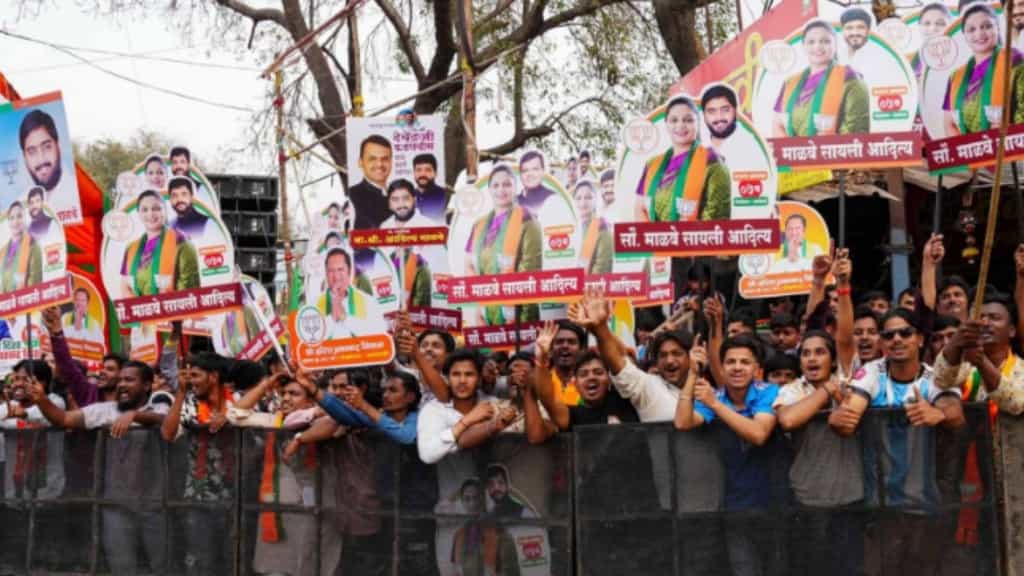
In the Maharashtra elections in 29 municipal corporations, scheduled for Thursday, the BJP led an aggressive campaign, even as these polls have turned into a battle for survival for regional parties, both in the ruling Mahayuti and the Opposition Maha Vikas Aghadi (MVA) alliances.
With the elections to the Brihanmumbai Municipal Corporation (BMC), India’s richest civic body, among the most hotly contested corporations in the state, several factors have marked the significance of these polls, ranging from fractured coalitions to the assertion of Marathi identity.
The BJP’s renewed aggression in the local body elections, particularly for the BMC, has taken many by surprise.
Explaining the BJP’s intense electioneering, Chief Minister Devendra Fadnavis said, “Many are ridiculing me for running a hectic campaign and holding so many rallies. But what you don’t realise is these local bodies elections are driven by karyakartas (grassroots workers). I feel it is our duty to support and stand by our karyakartas. After all, they are our backbone. It is their hard and selfless work that helps build and expand the organisation.”
Drawing a comparison with the BJP’s rivals, Fadnavis claimed, “When you ignore grassroots workers, a party cannot survive. The classic example is the Congress and Uddhav Thackeray led-Shiv Sena (UBT).”
According to the BJP’s poll managers, the party had drawn a list of 40 star campaigners, including leaders from outside Maharashtra, to connect with voters based on various caste and community groups. The party however avoided campaign events led by Prime Minister Narendra Modi and Union Home Minister Amit Shah. With Fadnavis reassuring the BJP’s central leadership that he would be able to reach out to voters across all municipal corporations, the BJP felt that a campaign centred on Modi and Shah may prove counterproductive by giving the Opposition reasons to rake up national issues in local polls.
Maharashtra CM Devendra Fadnavis, DCM Eknath Shinde and other party leaders take part in the launch of the Mumbai municipal corporation election manifesto ahead of BMC election, at Bandra east in Mumbai on 11 January 2026.(Express photo by Sankhadeep Banerjee)
While past local body elections have also witnessed high drama and regional flashpoints, these elections saw the reunion of the once-estranged Thackeray cousins – Shiv Sena (UBT) chief Uddhav and Maharashtra Navnirman Sena (MNS) president Raj – after 20 years.
The Thackerays centred their local body election campaign around the Marathi manoos – or sons of the soil – sentiment to evoke a sense of regional pride.
They also invoked the Samyukta Maharashtra Samiti – a movement in the 1950s that demanded a separate Marathi-speaking state – to draw parallels to an alleged ongoing “plot” to break Mumbai away from the rest of Maharashtra.
On Sunday, at a rally in Mumbai’s Shivaji Park, Raj said, “Now, Modi-Shah have let loose industrialists to grab Mumbai’s land. Once you lose land and language, you become an outsider in your own state. And that is the BJP’s long-term plan to dislodge Marathi manoos from Mumbai.” Echoing similar sentiments at the rally, Uddhav said, “All mega projects from Mumbai were relocated to Gujarat.”
With the Thackerays gaining traction with their Marathi manoos plank, both the Congress and BJP have been forced to come out with their counter planks.
The BJP used its Hindutva pitch to unsettle the Sena (UBT) for courting a Muslim vote bank through its MVA alliance with the Congress and Sharad Pawar-led Nationalist Congress Party (SP). The BJP has also promised that a Hindu-Marathi leader would be Mumbai’s next mayor, if it wins the elections.
Shiv Sena (UBT) chief Uddhav Thackeray and Maharashtra Navnirman Sena president Raj Thackeray formally announced their alliance for the Brihanmumbai Municipal Corporation (BMC) elections. (Express Photo By Ganesh Shirsekar)
“From giving Marathi a ‘classical language’ status to affordable houses to sons of the soil through the redevelopment of the Bombay Development Department (BDD) chawls, the BJP showed its commitment to Marathi manoos through its work,” said BJP minister Ashish Shelar.
Fadnavis argued, “Had it not been for the Marathi manoos support, the BJP would not have emerged as the largest party in the last three successive Assembly polls in Maharashtra and Mumbai.”
Though the Congress has focused on regaining its traditional vote bank of north Indian migrants, Dalits and Muslims, it could not afford to ignore the Marathi manoos issue. State Congress president Harshvardhan Sapkal said, “The Congress is the only party raising a voice against industrialists who are exploiting Marathi manoos in Mumbai.”
Polling officials gather to collect EVMs and other election material at a distribution centre, a day before Brihanmumbai Municipal Corporation (BMC) elections, in Mumbai, Wednesday, Jan. 14, 2026. (PTI Photo)
Over the last year, Mumbai witnessed several cases of anti-migrant incidents, especially involving MNS workers who allegedly targeted several migrants for not speaking Marathi.
But in the campaign for the local body elections, the migrant issue was downplayed by the contenders. The Thackerays, too, did not shut out potential support among migrants amid their fears that sharper polarisation may end up driving migrant voters en masse towards the BJP.
As the Congress gradually lost popularity across the state, north Indians, who account for more than 20% of Mumbai’s population, found a refuge in the BJP. In the BMC polls, the BJP is banking on north Indian and Gujarati communities to help counter the Thackerays’ Marathi manoos pitch.
Crowd gathers ahead of Mahayuti public meeting, at Dadar west in Mumbai on 12 January 2026. (Express photo by Sankhadeep Banerjee)
Despite state-level alliances remaining intact, the civic body polls have led to splits within the Mahayuti as well as the MVA, turning the contests in several corporations into multi-cornered fights.
Among the Mahayuti parties, while the BJP and Deputy CM Eknath Shinde-led Shiv Sena are allied in 14 municipal corporations, including Mumbai, Thane and Nagpur, they are in direct competition in the remaining 15 civic bodies. The BJP and Deputy CM Ajit Pawar-led NCP are contesting separately, with Pune and Pimpri-Chinchwad set to see their keen contests. The alliance’s failure to come together is an indication of the power tussle as each partner is looking to expand its influence while retaining their strongholds.
Similarly, on the MVA front, the Sena (UBT), MNS and NCP(SP) recognise that following the drubbing of the 2024 Assembly elections, these local body elections have come as a “do-or-die battle”. In a tactical gamble, the NCP(SP) has struck an alliance with the NCP in Pune and Pimpri-Chinchwad in a bid to avoid a division of votes.
Editorial Context & Insight
Original analysis and synthesis with multi-source verification
Methodology
This article includes original analysis and synthesis from our editorial team, cross-referenced with multiple primary sources to ensure depth, accuracy, and balanced perspective. All claims are fact-checked and verified before publication.
Primary Source
Verified Source
The Indian Express
Editorial Team
Senior Editor
James Chen
Specializes in India coverage
Quality Assurance
Copy Chief
Fact-checking and editorial standards compliance