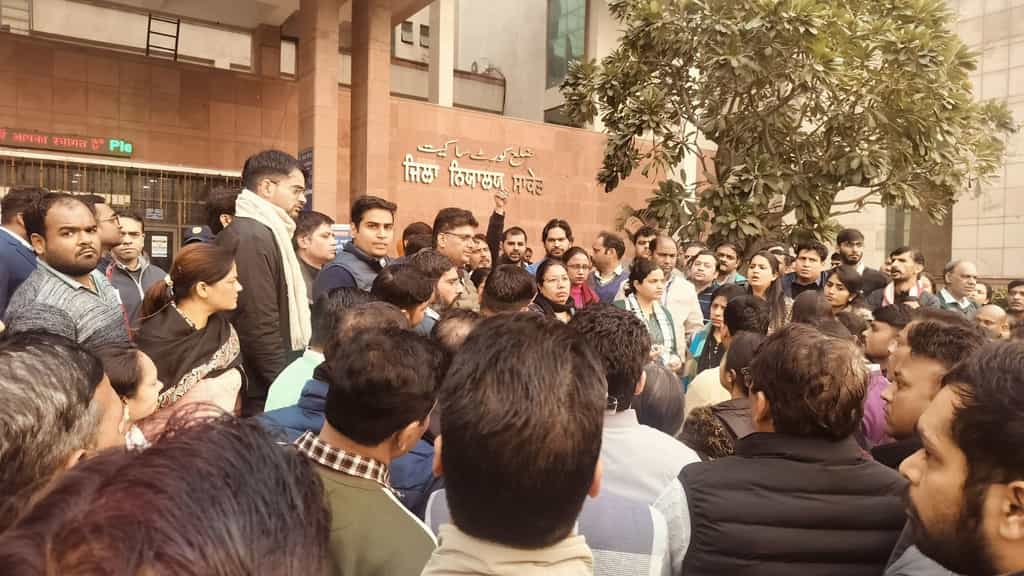
Hours after one of their own died by suicide due to “work pressure” on Friday, a large group of staffers huddled outside the Saket Court, surrounded by police personnel. For nearly two hours, the group waited for their co-workers who had gone inside to represent them and discuss the challenges they face on a daily basis with the Principal District and Sessions Judges.
After the meeting, a staffer who was part of the discussions, said, “They (judges) told us that anyone who has a problem can go to them before or after court hours and give their problems in writing.”
“But they are reminded of this when one of us dies,” came a response from the crowd, referring to ahlmad (record keeper) Harish Singh Mahar’s death by suicide earlier in the day. In his suicide note, Mahar, who had jumped to his death from the fifth floor of the court building, had cited workload. “I am 60% handicapped… this job is very tough for me and I succumbed to the pressure…,” the note by the 43-year-old, who had been working at the court since 2010, read.
Another staffer who was part of the discussions with the judges, said, “Our demands are related to compensation, FIR (in the suicide case), and fixing responsibility….in my opinion, nothing concrete has been done…they’ve shirked away from their duties.”
“Let’s boycott the National Lok Adalat tomorrow…let’s all abstain from work,” shouted a staffer in the crowd. Everyone present synchronously clapped.
Soon after, complaining apathy over their concerns and challenges, close to a hundred staffers kicked off a candle light march to the Delhi High Court, about 10 km away. Along the way, their counterparts from the Patiala House Court joined them. Together, they announced a protest on Saturday: “A peaceful sit-in was held at Saket Court complex by colleagues. After much deliberation, it has been decided that the members will abstain from work/ duties in the National Lok Adalat scheduled to be held tomorrow ie. 10. of 2026 in all districts. We stand in solidarity with the family of the late Harish Ji,” read a note.
Magistrate courts in Southeast districts have an average pendency of 2,200 cases with many courts operating at only half the capacity, as far as the employee strength is concerned, according to officials. Some Ahlmads are looking after multiple courts and hardly any courts have two assistant Ahlmads.
“There is a shortage of 3,000 clerical employees in Delhi’s courts… one person is handling the work of four (staffers),” a court staffer complained. “Perhaps many others are thinking of suicide right now.”
Cheque bounce or NI ACT courts have an average pendency of close to 7,900 cases. Harish, who was working as an Ahlmad in a Digital traffic challan court, was taking care of close to 8,900 cases, officials said.
“Backlog bad raha hai. 15-20 saal se post nahi create kari thi…kaise kaam kare hum log (Backlog is increasing… New posts have not been created for 15-20 years… how do we work?,” said a court staff.
Between 2018 to 2025, official data shows, the difference between the numbers of cases instituted and disposed of by Delhi’s district courts was nearly 1.3 lakh every year on average. Currently, there are close to 16 lakh pending cases.
On the other hand, court staff (Ahlmads, assistants and readers) are operating at about 80% of their sanctioned strength, which hasn’t been revised in 20 years. Of a sanctioned strength of 4,011, 733 (19%) posts are still vacant, as per the data.
Editorial Context & Insight
Original analysis & verification
Methodology
This article includes original analysis and synthesis from our editorial team, cross-referenced with primary sources to ensure depth and accuracy.
Primary Source
The Indian Express