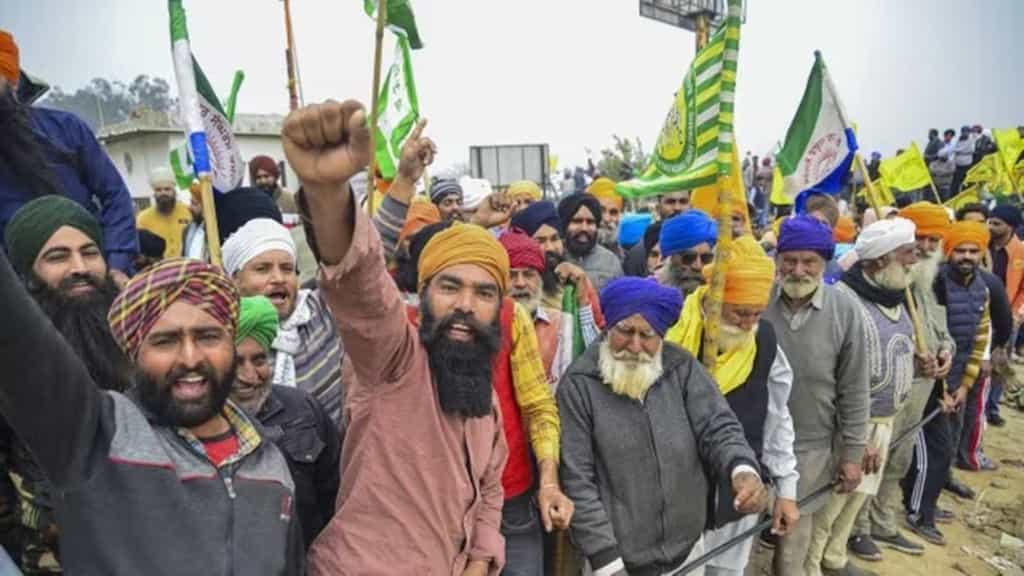
The Samyukta Kisan Morcha (SKM)-non political Friday asked the Supreme Court-constituted panel of experts to recommend legal guarantee of MSP and demanded that either the government should procure all 22 crops or stand as a guarantor for them.
The panel led by Justice Nawab Singh (retired) held its first meeting with the farmers in its office in Haryana’s PWD Rest House in Panchkula, a year after its constitution and having held over 30 sessions of discussions with various stakeholders. All this while, the farmers organisations were boycotting the invites by the panel to have discussions with them. It was last year, soon after the panel was constituted that Justice Nawab Singh had taken his team to Shambhu border point and met Dallewal when he was fasting unto death.
Sources said the panel’s interim report was ready and would be submitted to the Supreme Court soon. The panel had submitted a preliminary report last year. “Farmers are the major stakeholders in agriculture. Their personal viewpoint, taken across the table would only enrich the report,” said a source.
Led by SKM-non political chief, Jagjit Singh Dallewal, the farmers leaders from agrarian states including Punjab, Haryana, Rajasthan, Gujarat, Telangana and Tamil Nadu, not only reiterated their demand but made out a case that the farmers were not even getting the MSP on the crops, which were covered under it. Linking the financial losses to farmers suicides, they demanded MSP on the lines of recommendations of MS Swaminathan committee report.
Dallewal said, “We urge you to recommend the legal MSP guarantee on all crops. We know the governments will not accept it. But we want the experts to at least recommended it. In case it is recommended by the SC panel, we may even force the government to announce it by organising dharna and protests”.
On a question by SC panel member and noted economist RS Ghumman on whether the farmers would want the government to procure all crops or ensure procurement on MSP, Dallewal said, “We would want all the crops to be procured by the government. This will help.”
Another farmer leader from Haryana Abhimanyu Kohar, however, said that they could do even if the government acted as a guarantor. Later, Dallewal, in a conversation with The Indian Express, said, “We did not differ. We mean the same thing. Our concern is that no crop should be sold below the MSP, whether purchased by the government or by private traders.”
Bashing a “section of economists” who claimed that the MSP on all crops would cost the exchequer Rs 2 lakh crore, the farmers leaders tried to debunk it “as a myth.”
Kohar, citing figures for crops imported by India last year, said that crops worth Rs 2.58 lakh crore were imported, including edible oil worth Rs 1.61 lakh crore, pulses worth Rs 47,000 crore, and cotton worth Rs 65,000 crore. “Why cannot these be grown in India. This will also help diversification.”
Dallewal seconded him saying, “We are farmers and we are also Indians. Why should India’s money go out? It should rather stay here.”
Kohar said that during Covid-19, when oil imports stopped, the area under cultivation increased by 1.19 lakh hectares in Haryana, 25,000 hectares in Punjab, and 2.50 lakh hectares in Rajasthan.
Earlier, Justice Nawab Singh said that the “farmers did not block the Amabala-Delhi highway during their protest at Shambhu and Khanauri border points last year”. “They were just having a morcha on both sides of the roads. The government had blocked the roads as they did not want the protest to reach Delhi after having had a bad experience at Singhu border during 2020 farm protest,” he said.
His welcome note made the meeting start on a positive note with Dallewal thanking him for “exonerating” the farmers. “We did not want to block the highway but we were stopped by the government. We just wanted to lodge a protest so that our demands were taken a note of”.
The chairperson of the panel assured the farmers leaders that they could take as many hours as they needed to put their points across. He even asked them to drop in as and when they felt the need that the panel should be told another point. With the first farmers’ meeting, it is expected that more organisations would share their viewpoints with the committee. Earlier, Kisan and Mazdoor Morcha, led by Sarvan Singh Pandher had refused to meet the panel.
The panel has already met experts from NABARD, Niti Aayog, CACP, officials from related departments of Punjab and Haryana governments including Verka, Agriculture and Horticulture Department, Agriculture Minister from Kerala, Farmers Commission Chairperson from Telangana and others.
During the meeting, farmers from various states presented their concerns about the difficulties they faced in procurement of their crops. Justice Nawab Singh wanted to raise a point that only Punjab and Haryana farmers were getting the MSP. He asked leaders from other states to tell the meeting about how their produce was procured. Dallewal rejected the claim that paddy is sold at MSP in Punjab. He said in districts like Taran Tarn, Gurdaspur and Amritsar, the paddy was being sold for much lesser price than MSP. He said several farmers faced losses as their paddy was procured at lower price on the pretext of higher moisture content. “Somehow, Punjab government does not allow the paddy produce with more than 17 per cent moisture to enter the mandis. But when the crop is procured, they cite the moisture to be as high as 24 per cent. Where does that come from? Only they can tell.”
Farmers Rajbir Singh and Anil Talaan from Uttar Pradesh said in the NCR, their paddy crop was sold at higher price but as they go towards Purvanchal, it is sold for even Rs 900 to 1,100 per quintal.
Gajendra Singh Jal, a farmer from Gujarat, said that cotton sold for up to Rs 9,000 in 2010, but today it sells for Rs 7,000. Farmers also told the committee how governments have imposed a cap on quantity on crop purchases. In Gujarat, only 25 quintals of peanuts are purchased per farmer. Sandeep Singh of Rajasthan said moong beans were sold there for Rs 4,500 per quintal, while the MSP is Rs 8,768 per quintal. Abhimanyu Kohar reported that over the past five years, the Finance Ministry provided the Agriculture Ministry with Rs 1 lakh crore. But a lion’s share of money was returned to the finance department as it was unused. “If this is the state of affairs, what do you expect?” He asked. Justice Nawab Singh also had an experience to share when he said, he being the largest producer of moong in Haryana faced a cap of 3.5 quintal per acre while he was producing moong at the rate of 5 quintal per acre.
Besides Nawab Singh, committee members Devinder Sharma, Dr Ranjit Singh Ghumman, Prof. Sukhpal Singh, and former DGP BS Sandhu were also present. The panel was constituted by SC in September 2024.
Editorial Context & Insight
Original analysis & verification
Methodology
This article includes original analysis and synthesis from our editorial team, cross-referenced with primary sources to ensure depth and accuracy.
Primary Source
The Indian Express