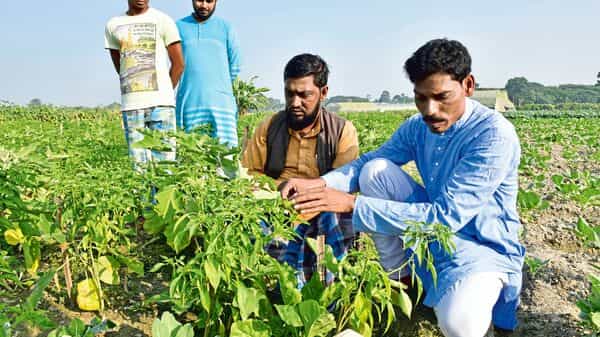
India’s rabi or winter crop sowing in 2025-26 has increased by more than 1.76 million hectares to 64.42 million hectares as on 9 January, according to data released by the ministry of agriculture and farmers’ welfare today. The sown area is 2.8% higher than a year earlier. The season’s average coverage is 63.78 million hectares.
Even though the sowing window remains open until mid-January, the higher acreage reflects the availability of adequate soil moisture, supported by an above-normal monsoon this season, according to agricultural officials.
The expansion in sown area was largely supported by higher acreage under wheat, rice, pulses and oilseeds. Wheat coverage rose by 613,000 hectares, while the area under rice increased by 222,000 hectares compared to the previous year. The total area under wheat and rice touched 33.42 million hectares and 2.17 million hectares, respectively. Pulses saw an overall increase of 374,000 hectares, driven mainly by a sharp rise in gram. The total area under pulses touched 13.64 million hectares. The area under oilseeds, led by rapeseed and mustard, also expanded to 9.68 million hectares, up 353,000 hectares from the previous year.
The above-normal monsoon has helped fill major water reservoirs and recharge groundwater tables, as well as improve soil moisture, which has boosted sowing.
However, according to the India Meteorological Department (IMD), rainfall during the January–March 2026 winter season is expected to be below normal, at less than 88% of the long-period average, which, in turn, may impact Rabi crops. The LPA (Long Period Average) of rainfall over the country as a whole during the period, based on data from 1971 to 2020, is about 69.7 mm. The below-normal seasonal rainfall is expected across most parts of Northwest, Northeast, and Peninsular India. The rainfall during January-March 2026 is likely to average below normal (less than 86% of the Long-Period Average) over Northwest India, including Jammu and Kashmir, Himachal Pradesh, Uttarakhand, Ladakh, Punjab, Haryana, and Uttar Pradesh.
Agriculture scientists said that there would be little impact on rabi crops, which are well-irrigated. "If crops are adequately irrigated, deficient rainfall is unlikely to have a significant impact, particularly in the northwestern region, barring Himachal Pradesh," said Dr Ratan Tiwari, director, ICAR-Indian Institute of Wheat and Barley Research (IIWBR), Karnal.
Editorial Context & Insight
Original analysis and synthesis with multi-source verification
Methodology
This article includes original analysis and synthesis from our editorial team, cross-referenced with multiple primary sources to ensure depth, accuracy, and balanced perspective. All claims are fact-checked and verified before publication.
Primary Source
Verified Source
mint - news
Editorial Team
Senior Editor
Maria Santos
Specializes in Business coverage
Quality Assurance
Fact-Check Editor
Fact-checking and editorial standards compliance