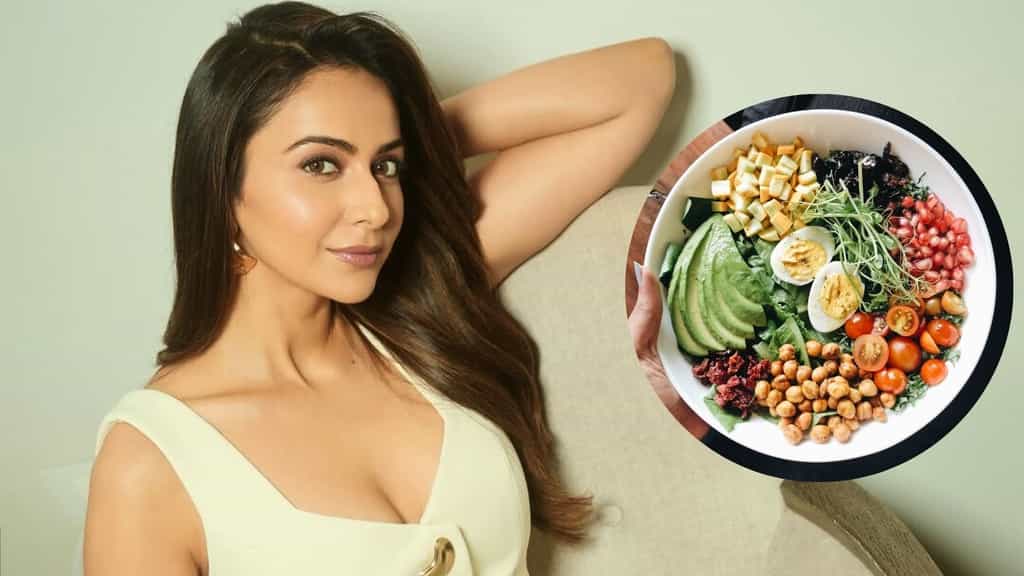
Rakul Preet Singh on why ordered salads can derail diets (Source: Instagram/Rakul Preet Singh and Canva)
Many people are unaware of how quickly a seemingly healthy salad bowl can turn into a calorie-heavy meal. Actor Rakul Preet Singh recently pointed this out while discussing common misconceptions about salads ordered from restaurants or delivery apps. “Well, let’s break that myth that salads are healthy,” she said in an interview published on the YouTube channel Khaane Mein Kya Hai. “Actually, when you end up eating these ordered salads, they are loaded with calories because you’ll have a handful of nuts, you’ll have cheese and multiple things, and tonnes of oil. I’m not a believer in that. I feel like homemade food or clean, clear food is always healthier.”
Her comments echo what many nutrition professionals have long cautioned: that toppings, dressings, and portion sizes can drastically change the nutritional profile of a salad.
What may appear fresh and light can actually contain more calories than a home-cooked meal. To confirm this, we spoke with an expert.
Kanikka Malhotra, consultant dietician and certified diabetes educator, tells indianexpress.com, “A basic bowl of veggies might be 80–150 kcal, but once restaurants add generous oil, nuts and cheese, the numbers climb fast. Just one tablespoon of oil (olive, canola, etc.) adds about 120 kcal; many salads easily have 3–4 tablespoons in the dressing, which is nearly 360–480 kcal from oil alone.”
She continues, “A small handful (30 g) of mixed nuts adds roughly 180–190 kcal. About 30 g of cheese (two small cubes or a thick sprinkle) adds another ~120 kcal.”
So a “healthy” ordered salad can quietly cross 500–800 kcal, she says, especially if there is creamy dressing, croutons, fried toppings or added bread on the side.
She suggests asking how much dressing is being used and requesting dressing on the side, preferably vinaigrette with limited oil. Scan the menu for words like “creamy,” “mayo-based,” “crispy,” “fried,” “candied nuts,” “loaded cheese” – these usually mean high fat and sugar. “Request for less cheese, fewer nuts (or seeds instead), grilled protein instead of fried, and no extra croutons or garlic bread unless you’re consciously accounting for them,” mentions the expert.
From a nutrition point of view, Malhotra states, ‘clean’ or minimally processed eating is less about perfection and more about choosing foods in their natural form while limiting added oil, sugar and salt. It looks like plates built around vegetables, whole grains, pulses, good-quality protein, and measured healthy fats, with sauces and toppings contributing most of the calories.
“In restaurants, this means picking meals where you can clearly see the ingredients like grilled paneer/chicken/fish, roasted veggies, plain lentils, millets or brown rice, simple soups and salads with light, visible dressings and customising by asking for less oil, no butter/ghee finishing, sauces on the side and swapping sugary drinks for water, buttermilk or unsweetened options,” notes Malhotra.
DISCLAIMER: This article is based on information from the public domain and/or the experts we spoke to. Always consult your health practitioner before starting any routine.
Editorial Context & Insight
Original analysis and synthesis with multi-source verification
Methodology
This article includes original analysis and synthesis from our editorial team, cross-referenced with multiple primary sources to ensure depth, accuracy, and balanced perspective. All claims are fact-checked and verified before publication.
Primary Source
Verified Source
The Indian Express
Editorial Team
Senior Editor
James Chen
Specializes in India coverage
Quality Assurance
Associate Editor
Fact-checking and editorial standards compliance