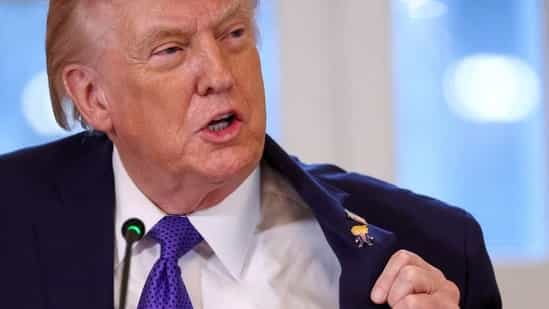
Amid the growing violent protests in Iran, US President Donald Trump on Monday announced that trade partners of Tehran will face 25 per cent tariffs from the United States "on any and all business".
More than 600 protests have taken place across all of Iran's 31 provinces, with the US-based Human Rights Activist News Agency reporting that the death toll is at least 646, the Associated Press reported. Follow live updates on Iran protests
Trump has been threatening Iran with US military action if his administration found that the Islamic Republic was using deadly force against the anti-government protestors. The US President said that he believed that it is a 'red line' that Iran is "starting to cross", adding that it has left him and his national security team weighing "very strong options".
In a post on Truth Social on Monday, Trump wrote, "Effective immediately, any Country doing business with the Islamic Republic of Iran will pay a Tariff of 25% on any and all business being done with the United States of America. This Order is final and conclusive. Thank you for your attention to this matter!"
Trump's threat of considering military actions was further solidified by White House press secretary Karoline Leavitt, who told reporters that airstrikes are among the "many, many options" being considered.
However, Leavitt added, "diplomacy is always the first option for the president".
Short answer: Yes. Trump's move to impose tariffs on Iran's trade partners is most likely to have a certain impact on India.
Although China is considered Iran's largest trading partner, Iraq, the United Arab Emirates, Turkey and India are also considered Tehran's major trade allies.
India and Iran share a long-standing relationship and are key trade partners for each other. According to the Indian Embassy in Tehran, in 2024-25, India's exports to Iran totalled US$1.24 billion, and imports from Iran were US$0.44 billion. The total bilateral trade stood at US$1.68 billion.
Major Indian exports to Iran include basmati, rice, tea, sugar, fresh fruits, and pharmaceuticals, while imports from Iran comprise apples, pistachios, dates and kiwi.
According to a report from Trading Economics, in 2024, cereals accounted for the largest share of India's exports to Iran at $698.51 million, whereas organic chemicals held the largest share of New Delhi's imports from Tehran at $512.92 million.
Other major exports from India to Iran included residues and wastes of the food industry and animal fodder, at $149.49 million; coffee, tea, mate, and spices, at $73.93 million; edible fruits, nuts, citrus fruit peels, and melons, at $66.12 million, and machinery, nuclear reactors and boilers at $32.65 million.
Significant imports from Iran to India, other than organic chemicals, were edible fruits, nuts, citrus fruit peels, and melons, at $311.60 million; mineral fuels, oils, and distillation products, at $86.48 million, and salt, sulphur, earth, stone, plaster, lime, and cement, at $55.65 million.
Considering that the US has already levied tariffs as high as 50 per cent on Indian goods due to New Delhi's Russian oil purchase, the additional duty on Iran trade will further cause difficulties for India.
The new tariff will also pose obstacles for the India-US trade deal, which has been in the process of finalisation for a long time.
US ambassador-designate Sergio Gor on Monday emphasised the importance of the India-US partnership, stating that the two sides are actively engaged in concluding a bilateral trade deal, signalling Washington's desire to reset bilateral ties that have been strained for months.
Gor said that there is "no partner more essential than India".
Meanwhile, a key fear hanging over the Trump administration's head is the US Supreme Court's ruling on its tariff policies. The sweeping levies are being challenged at the top court by a number of small businesses and a group of American states.
They are contending that Trump exceeded his authority as President in imposing the additional taxes, which are levied on goods coming into the US. If the Trump administration lost the argument, it might have to refund some of the billions of dollars it has already collected.
In a post on Truth Social on Monday, Trump said that if the US Supreme Court rules against his administration on the tariff policy, then "we're screwed!"
Violent, nationwide protests in Iran, triggered by the Islamic Republic's ailing economy, are putting new pressure as the government has shut down the internet and telephone networks.
The economic pressure, which intensified since September last year when the UN reimposed sanctions on Iran over its atomic program, has sent the country's currency, Rial, into a free fall. The currency crash has caused Rial to now trade at over 1.4 million to the dollar.
Activists said the death toll from the ongoing protests is at least 646. The US-based HRANA, which has reported accurate information in previous unrest in recent years, relies on supporters in Iran for cross-checking the information.
It said that of the dead, 512 were protestors and 132 were security force members.
Additionally, over 10,700 people have also been detained in the protests over the past two weeks, the US-based agency said.
Iran's foreign minister on Monday alleged that the protests in his nation "turned violent and bloody to give an excuse" for US President Donald Trump to intervene.
However, foreign minister Abbas Araghchi did not provide any evidence for his claim.
Editorial Context & Insight
Original analysis and synthesis with multi-source verification
Methodology
This article includes original analysis and synthesis from our editorial team, cross-referenced with multiple primary sources to ensure depth, accuracy, and balanced perspective. All claims are fact-checked and verified before publication.
Editorial Team
Senior Editor
Aisha Patel
Specializes in India coverage
Quality Assurance
Fact-Check Editor
Fact-checking and editorial standards compliance