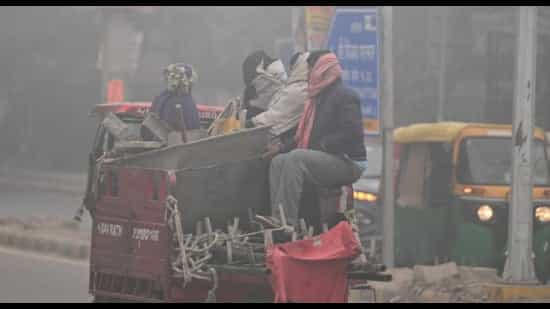
Cold wave conditions continued in Delhi for a third day on Tuesday as the mercury plunged 4.4 degrees below normal to 3°C, the lowest in January in three years, and the air quality deteriorated to the “very poor” category.
Similar conditions were expected on Wednesday, before a feeble western disturbance was expected to influence the weather in the northern plains from Thursday.
On Monday, Safdarjung, Delhi’s representative weather observatory, recorded a minimum temperature of 3.2°C. Lodhi Road observatory recorded a minimum temperature of 3°C on Tuesday, Ayanagar 3.2°C, Palam 4°C, and Ridge 4.4°C.
A cold wave is declared when the minimum temperature is below 10°C, while its departure is 4.5°C or more below normal. The minimum temperature at a weather station of 4°C or lower also amounts to a cold wave.
An India Meteorological Department (IMD) official said cold wave conditions persisted and were likely to be so on Wednesday too. “A rise in minimum temperature is likely from Thursday,” said the official.
Navdeep Dahiya, a weatherman, shared a photograph on X of ground frost and a hand held monitor showing a reading of -0.9°C in the suburbs of Gurugram. On Monday, similar frost was observed in New Delhi’s Sainik Farms, where a private automatic weather station showed a reading of 1.1°C.
Experts said a series of western disturbances expected after January 15 will halt dipping mercury. “The first western disturbance is expected to be mild. It will still change the wind direction and prevent cold northwesterly winds from blowing across the plains,” said Ashwary Tiwari, a weatherman who runs IndiaMetSky on X.
Private forecaster Skymet Weather vice president Mahesh Palawat said the western disturbance will start impacting the mountains from January 15. “It will bring snowfall to the mountains and the impact over plains will be minimal. It will lead to a change in wind direction to southwesterly, thus reducing the wind chill factor.”
A 24-hour average air quality index (AQI) of 342 (very poor) was recorded at 9am on Tuesday, compared to 297 (poor) at 4pm on Monday. The Air Quality Early Warning System (EWS) for Delhi said “very poor” AQI was expected until January 22.
Editorial Context & Insight
Original analysis and synthesis with multi-source verification
Methodology
This article includes original analysis and synthesis from our editorial team, cross-referenced with multiple primary sources to ensure depth, accuracy, and balanced perspective. All claims are fact-checked and verified before publication.
Editorial Team
Senior Editor
James Chen
Specializes in India coverage
Quality Assurance
Senior Reviewer
Fact-checking and editorial standards compliance