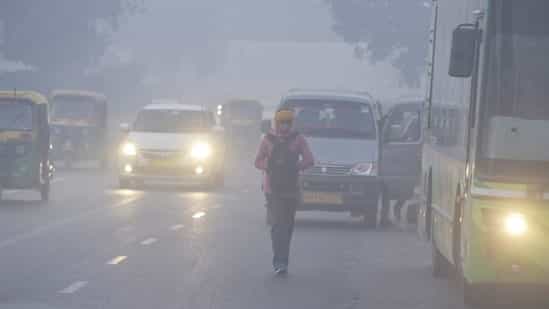
Residents of Gurugram are reeling under an intense cold wave even on Tuesday, a day after the city recorded a historic 0.6 degrees Celsius, its lowest temperature in nearly five decades and colder than several Himalayan hill stations. Delhi isn't far behind and is freezing at a minimum temperature of 3 degrees Celsius.
According to the India Meteorological Department data, Gurugram's 0.6 degrees reading was logged on Monday morning, matching the city’s January 22, 1977 low. Such extreme cold is rare, the city has gone lower than this only three times on record: minus 0.4 degrees Celsius on December 5, 1966, 0 degrees Celsius on January 11, 1970, and 0.3 degrees Celsius on January 22, 1979.
On Monday, Gurugram was colder than many popular hill destinations. Himachal Pradesh’s Kangra and Palampur recorded 3 degrees Celsius, Jammu 3.4 degrees Celsius, while Uttarakhand’s Mukteshwar, Jollygrant and Tehri stood at 4.1 degrees Celsius each.
In contrast, hill stations were far warmer, with Mussoorie at 7.7 degrees Celsius and Shimla at 8.8 degrees.
Explaining the unusual pattern, IMD director general M Mohapatra said cloud cover over the hills, triggered by an active western disturbance, prevented heat from escaping at night. “The night was cloudy over the higher reaches, which is why minimum temperatures remained higher there,” he said.
Over the plains, however, clear skies and persistent cold northwesterly winds led to strong radiative cooling, allowing temperatures to drop sharply.
The bitter cold left visible signs across Gurugram and its outskirts on Monday, with frost (pala) forming over crops, grasslands and car windshields.
Jeeva Thavasiraj, a 22-year-old site engineer from Sector 66, said the chill was unprecedented for him. “I come from Tamil Nadu and have never experienced this kind of cold. Even with heavy safety shoes, our feet become numb,” he said.
Sunita Devi, a daily commuter from Sohna, said dense fog and frost made travel difficult. “There was frost on our bus’s windshield and crops in the fields. The elevated roads had very poor visibility, and vehicles had to move slowly,” she said.
IMD has extended an orange alert till January 13, warning of cold wave to severe cold wave conditions, dense fog and ground frost across parts of Haryana, Delhi and neighbouring states.
Health advisories warn that prolonged exposure could lead to frostbite, flu and aggravated respiratory problems such as asthma and bronchitis, especially among the elderly and children. Motorists have also been cautioned about reduced visibility and higher accident risk during late-night and early-morning hours.
Meteorologists said the extreme cold is being driven by a combination of western disturbances, an upper-air cyclonic circulation over north Haryana, and strong westerly winds in the upper atmosphere.
A fresh western disturbance is likely to affect the western Himalayan region from January 15, which could finally bring cloud cover and some relief.
The cold wave has been intensified by an exceptionally dry winter, with northwest India recording an 84.8 per cent rainfall deficit in December and 84 per cent in the first ten days of January, leaving the hills largely without snow.
Until that pattern breaks, the plains - not the mountains - remain the coldest places in north India.
Editorial Context & Insight
Original analysis and synthesis with multi-source verification
Methodology
This article includes original analysis and synthesis from our editorial team, cross-referenced with multiple primary sources to ensure depth, accuracy, and balanced perspective. All claims are fact-checked and verified before publication.
Editorial Team
Senior Editor
Shiv Shakti Mishra
Specializes in India coverage
Quality Assurance
Associate Editor
Fact-checking and editorial standards compliance