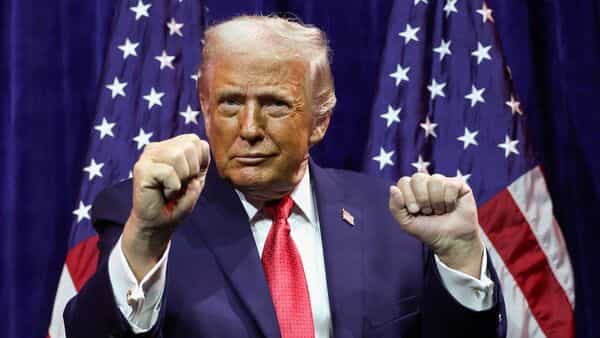
US President Donald Trump expressed little concern over the expiration of the last major nuclear arms control agreement with Russia. On the 2010 New START accord, he told the New York Times in an exclusive interview on Wednesday: “If it expires, it expires."
“We’ll just do a better agreement,” Trump added, insisting that China, which has the fastest-growing arsenal in the world, should be incorporated in any future agreement.
“You probably want to get a couple of other players involved also,” Trump said.
The treaty expires on February 5.
The agreement limits the US and Russia to deploying no more than 1,550 warheads on 700 delivery vehicles — missiles, bombers and submarines.
Trump had said in July he would like to maintain the limits set out in the treaty after it expires.
Trump told the New York Times that China should be included in a treaty that replaces New START.
Beijing, seen by the US as its main global rival, has spurned that proposal since Trump promoted it in his first administration, asserting the Russian and US nuclear forces dwarf its arsenal.
The Chinese Embassy in Washington said it would be "neither reasonable nor realistic to ask China to join the nuclear disarmament negotiations with the US and Russia."
"China always keeps its nuclear strength at the minimum level required by national security, and never engages in an arms race with anyone," spokesperson Liu Pengyu said when reached for comment.
In the interview, Trump also made clear that he would be the arbiter of any limits to his authority, not international law or treaties.
“I don’t need international law,” Trump said, adding, “I’m not looking to hurt people.”
When asked if there were any limits on his global powers, Trump told the NYT, “Yeah, there is one thing. My own morality. My own mind. It’s the only thing that can stop me.”
When pressed further about whether his administration needed to abide by international law, Trump said, “I do.” But he made clear he would be the arbiter when such constraints applied to the United States.
“It depends on what your definition of international law is,” he said.
Trump's statement came days after the US launched its “large-scale attack” on Venezuela.
In the days since the action in Venezuela, there have been arguments that the US precedent would help justify a Chinese effort to take Taiwan, or Russia’s attempt to seize Ukraine, which Russian President Vladimir Putin has described as a historical part of the Russian empire, dating back more than a dozen centuries.
Asked whether he had created a precedent that he may later regret, Trump argued that his view of the threat posed by Maduro’s Venezuela was quite different from Xi’s view of Taiwan.
“This was a real threat,” he said of Venezuela. “You didn’t have people pouring into China,” he argued, repeating his oft-made claim that Mr. Maduro dumped gang members into the United States.
Trump added: “You didn’t have drugs pouring into China. You didn’t have all of the bad things that we’ve had. You didn’t have the jails of Taiwan opened up and the people pouring into China,” or, he said later, criminals and others “pouring into Russia.”
When a reporter noted that Xi regarded Taiwan as a separatist threat to China, Trump said, “That’s up to him, what he’s going to be doing. But, you know, I’ve expressed to him that I would be very unhappy if he did that, and I don’t think he’ll do that. I hope he doesn’t.”
Editorial Context & Insight
Original analysis & verification
Methodology
This article includes original analysis and synthesis from our editorial team, cross-referenced with primary sources to ensure depth and accuracy.
Primary Source
mint - news