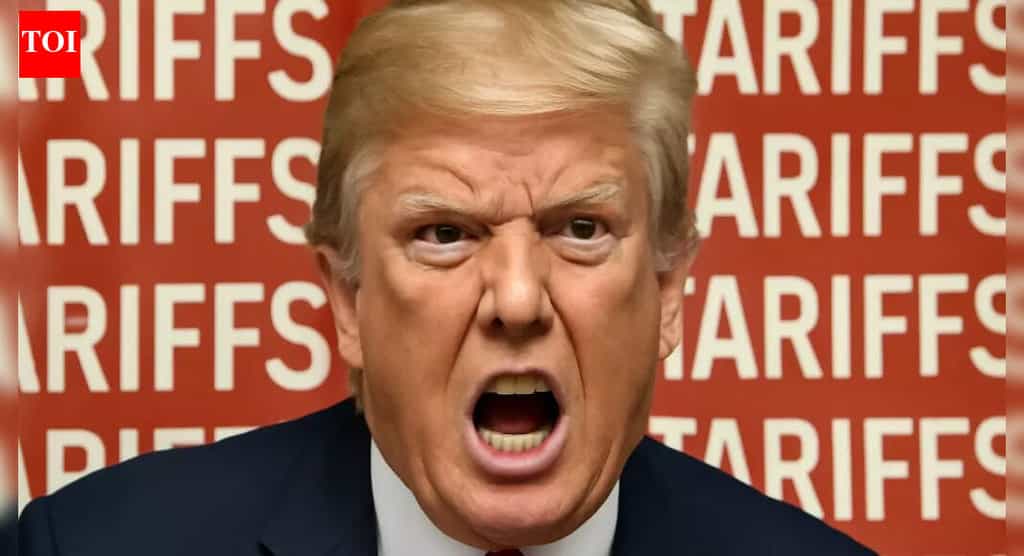
In a fresh round of global tariffs, US President Donald Trump has announced that countries doing trade with Iran will attract a 25% tariff from the world’s largest economy. The move is seen as a pressure tactic on Iran over its response to nationwide protests that have reportedly claimed nearly 600 lives.Trump has repeatedly warned that his administration could consider military action if it determines that the Iranian government is using lethal force against demonstrators. Trump described this as a threshold Iran is ‘beginning to cross,’ prompting discussions within his national security team on what he called ‘very strong options’.The tariff decision was announced by Trump in a social media post on Monday, where he said that measures would take effect immediately.
Several major economies, including China, Brazil, Turkey, Russia, and India maintain trade ties with Iran.“Effective immediately, any Country doing business with the Islamic Republic of Iran will pay a Tariff of 25% on any and all business being done with the United States of America. This Order is final and conclusive. Thank you for your attention to this matter!,” Trump posted on Truth Social.
India already faces 50% tariffs on its exports to the US. While 25% of this figure are ‘reciprocal’ tariffs’, the remaining 25% are a penal duty for India’s crude oil imports from Russia.
India and Iran share an important trading relationship, with India consistently ranking among Iran’s top five trading partners in recent years, according to the Ministry of External Affairs.
India’s key exports to Iran span a range of products, including rice (especially basmati), tea, sugar, pharmaceutical goods, man-made staple fibres, electrical equipment, and imitation jewellery. In return, India mainly imports items such as dry fruits, inorganic and organic chemicals, and glassware from Iran.Iran is a crucial market for Indian basmati rice, typically purchasing more than one million tonnes each year, according to reports. Iran has traditionally been among the biggest overseas markets for Indian basmati rice. Reports suggest that Iran purchases close to 12 lakh tonnes each year, with the trade estimated at around Rs 12,000 crore.However, Iran is not among its top 5 trading partners in terms of both imports and exports.
India’s top exporting destinations are currently the United States of America, United Arab Emirates, Netherlands, China, United Kingdom - accounting for 41% of India’s exports according to the Ministry of Commerce dashboard.
From a trade and strategy perspective, India also has a major stake in Iran’s Chabahar port. Last year, the US extended its sanctions waiver for Iran’s Chabahar port by an additional six months to April this year.
The waiver had earlier been withdrawn in September 2025 when the US State Department cancelled the exemption first issued in 2018, which had allowed India to develop the port as a gateway to Afghanistan and Central Asia while avoiding routes through Pakistan, as part of efforts to increase pressure on Tehran.If the exemption were to lapse, entities involved in operating the port or engaging in related activities could be exposed to US penalties under the Iran Freedom and Counter-Proliferation Act.Chabahar has gained strategic relevance for India’s outreach to Afghanistan, especially as engagement with the Taliban administration in Kabul has been gradually improving.
Editorial Context & Insight
Original analysis and synthesis with multi-source verification
Methodology
This article includes original analysis and synthesis from our editorial team, cross-referenced with multiple primary sources to ensure depth, accuracy, and balanced perspective. All claims are fact-checked and verified before publication.
Primary Source
Verified Source
Times of India
Editorial Team
Senior Editor
Shiv Shakti Mishra
Specializes in India coverage
Quality Assurance
Quality Assurance Editor
Fact-checking and editorial standards compliance