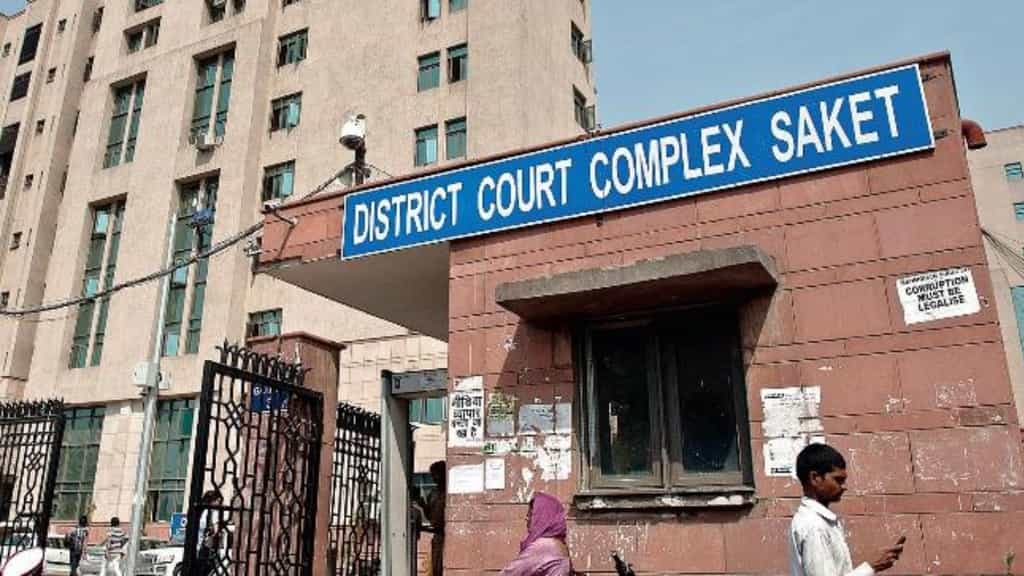
Security at Saket Court Judicial staff body writes to CJI Surya Kant after Saket Court employee’s suicide, seeking Supreme Court monitored review of workloads and service conditions. (Credit: Saket Court)
Days after a 43-year-old differently-abled ahlmad (record keeper) jumped to death from the fifth floor of the Saket Court and allegedly cited “work pressure” in his suicide note, the All India Judicial Employees Confederation (AIJEC), a national body representing court staff, wrote to Chief Justice of India Surya Kant on Monday. The AIJEC has requested that a Supreme Court-monitored panel review the staff strength, workload, salary, and service conditions in the district courts. Harish Singh Mahar, the ahlmad, died by suicide on January 9.
The Ahmedabad-based Confederation has also demanded an “immediate revision of staff pattern” in all district courts based on workload and sought the implementation of time-bound promotions. “In recent years, a disturbing number of judicial employees across the country have been driven to extreme mental distress, resulting in suicides, depression, and serious health breakdowns. These tragedies point toward a systemic failure in the working conditions of the district judiciary,” the letter read.
In the letter, the AIJEC flagged: “Judicial employees today are suffering from acute staff shortages, forcing existing employees to perform the work of multiple persons; excessive and unrealistic workload, often extending late into nights and holidays; mental harassment and pressure due to the absence of defined work profiles and accountability of officers; and an outdated staff pattern which has not been revised in decades despite a manifold increase in litigation and digital work.”
It has also requested clear job descriptions to prevent exploitation and harassment of the court staff and the establishment of mental health, counselling, and grievance redressal cells in every district court.
Meanwhile, the Delhi-based Stenographers’ Association has written to the Registrar General of the High Court of Delhi in this regard, requesting a review of the existing mechanisms to prevent such incidents in the future. “Judges are recruited from time to time, but simultaneously, ancillary staff is not recruited proportionately and timely, which results in a greater burden on existing staff,” the letter stated.
The Association has sought the setting up of a committee in each district with at least two of its office bearers. Among the Association’s demands are the posting of differently-abled and senior employees near their residences, timely filling of vacant posts and creation of an adequate number of posts, and posting of at least two stenographers in Magistrate and Civil Courts.
It also sought the establishment of de-stress, meditation, and yoga centers and the appointment of data entry operators for uploading judgments and orders to the server.
Editorial Context & Insight
Original analysis and synthesis with multi-source verification
Methodology
This article includes original analysis and synthesis from our editorial team, cross-referenced with multiple primary sources to ensure depth, accuracy, and balanced perspective. All claims are fact-checked and verified before publication.
Primary Source
Verified Source
The Indian Express
Editorial Team
Senior Editor
Aisha Patel
Specializes in India coverage
Quality Assurance
Associate Editor
Fact-checking and editorial standards compliance